
Test First, Treat Second
Every good treatment decision starts with a lab report. Every bad one starts with a salesperson or a guess.
Well water treatment only works when it is matched to the specific contaminant in your specific water. A UV system that makes bacteria harmless does nothing for arsenic. A softener that fixes hardness does nothing for nitrate. Reverse osmosis, which handles an impressive list of dissolved contaminants, cannot touch radon gas. Buying equipment before testing is like filling a prescription before the diagnosis.
So before anything on this page, get a certified lab test - our well water testing guide covers what to test for based on your region and situation, and the contaminant directory explains what each result means. With a lab report in hand, the matrix below tells you which technology is proven for what you found.
The Eight Treatment Technologies
Every home well treatment system on the market is built from a short list of core technologies. Know these eight and no sales pitch can confuse you.
1. Sediment filtration
A spun-poly or pleated cartridge that catches sand, silt, and rust particles. It is the workhorse first stage of almost every treatment train - it protects the finer equipment downstream - but it removes particles only, nothing dissolved. If your water has grit or cloudiness, start here; certification to look for is NSF/ANSI 42 (aesthetic effects).
2. Granular activated carbon (GAC)
Carbon adsorbs organic chemicals and gases onto its enormous internal surface area: VOCs, fuel compounds like MTBE, trihalomethanes, pesticide residues, and taste-and-odor problems. Certified carbon systems (NSF/ANSI 53, and 58-paired units with a PFAS claim) are also a frontline treatment for PFAS. Carbon does notremove nitrate, bacteria, or most metals, and spent carbon must be replaced on schedule or it quietly stops working. Two placement rules: dissolved iron blinds carbon's pores, so it belongs downstream of iron removal - and because carbon strips chlorine, bacteria can colonize the bed itself on a well that is not microbiologically secure.
3. Reverse osmosis (RO)
The most versatile point-of-use technology: water is forced through a membrane that rejects most dissolved contaminants - arsenic, nitrate, uranium, lead, PFAS, sodium, and total dissolved solids. Look for NSF/ANSI 58 certification for the specific contaminant - certified membranes typically reject 90-99% of total dissolved solids and 83-95% of nitrate. Two caveats: RO is not a microbiological treatment (bacteria belong to UV), and it cannot remove gases like radon. The membrane is also the most fragile component on this page: hardness scales it, iron plugs it, and chlorine chemically destroys the film - which is why RO always sits behind softening or carbon stages, and why it sends several gallons of reject water down the drain for each purified gallon. Under-sink RO serves the kitchen tap; whole-house RO exists but is a different budget class entirely.
4. UV disinfection
A UV lamp in a stainless chamber inactivates coliform bacteria, E. coli, viruses, and Giardia/Cryptosporidium without adding any chemical. Choose NSF/ANSI 55 Class A for disinfection duty - Class A units must deliver a 40 mJ/cm2 dose, the 99.9%-plus inactivation standard, while Class B units (16 mJ/cm2) are supplemental only and are not certified to make unsafe water drinkable. UV needs clear water to work - manufacturers typically require turbidity under about 1 NTU, iron under 0.3 ppm, and moderate hardness, because sediment shields microbes in its shadow and minerals bake onto the hot quartz sleeve - so it always runs behind pre-filtration. And because a positive bacteria test usually means surface water is reaching the well, fix the cap, casing, or source problem too, not just the symptom.
5. Water softener (cation exchange)
Softeners swap calcium and magnesium for sodium as water passes through a resin bed, solving hardness scale, spotted dishes, and scale-choked water heaters; they also pick up modest amounts of dissolved "clear-water" iron. Certification is NSF/ANSI 44. A softener is not a safety device - it does nothing for bacteria, nitrate, arsenic, or uranium. One hard-earned caution: dissolved iron permanently fouls softener resin - even modest levels steadily strip capacity, and cleaning a fouled bed is unreliable - so iron removal always comes first in the train. Whether you need a softener at all depends on a hardness test - see our dedicated water softener guide for well owners.
6. Anion exchange & adsorptive media
The softener's mirror image: a resin that captures negatively charged contaminants - nitrate, sulfate, arsenic (as arsenic V), and uranium - making it the main whole-house option for contaminants RO only fixes at one tap. Specialty adsorptive media (iron-based or titanium-based for arsenic, for example) work similarly and are sized by a water professional from your lab numbers. Two specifics worth knowing: for nitrate duty, insist on nitrate-selective resin - standard anion resin prefers sulfate, and a sulfate-saturated bed can dump collected nitrate back into the water at higher-than-raw concentrations. And for uranium, the resin works so well that its regeneration brine becomes concentrated radioactive waste - plan the discharge with a professional rather than sending it to a septic drain field.
7. Oxidation + filtration (iron/sulfur systems)
Air-injection, greensand, and chlorination-plus-filter systems all do the same two-step: oxidize dissolved iron and manganese or hydrogen sulfide into solid particles, then filter the particles out. This is the standard fix for rust stains, black slime, metallic taste, and rotten-egg odor. Which oxidizer and media fit depends on iron level, pH, and form: budget media (Birm) tops out around 3-5 ppm iron and is ruined by hydrogen sulfide or chlorine; greensand handles iron, manganese, and sulfur together but needs potassium permanganate regeneration to stay alive; modern air-injection catalytic media run a much wider pH window, handle far heavier iron loads, and backwash gently enough for low-yielding wells. Iron bacteria are their own case - they usually need chlorination rather than air injection.
8. Aeration & shock chlorination
Aeration strips dissolved gases out of water before they reach your taps - it is the EPA-recognized whole-house treatment for radon and works on hydrogen sulfide and VOCs too. For radon the dividing line is roughly 5,000 pCi/L: below it a carbon tank can work, but the carbon accumulates radioactive lead-210 as the radon decays and eventually becomes a disposal problem, so aeration is the default at any serious level. Shock chlorination is different from everything above: a one-time disinfection of the well itself after repairs, flooding, or a bacteria hit - a reset button, not a treatment system. If bacteria keep coming back after shocking, that is your cue for UV plus a well inspection.
Reading the Certifications (NSF/ANSI)
Marketing language is free; certification is earned. The NSF/ANSI numbers on a box are the difference between a verified claim and a hopeful one.
One distinction does most of the work: "certified to" means an independent laboratory verified the claim and audits the product; "tested to" means the manufacturer ran its own test. Insist on the former. Then match the number to the job:
- NSF/ANSI 42 - aesthetics: chlorine taste, odor, and particulates. Not a health standard.
- NSF/ANSI 44 - cation-exchange water softeners: hardness reduction plus salt and water efficiency.
- NSF/ANSI 53 - health effects for filters: lead, VOCs, cysts, PFAS, and more. Certification is contaminant-specific: a filter certified for lead is not automatically certified for anything else, so check the listing for the exact contaminant your lab found.
- NSF/ANSI 55 - UV systems. Class A (40 mJ/cm2 dose) disinfects unsafe water; Class B (16 mJ/cm2) is supplemental only.
- NSF/ANSI 58 - reverse osmosis, including contaminant-specific claims for arsenic, nitrate, and PFAS.
- NSF/ANSI 61 - material safety: the tank, resin, media, and fittings themselves do not leach anything harmful.
- NSF/ANSI 401 - emerging contaminants such as trace pharmaceuticals and some pesticides.
PFAS certification deserves its own note because it changed recently. The old standalone PFAS protocol (NSF P473) was retired and folded into Standards 53 and 58. The current "Total PFAS" claim requires a certified unit to cut a seven-compound PFAS panel to below 20 parts per trillion - and with the EPA's first enforceable PFAS drinking-water limits (4 ppt for PFOA and PFOS) now on the books, the standards are tightening further. The practical rule: a generic "NSF 53 certified" badge does notmean PFAS removal - look for the explicit PFAS reduction claim in the product's certification listing.
The Contaminant-to-Treatment Matrix
Find your lab result in the left column. Every contaminant links to its full guide - target levels, health effects, and treatment specifics.
| Contaminant | Proven treatment | Worth knowing |
|---|---|---|
| Coliform & E. coli bacteria | UV disinfection (NSF/ANSI 55 Class A - 99.9%+ inactivation); continuous chlorination for tough cases | Fix the well first - a positive test usually means a compromised cap, casing, or nearby septic. Shock chlorination handles one-time events. |
| Arsenic | Reverse osmosis (point-of-use); anion exchange or adsorptive media (whole-house) | Speciation matters: arsenic V removes at 95-99%, but arsenic III is uncharged below pH ~9 and slips past most media - oxidize it first (a lab can speciate), or use titanium-based media that captures both forms. Carbon filters alone do not remove arsenic. |
| Nitrates | Reverse osmosis (83-95% rejection), nitrate-selective anion exchange, or distillation | Boiling makes nitrate WORSE (it concentrates). Carbon filters and softeners do not touch it, and whole-house resin must be nitrate-SELECTIVE - standard anion resin can dump collected nitrate back when sulfate competes. |
| Lead | Reverse osmosis or an NSF/ANSI 53 lead-certified carbon filter at the tap | Lead almost always comes from plumbing, not the aquifer - replacing the source fixture or line can solve it outright. |
| Uranium | Reverse osmosis (point-of-use); anion exchange (whole-house) | A water softener removes some radium but is not a uranium treatment. Anion exchange works (>90%) but concentrates radioactive brine that needs a disposal plan - RO at the drinking tap avoids that problem. |
| Radon | Aeration (whole-house) | Radon is a gas - you breathe it in the shower, so point-of-use filters miss the exposure. Aeration strips up to 99%; GAC only suits levels below roughly 5,000 pCi/L and accumulates radioactivity as it works. |
| Iron & manganese | Oxidation + filtration (air-injection or greensand filter); softener for low "clear-water" iron | Match the system to the iron form and level - dissolved vs particulate vs iron bacteria behave differently. |
| Hydrogen sulfide (rotten-egg smell) | Oxidation + filtration or aeration; shock chlorination if sulfur bacteria are in the well | If only the hot water smells, the fix may be the water heater anode rod, not a treatment system. |
| PFAS ("forever chemicals") | Certified GAC or reverse osmosis (NSF/ANSI 53 or 58 with a PFAS claim) | Look for the explicit "Total PFAS" claim (NSF/ANSI 53 or 58) - certified units must cut a seven-compound PFAS panel below 20 ppt. Generic carbon filters vary widely. |
| VOCs & MTBE | Granular activated carbon (whole-house); aeration for high levels | Treat whole-house - many VOCs volatilize in the shower, so the exposure is not just from drinking. |
| Trihalomethanes | Granular activated carbon | Usually appear after chlorinating a well with organic matter present - re-test a few weeks after any shock chlorination. |
Two contaminants deserve a special flag. Radon and VOCs reach you through the air you breathe in a running shower, not just the water you drink - so a filter on the kitchen tap leaves most of the exposure in place. Both need whole-house treatment. The reverse is true for arsenic, nitrate, uranium, and lead: the health exposure is from ingestion, so a point-of-use system at the drinking tap addresses the real risk at a fraction of whole-house cost.
Whole-House vs Point-of-Use
Where the system goes matters as much as what it is. The split comes down to how the contaminant reaches you.
Who installs what
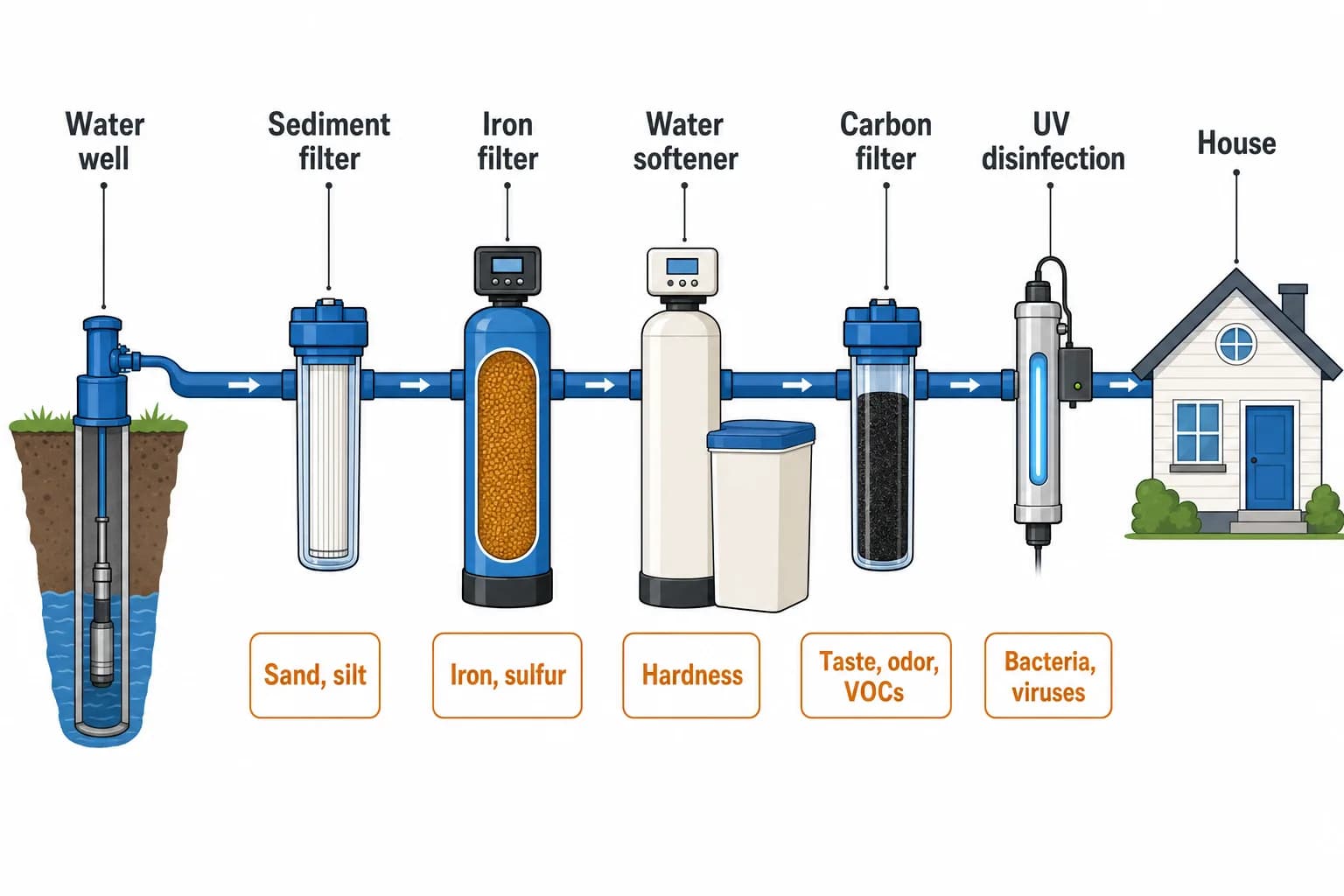
Why the order matters
When several stages are needed, the sequence is not cosmetic - each stage exists to protect the one after it, and a train installed out of order destroys its own equipment:
- Sediment filter first - grit ruins every valve and control head downstream.
- Iron/sulfur oxidation next - dissolved iron permanently fouls softener resin, blinds carbon, and plugs RO membranes, so it must leave the water before any of them.
- Acid neutralizer (if pH is low) - and note it adds hardness, which is exactly why it sits before the softener.
- Softener - protects the water heater, fixtures, and the UV sleeve and RO membrane behind it from scale.
- Carbon - polishes taste and strips any chlorine ahead of chlorine-sensitive equipment.
- UV dead last on the main line - it needs the cleanest possible water to avoid shadowing and sleeve scale.
- RO at the kitchen tap - with iron and hardness gone, the membrane lives its full life.
One more constraint city homeowners never think about: most well homes are also septic homes, and treatment wastewater has to go somewhere. A whole-house RO system can send hundreds of gallons of reject water a day to a drain field that was never sized for it, and anion-exchange brine concentrates whatever the resin captured - a real disposal question when that is uranium or nitrate. Ask the installer where every gallon of backwash, brine, and reject water goes before you sign.
A licensed water professional will size equipment from your flow rate, pressure, and lab results - undersized systems channel and fail early. If you need a pro who knows wells rather than city plumbing, our contractor directory lists well and pump companies near you, many of whom install and service treatment.
What Well Water Treatment Costs
Planning ranges for installed residential systems. Your water chemistry, flow rate, and local labor set the real number.
Installed-cost planning ranges compiled from industry pricing and state health department guidance, 2026. Complex water commonly needs 2-3 stages, so totals stack.
Two cost-sanity notes. First, a point-of-use RO at the kitchen tap often delivers the same health protection as a whole-house system costing five times more - for ingestion-only contaminants, treat where you drink. Second, the cheapest treatment is often not equipment at all: a new well cap, a graded wellhead, or a repaired casing can end a recurring bacteria problem at the source. See the well maintenance guide before you buy a system to treat a symptom.
Keeping Treatment Working
An unmaintained treatment system is worse than none - it gives you confidence without protection.
Annual testing is the thread that ties all of this together - it catches both new contamination and treatment drift. The testing guide covers building an annual panel, and the well water upkeep guide covers the rest of the well-care rhythm around it.
Frequently asked questions
Keep reading
Sources & further reading
- Private Drinking Water Wells — U.S. EPA (accessed July 2026)
- Protect Your Home's Water (Private Wells) — U.S. EPA (accessed July 2026)
- Potential Well Water Contaminants and Their Impacts — U.S. EPA (accessed July 2026)
- Home Water Treatment — Minnesota Department of Health (accessed July 2026)
- Quality of Water from Domestic (Private) Wells — USGS (accessed July 2026)
- Per- and Polyfluoroalkyl Substances (PFAS) in Drinking Water — U.S. EPA (accessed July 2026)
- Common Contaminants — Water Quality Association (accessed July 2026)