
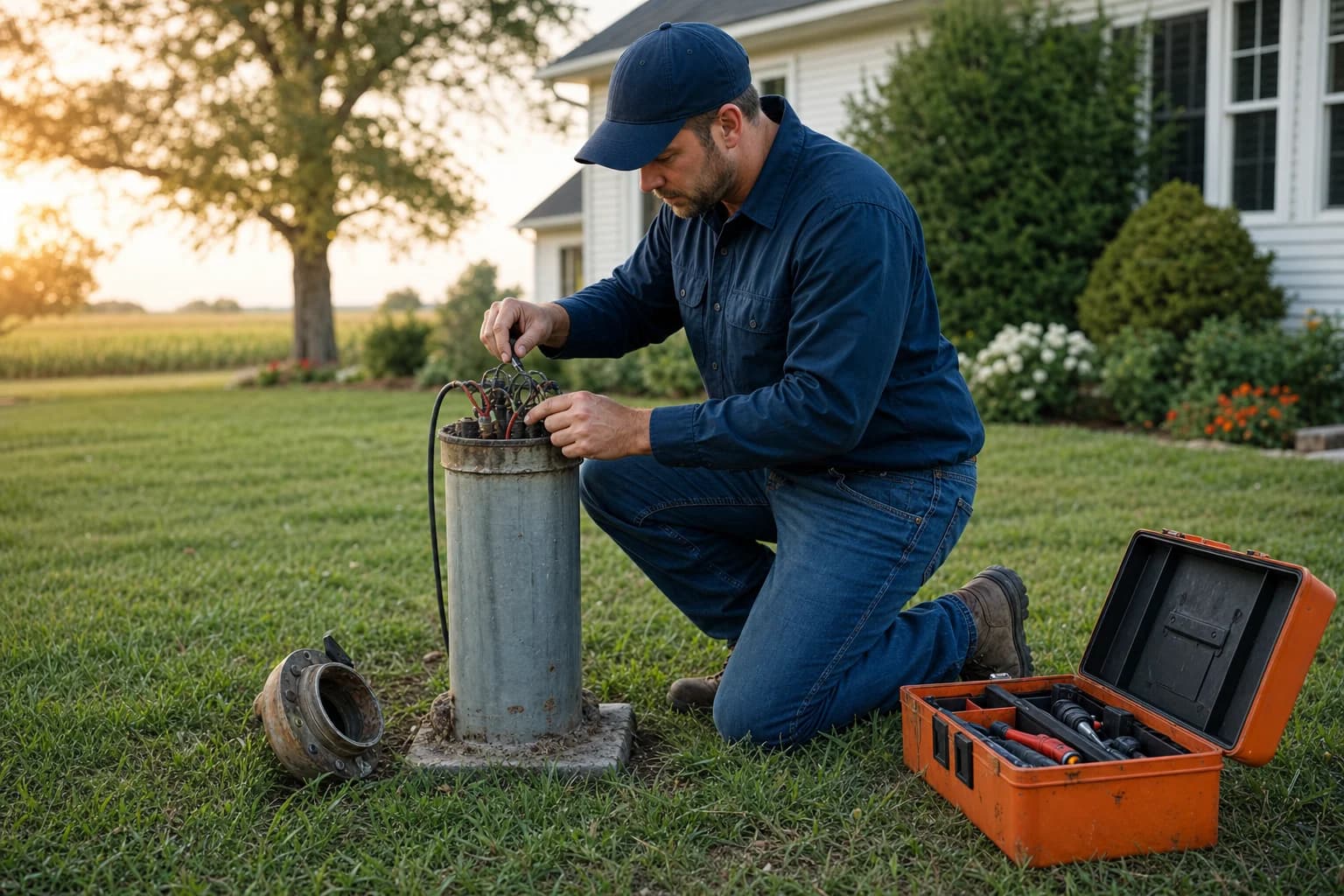
Why Well Maintenance Matters
More than 23 million U.S. households - over 43 million people - drink from private wells that no government agency monitors. The Safe Drinking Water Act explicitly excludes them.
If your home is on city water, a utility tests the supply many times a day and maintains the pumps and mains that deliver it. If your home is on a well, all of that is your job. No one will tell you the water has turned unsafe, and no one will notice the pump is wearing out until the taps run dry. The U.S. EPA recommends private wells be tested at least annually precisely because there is no other safety net.
1 in 5
sampled private wells contains at least one contaminant - bacteria, nitrate, arsenic - at levels that could affect human health
Source: CDC / USGS
That figure is not an outlier. Broader studies have found that between 15 and 50 percent of private wells fail at least one standard that public water systems are required to meet. And the consequences show up in hospital data: in North Carolina alone, researchers linked contaminated private well water to roughly 29,400 emergency department visits per year for acute gastrointestinal illness.
The good news: nearly all of that risk is manageable with a simple routine - annual water testing, monthly visual checks, and a professional checkup every one to three years. The same routine protects the machinery. A well system is a 30-to-50-year asset, but its pump lasts only 10 to 15 years, and neglect shortens that dramatically. Maintenance is cheap; emergencies are not. That trade-off is the theme of this whole guide.
The Complete Well Maintenance Schedule
Everything on this schedule is either a two-minute habit or a once-a-year appointment. Work through it by cadence.
The schedule below follows CDC and National Ground Water Association guidance. If you want a one-page version to hang by the pressure tank, use our printable well maintenance checklist.
When yield drops or sediment shows up despite good upkeep, physical cleaning is usually the fix - our guide to how to clean a well walks through brushing, surging, and chemical rehabilitation. And if a well is past saving or has been replaced, don't just leave it: an unused well is a direct channel to the aquifer and most states require it to be properly decommissioned and sealed.
Component-by-Component Care
A well is an engineered hydraulic system, not a hole in the ground. Know the six components, what each one costs, and which ones you may touch.
Well cap and wellhead (DIY-safe)
The cap seals the top of the casing against insects, vermin, and surface water, venting the well through downward-facing screens. A quality vermin-proof cap costs $50-$200, and checking it is the single most valuable monthly habit a well owner has. The casing itself should rise at least 12 inches (ideally 18) above grade - never bury or landscape over it. Full details in our well caps guide.
Well casing (licensed pro)
The casing is the steel or PVC tube that lines the borehole and, with its grout seal, forces the well to draw naturally filtered deep water instead of surface runoff. You can eyeball the above-ground portion for cracks and rust, but the underground length needs a downhole camera every 5-10 years - sooner if the water suddenly turns muddy, the classic symptom of a cracked casing letting sediment in. A casing that fails outright cannot usually be repaired; a replacement well runs $5,000-$24,500.
Pitless adapter (licensed pro)
This watertight fitting passes through the casing wall below the frost line - typically 4 to 6 feet down - and connects the vertical drop pipe to the horizontal service line into the house. It needs no routine homeowner care, but replacement means excavation and pulling the pump: $500-$1,500 installed, even though the part itself is only $50-$150.
Well pump (licensed pro)
The pump is the heart of the system: a surface-mounted jet pump on shallow wells (under about 25 feet), or a submersible pump hanging deep inside the casing on most modern drilled wells. A submersible runs on 240 volts at the end of hundreds of feet of water-filled pipe, which is why pump work is never DIY. Expect 10-15 years of service; during the periodic checkup a pro measures the motor's amp draw to catch failing bearings and worn impellers before they strand you. Replacement runs $1,500-$4,000 installed.
Pressure tank (DIY-safe)
The tank stores pressurized water behind a rubber bladder so the pump does not start every time someone washes their hands. Its one enemy is losing its air charge: a "waterlogged" tank makes the pump short-cycle - on and off every few seconds - which can burn out a pump motor in months. The annual air-charge check (2 PSI below the switch cut-in, measured with the system drained and the pump powered off) is the highest-value DIY task in well ownership. Replacement, when the bladder finally fails, is $800-$1,500.
Pressure switch (check DIY, replace pro)
The small relay near the tank that tells the pump when to run - typically cutting in at 30 or 40 PSI and out at 50 or 60. You can watch the gauge to confirm it cycles at the right pressures, and it is worth knowing that ants and other insects, drawn to the electrical warmth, are a common cause of pitted contacts. Replacement involves 240-volt wiring: leave it to a pro at $75-$150.
The Professional Checkup and What Maintenance Costs
Every 1-3 years, a licensed contractor should put numbers to the things you cannot see. Here is what the visit includes and what to budget.
A proper professional checkup covers four measurements:
- Flow test and yield: how many gallons per minute the well actually produces, to confirm the aquifer is not declining.
- Electrical profiling: line voltage and the pump motor's amp draw - the early-warning number for mechanical wear.
- Sanitary seal verification: cap, casing, and pitless adapter checked for watertight integrity.
- Drawdown assessment: static versus pumping water level, the health metric for the aquifer itself.
If you are buying a home with a well, the same visit doubles as a pre-purchase evaluation - our well inspection guide covers what a full inspection adds.
National ranges from 2024-2026 cost surveys; get 2-3 local quotes.
Maintenance vs Replacement: The Economics
Well maintenance is asset protection. The math is lopsided, and it is worth seeing plainly.
$450/yr
is what a typical homeowner spends on preventative well maintenance - versus $4,000+ for the emergency pump-and-tank failures it prevents
Source: Quality Water Treatment
Stack the routine costs against the emergency ones. A well pump replacement averages about $1,900 and commonly runs $1,500-$4,000 installed - $6,000 or more for deep submersibles. A pressure tank is $800-$1,500. And a casing failure that forces a new well is $5,000-$24,500. Meanwhile the maintenance that prevents most of these failures - an annual lab test, an air-charge check with a tire gauge, a $300-$600 checkup every few years - totals roughly $450 a year.
The two failure modes are connected, which is what makes neglect expensive. A waterlogged tank does not just fail on its own - the short-cycling it causes destroys the pump too, turning a $150 air-charge fix into a $3,000-$4,500 combined replacement. Over a ten-year horizon, roughly $4,500 of scheduled maintenance protects a system whose emergency failure costs routinely double that, and it buys safe drinking water the whole time.
Warning Signs of Well Failure
Wells rarely die without warning. Catching these five signals early is the difference between a service call and a replacement.
- A breaker that keeps tripping. A struggling pump motor with failing bearings or sediment-bound impellers draws locked-rotor amperage - up to 5 times its normal running current. A 240V breaker that trips repeatedly is an electrical cry for help, not a breaker problem.
- Sputtering faucets. Air in the lines means a dropping water table, a cracked drop pipe, or a failed check valve letting the water column fall back down the well.
- Rapid pump cycling. On-off every few seconds while water runs is the signature of a waterlogged pressure tank. Fix it immediately - the thermal stress is actively destroying the pump motor.
- Muddy, cloudy, or sandy water. Sediment means a failing well screen, a cracked casing, or a pump set too close to the bottom. Pumping sand grinds away impellers fast.
- Slowly fading pressure. A weeks-long decline points to mineral scale in the plumbing, a clogged whole-house filter, or a pump that can no longer reach its cut-out pressure.
If two or more of these are happening at once, stop diagnosing and call a licensed well contractor - compound symptoms usually mean the pump is on borrowed time.
Record Keeping: Your Well's Paper Trail
The cheapest maintenance tool you own is a folder. Every future repair gets faster and cheaper when the history is written down.
Start with the well log (well completion report) - the document filed when your well was drilled. It records total depth, casing depth, static water level, yield in gallons per minute, and the geology the drill passed through. Every contractor who ever works on your well will ask for it, because it tells them what pump the well can support and how deep everything hangs. If you do not have yours, you can look up your well record in state databases through DrillerDB.
Alongside the log, keep:
- Every water test result, with dates - trends matter more than single readings
- Invoices and reports from professional checkups (amp draw and yield numbers especially)
- Pump and tank model numbers, install dates, and warranty terms
- Dates of any shock chlorination or repairs that opened the well
A documented well is also worth real money at resale: buyers' inspectors flag undocumented wells, and a clean maintenance file answers their questions before they become price negotiations.
Seasonal and Well-Type Notes
Climate and construction change the maintenance calculus. Adjust the baseline schedule for your well, not someone else's.
Winter: the system's freeze protection lives at the frost line - the pitless adapter and service line sit 4 to 6 feet down in northern states for exactly this reason. The above-ground risk is power, not pipes: a submersible pump is useless in an outage, and its starting surge is the sizing number for a backup generator. A 1/2 HP pump needs roughly 2,000 watts to start (900 running); a 1 HP pump needs about 4,000 starting watts (1,400 running). An undersized generator that bogs down on the inrush can damage the pump's control box.
Spring and after storms: flooding, nearby construction, and major land disturbance are immediate test triggers - if the wellhead was ever under standing water, assume contamination until a lab says otherwise.
Summer drought: shallow wells feel drought first. Sputtering taps in late summer often mean the water table has dropped near the pump intake. Wondering how deep the wells around you go? Check real driller-reported depths on the DrillerDB well map.
Age matters as much as type. Wells drilled before the 1980s often used carbon steel casing, which corrodes and can develop pinhole leaks that let shallow groundwater into the aquifer - those wells earn the 5-year downhole camera interval. Modern Schedule 40/80 PVC casing does not rust, shifting the maintenance load almost entirely to the pump and tank.
Frequently asked questions
Keep reading
- Printable Well Maintenance Checklist - the one-page version of this guide's schedule
- Well Inspection Guide - what a professional inspection covers and when to order one
- Well Water Testing Guide - the full testing panel, certified labs, and reading results
Sources & further reading
- Private Drinking Water Wells — U.S. EPA (accessed June 2026)
- Private Water Systems and Public Health — U.S. CDC (accessed June 2026)
- Domestic (Private) Supply Wells — USGS (accessed June 2026)
- Unwell Water: Legal Silence, Private Wells, and Public Health in the Rural Americas — University of Colorado Law Review (accessed June 2026)
- Estimated emergency department visits for acute gastrointestinal illness attributable to private well water, North Carolina — PubMed Central (NIH) (accessed June 2026)
- National Primary Drinking Water Regulations — U.S. EPA (accessed June 2026)
- Well Water System Maintenance: Affordable or Expensive? — Quality Water Treatment (accessed June 2026)
- How Much Does a Well Inspection Cost? — Angi (accessed June 2026)
- Well Inspection Cost Guide — HomeAdvisor (accessed June 2026)
- Well Pump Replacement Cost Guide — The Well Guide (accessed June 2026)
- How Much Does Well Pump Replacement Cost? — Angi (accessed June 2026)
- Cost to Replace a Well Pressure Tank — HomeGuide (accessed June 2026)
- How Much Does Well Drilling Cost? — Angi (accessed June 2026)
- Well Maintenance: Costs and Schedule — WellDrillingCost.com (accessed June 2026)
- How Much to Replace a Well Water Pump — Night Owl Water Monitoring (accessed June 2026)
- Well Maintenance and Care Guide — ETR Laboratories (accessed June 2026)
- Water Well Maintenance Guide — SC Well Service (accessed June 2026)
- Well Maintenance (wellcare Information Sheet) — Water Systems Council (accessed June 2026)
- What's a Well Owner to Do? — Public Health Madison & Dane County (accessed June 2026)
- Well Pump Maintenance Guide — The Well Guide (accessed June 2026)
- Well Pressure Tank Sizing Guide — SC Well Service (accessed June 2026)
- How to Shock Your Private Well (200 ppm chlorination procedure) — Stillwater County, MT (accessed June 2026)
- Signs of Well Failure — Brown Well Supply (accessed June 2026)
- Most Homeowners Ignore These Well Warning Signs — Living Water Well Service (accessed June 2026)
- Inverters: General Information (locked rotor amperage) — Samlex America (accessed June 2026)
- What Size Generator Do I Need to Run My Submersible Well Pump? — How to Look at a House (accessed June 2026)
- The Pitless Adapter Explained — SC Well Service (accessed June 2026)
- Well Pump Maintenance Checklist — National Water Service (accessed June 2026)
- Drinking Water Well Components — Washtenaw County, MI (accessed June 2026)
- Well Water System Diagram: Components Explained — Water Filter Guru (accessed June 2026)
- A Guide to Common Well Types for Homeowners — Reliable Home Inspection Service (accessed June 2026)
- Well Pump Replacement Cost Breakdown (2026) — SC Well Service (accessed June 2026)