
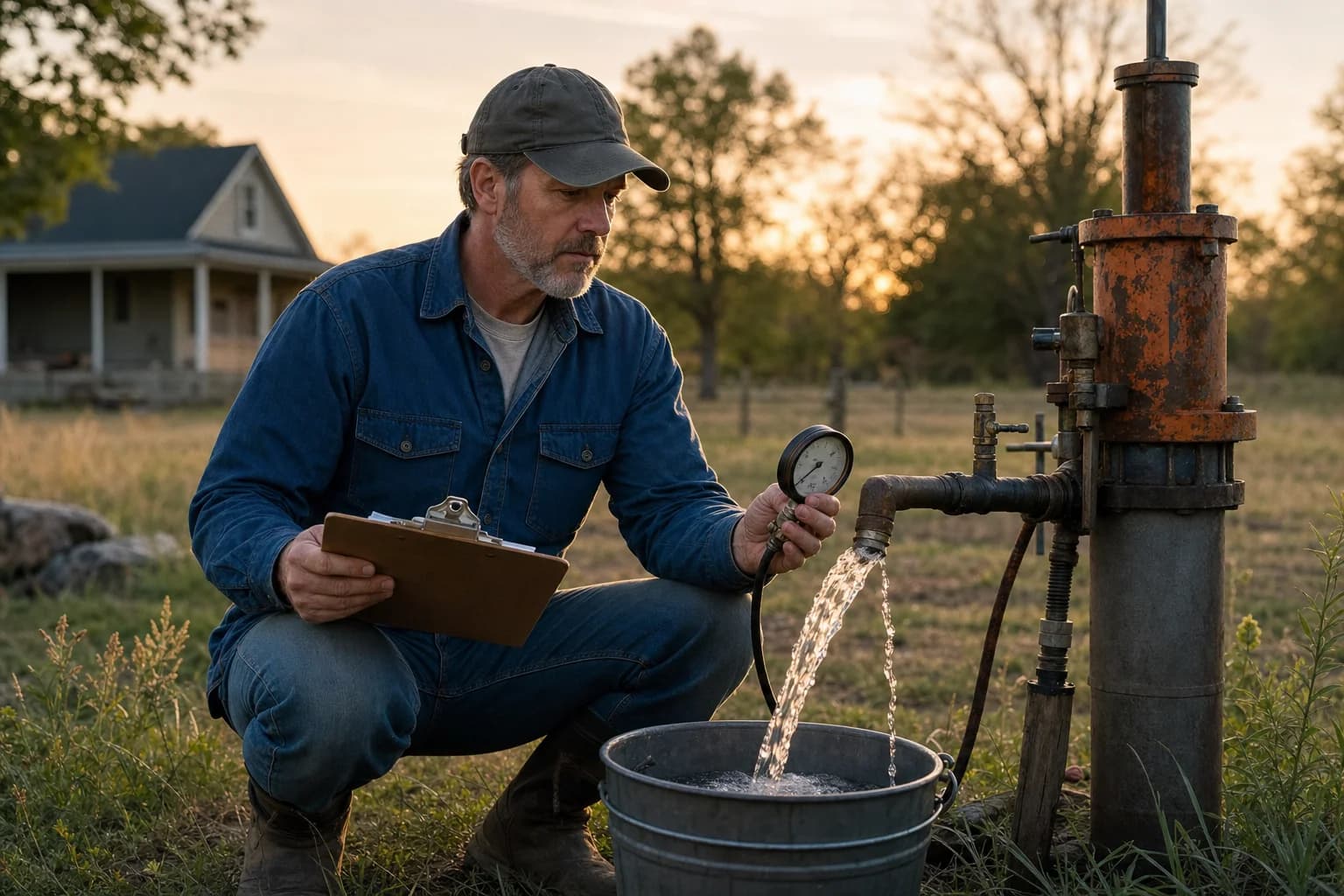
What a Professional Well Inspection Includes
Unlike city water, nobody regulates or monitors a private well for you - the Safe Drinking Water Act does not apply, so the burden of proving the system is safe and functional falls entirely on the owner.
Nearly 20% of US households rely on a private well, and a real inspection is much more than a glance at the plumbing. A professional follows a systematic diagnostic process with four distinct phases: a sanitary survey, an equipment check, a flow/yield test, and water quality sampling. A perfectly running pump can deliver contaminated water, and a failing pump can deliver clean water at useless pressure - the inspection has to cover both failure modes.
Step 1: Sanitary survey and wellhead inspection
The inspection starts at the surface. Per CDC and National Ground Water Association (NGWA) guidance, the casing - the steel or PVC pipe lining the borehole - must extend at least 12 inches above the ground (1 to 2 feet in flood-prone areas) so surface runoff cannot infiltrate the aquifer. The inspector checks that the well cap is securely bolted with intact rubber gaskets to keep insects and rodents out, that the ground slopes away from the wellhead, and that the well keeps proper distance from hazards like septic drain fields, dog kennels, and pesticide storage.
Step 2: Mechanical and equipment check
Indoors (or in the pump house), the inspector watches the pressure tank and pressure switch under load, looking for "short cycling" - the pump kicking on and off every few seconds, the classic symptom of a waterlogged tank with a failed bladder. Using a tire gauge, they verify the tank's air pre-charge sits exactly 2 PSI below the switch's cut-in setting (28 PSI on a 30/50 switch; 38 PSI on a 40/60). Electrical conduits get checked for frayed wires and unsecured connections.
Step 3: Flow rate and yield testing
For a home purchase this is arguably the most important test. A simple flow check - timing how fast the pump fills a 5-gallon bucket - only measures what the borehole holds at that moment. A true yield (drawdown) test runs water continuously for two to four hours while comparing the static water level against the pumping level. Dividing the pumping rate (GPM) by the drawdown distance gives the well's specific capacity; a sharp drop in that number over the well's life points to mineral encrustation or biofouling of the well screen, which means expensive rehabilitation. Curious how your area compares? Browse nearby well depths and yields on the DrillerDB well map.
Step 4: Water quality sampling
Finally, the inspector draws samples for laboratory analysis - from a raw tap near the pressure tank, before any filtration or softener, so the lab sees the aquifer's true baseline. In real estate transactions the sample must be collected by a disinterested third party (never the buyer, seller, or agents) and analyzed by a state-certified drinking water laboratory; the EPA maintains a national directory of certified labs. Standard panels cover total coliform, E. coli, nitrates, nitrites, and lead, with regional add-ons like arsenic, radon, or VOCs.
- 01Well cap & sanitary seal. Bolted, gasketed, vermin-proof
- 02Casing height & condition. 12 in. minimum above grade (1-2 ft in flood areas)
- 03Grade slope. Ground must slope away from the wellhead
- 04Setback distances. 50 ft to septic tank, 100 ft to drain field
- 05Electrical conduit & wiring. No frayed wires or loose connections
- 06Pitless adapter. Frost-proof fitting below the frost line
- 07Drop pipe. 1 to 1.25 in. pipe down the water column
- 08Submersible pump & drawdown. Static vs. pumping level during the yield test
- 09Pressure tank pre-charge. 2 PSI below the switch cut-in setting
- 10Pressure switch. Cycling behavior at 30/50 or 40/60 PSI
- 11Flow & yield test point. GPM measured at a fixture under sustained load
- 12Raw water sample point. Drawn before any filtration or softener
What a Well Inspection Costs
The national average runs $350 to $450, but the lab work you order is the single biggest variable on the invoice.
Pricing scales with scope, well depth, and geography. Shallow coastal wells in the Southeast sit at the low end; deep-rock wells over 500 feet in the Northeast cost the most to evaluate. Midwest agricultural areas often add pesticide and herbicide screens, and known geological hazards (arsenic in New Jersey and Oregon, for example) push lab panels toward the top of the range.
National 2025-2026 ranges; the extent of laboratory testing is the largest cost variable. Get 2-3 local quotes.
Searching "well inspection near me"? Skip the generic directories - the people who inspect wells for a living are licensed well contractors and pump installers. Find licensed well professionals in your area and compare at least two quotes against the ranges above.
When an Inspection Is Required vs. Recommended
Three things trigger a well inspection: a real estate transaction, an environmental event, or the calendar.
Most comprehensive inspections happen during property transfers. Cash buyers can technically waive them, but that is a serious financial gamble: a well producing under 1 GPM cannot sustain a modern household without thousands of dollars in engineered storage, and unfixable contamination can make a home effectively uninhabitable. Flaws found before closing become negotiated remediation credits; flaws found after closing are entirely the buyer's expense.
If the buyer is using a federally backed loan, the choice disappears. FHA (HUD Handbook 4000.1), VA (Pamphlet 26-7), and USDA (HB-1-3555) each impose specific yield minimums, setback distances, water panels, and validity windows - all enforced by the underwriter, not the seller. Separately, a handful of states mandate testing on every transfer regardless of financing: New Jersey's Private Well Testing Act requires a panel of up to 43 parameters before title can close (typically $1,200-$1,500, paid by the seller), Oregon's ORS 448.271 obligates sellers to test for arsenic, nitrates, and coliform when an offer is accepted, and Rhode Island requires testing before any sale plus a 10-day buyer testing window in every purchase contract. Maryland, Maine, and Virginia have recently extended testing duties to landlords. Rules vary widely by state - check your state's requirements in our state-by-state well guides.
90 days
how long VA water test results stay valid - the shortest federal window. If closing slips past it, the buyer pays for a brand-new test.
Source: VA Pamphlet 26-7
Outside of a sale, the CDC recommends checking the well every spring for mechanical issues and testing the water annually for total coliform bacteria, nitrates, pH, and total dissolved solids. Every 2-3 years, add a full mechanical inspection with an extended yield test and a comprehensive panel.
Well Inspection vs. Water Testing
They are routinely confused, often performed together, and evaluate entirely different risks.
A water test is a laboratory assay of what is in the water; a well inspection is a physical evaluation of the machine that extracts, pressurizes, and delivers it. Order only a water test and you can buy a house with a pressure tank on the verge of failure; order only an inspection and you stay blind to invisible, tasteless threats like arsenic and nitrates. Federal guidance uniformly recommends doing both together.
For the full picture of what to test for, how sampling works, and how to read lab results, see our complete guide to well water testing.
Who Is Qualified to Inspect a Well
A general home inspector turning on a faucet is not a well inspection.
General home inspectors are generalists; for wells they typically perform only a rudimentary functionality check. A definitive inspection requires a licensed well contractor, a certified pump installer, or an environmental health specialist - someone with real hydrogeology and pump-mechanics knowledge. Verify the contractor holds an active license with your state's environmental agency or certification through the National Ground Water Association (NGWA).
For government-backed loans the bar is higher still: yield tests and chain-of-custody water samples must come from a disinterested third party recognized by the state, such as a licensed sanitary engineer or a technician from a state-certified laboratory. When you are ready to book, search licensed well contractors by state and city on DrillerDB.
What the Inspection Report Contains
Expect two documents: a concise written report on the functional status of every component - cap, casing, pump, tank, switch - with an opinion on remaining life and whether the flow is adequate for the household, plus the official laboratory assay sheets. The lab sheet measures each contaminant against the EPA's Maximum Contaminant Levels (MCLs), so you can see not just pass/fail but how much margin the water has. Keep the report with your well records: the yield and specific-capacity numbers become the baseline that future inspections are judged against, alongside the original construction log you can pull from your state's records.
Red Flags Inspectors Find Most Often
Four findings dominate inspection reports:
- Waterlogged pressure tanks. Tapping the tank yields a dull, solid thud all the way up the side - the internal bladder has ruptured. The result is short cycling and rapid pump motor burnout.
- Coliform presence. Total coliform is a sentinel indicator: usually harmless itself, but proof that a pathway exists for dangerous pathogens like E. coli to enter the system.
- Corroded or buried wellheads.Pre-1980s wells were often finished in underground "well pits" that flood with surface runoff and contaminate the well. Modern codes require the casing to extend above ground.
- Inadequate recovery rate. A well may push 5 GPM at first, but if recovery drops to 0.3 GPM under sustained use, it will run dry during a normal morning routine.
One more finding that stops a sale cold: an old, unused well hiding on the property. An unsealed abandoned well is a direct contamination channel to the aquifer and a liability in most states - if the inspection turns one up, it needs to be properly decommissioned and sealed by a licensed contractor, not just capped and forgotten.
The most common homeowner mistake feeding these findings is assuming clear, odorless water is safe - arsenic, nitrates, and lead are all invisible and tasteless. The second is masking symptoms, like installing a sulfur filter for odors that actually come from a failing, waterlogged pressure tank. A steady well maintenance routine catches most of these before they become inspection-day surprises.
How Long It Takes
The on-site inspection takes one to three hours. The lab dictates the rest of the timeline: standard coliform and nitrate results return in three to five days, while heavy-metal and VOC panels can take 10 to 14 days. In a purchase, that timing cuts both ways - schedule the inspection within the first week of your due-diligence period. Test too late and you risk delaying the closing; test too early and you risk expiring the 90-day VA or 150/180-day USDA/FHA validity window before you reach the table.
Frequently asked questions
Keep reading
Sources & further reading
- Guidelines for Testing Well Water — U.S. CDC (accessed June 2026)
- Private Drinking Water Wells — U.S. EPA (accessed June 2026)
- Certification Programs and Certified Laboratories for Drinking Water — U.S. EPA (accessed June 2026)
- Private Drinking Water Well Programs in Your State — U.S. EPA (accessed June 2026)
- Single Family Housing Policy Handbook 4000.1 — U.S. HUD / FHA (accessed June 2026)
- VA Lenders Handbook - Pamphlet 26-7 (Minimum Property Requirements) — U.S. Department of Veterans Affairs (accessed June 2026)
- HB-1-3555 Single Family Housing Guaranteed Loan Program Technical Handbook — USDA Rural Development (accessed June 2026)
- Private Well Testing Act (PWTA) — New Jersey DEP (accessed June 2026)
- ORS 448.271 - Domestic well testing upon sale of property — Oregon Public Law (accessed June 2026)
- Rhode Island General Laws 23-1-5.3 - Private drinking water systems — Rhode Island General Assembly (accessed June 2026)
- Well Maintenance and Inspection Resources — NGWA WellOwner.org (accessed June 2026)
- How Much Does a Well Inspection Cost? (2026) — HomeGuide (accessed June 2026)
- Cost of a Well Inspection in 2026 — Angi (accessed June 2026)
- Laws Requiring Private Well Testing at Rental Properties — Network for Public Health Law (accessed June 2026)