
How Lead Gets Into Well Water
The instinct is to blame the aquifer. For lead, that instinct is almost always wrong. Lead enters the water after it leaves the ground, leached from metal plumbing and well parts by naturally corrosive groundwater.
With arsenic or uranium, the contaminant really does rise out of the bedrock. Lead is different. In the vast majority of private wells across the country, the groundwater at the bottom of the well contains virtually undetectable lead. The lead you measure at the kitchen sink was added after the water left the aquifer - dissolved out of the pipes, fittings, and pump components the water touches on its way to the tap.
Lead is uniquely vulnerable to this because corrosive water acts as a solvent. When water sits idle in your plumbing overnight, low-pH or low-mineral "soft" water slowly strips lead from any component that contains it. The primary culprits inside a private well system are:
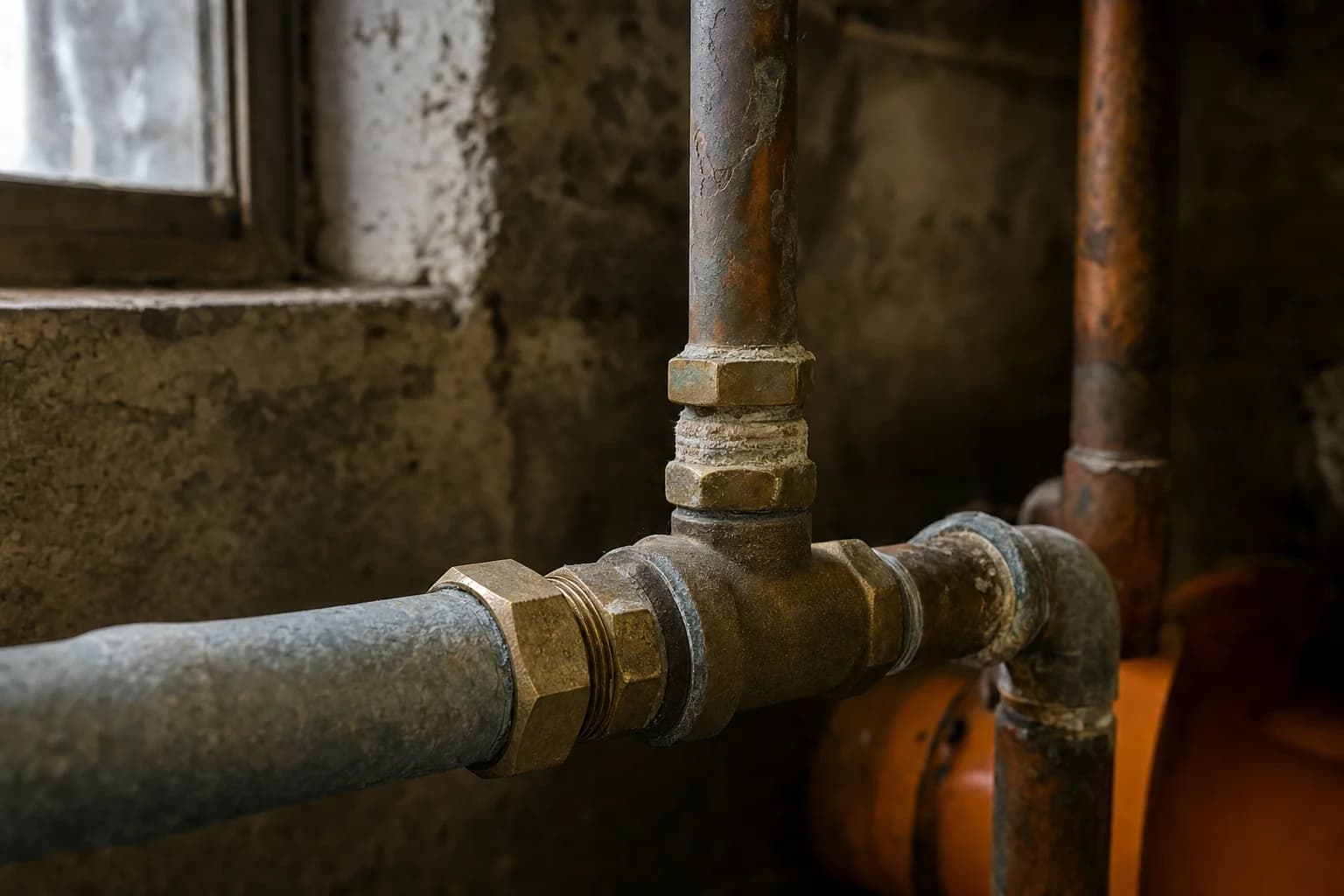
- Pre-1986 lead solder: Before 1986, copper pipes were joined with a 50% tin / 50% lead solder. Corrosive water resting in those joints forms a microscopic galvanic battery that dissolves the lead directly into the standing water.
- Brass fittings and faucets (pre-2014):Even in a post-1986 home, "lead-free" brass valves, faucets, and elbows were legally permitted to contain up to 8% lead for machinability. The Reduction of Lead in Drinking Water Act did not cut that to a 0.25% weighted average of wetted surfaces until 2014. Nearly any brass fixture made before 2014 is an active lead source.
- Lead packers (legacy wells):In wells drilled before the mid-1990s, drillers often used a thick lead ring - a "lead packer" - swedged against the casing to seal the screen. Submerged in the water column, it is a permanent source. Lead packers were generally prohibited by 1993 and replaced with neoprene "K-packers."
- Older submersible pumps (pre-1995): Pumps made before 1995 often used leaded-brass housings and bronze fittings sitting fully submerged. American manufacturers voluntarily stopped using leaded brass in 1995.
There is a narrow geological exception. In parts of the Northeast - notably the granite of New Hampshire and Massachusetts - trace minerals can introduce small amounts of dissolved lead over geological time. But even there, if you detect lead at the tap, the odds overwhelmingly favor a plumbing source. The practical takeaway drives everything below: because lead is added inside your home, you have to test in a way that pinpoints where, and you treat it at the tap rather than at the basement.
Where Lead Risk Is Highest
Lead is not in the aquifer, but corrosive water that dissolves lead from plumbing absolutely is. The USGS mapped it: untreated groundwater in 25 states has a high or very high potential to be corrosive.
A landmark USGS study of more than 20,000 wells found that roughly 33% of untreated groundwater samples nationwide had a lead solubility potential capable of dissolving at least 15 parts per billion (ppb) of lead, and about 5% could dissolve a staggering 300 ppb or more. The risk is concentrated where soft, acidic water meets unreactive bedrock or young coastal-plain aquifers that never form a protective mineral scale inside pipes.
Two aquifer families dominate the high-risk map. Atlantic and Gulf Coastal Plain aquifers along the Eastern Seaboard and Gulf Coast carry oxygenated, naturally acidic water (pH 6.5 or below) that prevents protective scale. Granite and sandstone bedrock aquifers common across the Northeast produce soft water that lacks the calcium and magnesium needed to coat pipe interiors. Where you have legacy plumbing on top of either, the leaching risk is real.
Corrosive water exists in all 50 states, so geography narrows the odds but never replaces a test. To gauge your own exposure, it helps to know how deep your well sits and how old it is - a shallow or older well is more likely to carry both surface influence and legacy components. Look up nearby wells and depths on the DrillerDB well map, and check your state's specific rules in our state well guides.
Health Effects and the EPA Limit
There is no safe level of lead. The body mistakes it for calcium, absorbs it, and stores it in bone - and developing children pay the highest price.
When consumed, lead mimics calcium. The body absorbs it into the bloodstream, where it crosses the blood-brain barrier and settles into bones and teeth. In adults, chronic exposure drives high blood pressure, cardiovascular and kidney damage, and cognitive decline. In children and fetuses, whose brains and nervous systems are still forming, even microscopic amounts disrupt neural development - causing permanent loss of IQ, behavioral problems, and stunted growth. The EPA states plainly that no safe level of lead exposure has been identified.
3.5 ug/dL
the CDC's Blood Lead Reference Value for children - lowered from 5.0 in 2021; at or above this, environmental investigation and abatement are clinically mandated
Source: CDC
The Safe Drinking Water Act regulates municipal utilities, not private wells, but its numbers set your baseline. For decades the EPA used a 15 ppb "action level" - a treatment trigger for water systems, never a health-based safety standard. In October 2024, the Lead and Copper Rule Improvements lowered that action level to 10 ppband ordered the removal of nearly all legacy lead service lines nationwide within a decade. The EPA's health-based goal, the Maximum Contaminant Level Goal, is and always has been exactly zero. As a private well owner, that zero is your target.
How to Test for Lead
You cannot see, smell, or taste lead. Because the source is usually your plumbing, the test has to be designed to reveal where the lead is coming from - which means two samples, not one.
Testing for lead correctly means collecting a pair of samples from the same tap so the lab can locate the source:
- First-draw sample: taken the moment you turn on the tap in the morning, after the water has sat stagnant in the pipes for at least 6 to 8 hours. This captures the worst case - lead leached from your interior plumbing fixtures overnight.
- Flushed sample: taken after the tap has run on high for 3 to 5 minutes. This purges the household plumbing and pulls water straight from the wellhead and aquifer.
The comparison is the whole point. If the first-draw is high but the flushed sample is clean, your interior plumbing (solder, brass faucets) is the source. If both are high, the lead is down inside the well itself - a lead packer, a leaded-brass pump housing, or, rarely, the aquifer. That distinction decides whether you fix the problem at the tap or call a driller to pull the pump.
Use a certified mass-spectrometry laboratory, not a hardware-store strip. Lead exists as both soluble (dissolved, invisible) and particulate (microscopic flakes of lead or brass that snap off pipe walls and lodge in faucet aerators), and cheap strips are notoriously blind to the particulate form. Only an accredited lab can quantify total lead.
National ranges; a comprehensive mail-in panel is the only way to establish a true lead baseline. Re-test for metals every 3-5 years.
Reading Your Results
Lead is reported in two units that trip people up. Here is how to translate the number on your lab report into a decision.
Labs report lead either in ppb (parts per billion, the same as micrograms per liter, ug/L) or in ppm(parts per million, the same as milligrams per liter, mg/L). The conversion is simple: 1 ppm equals 1,000 ppb. So the EPA's 2024 action level of 10 ppb shows up on a report as 0.010 mg/L.
- Greater than 0.000 mg/L: lead is present. Begin flushing protocols and plan for Point-of-Use carbon or RO filtration. Your target is 0.0.
- Greater than 0.010 mg/L (10 ppb): you are over the 2024 EPA action level. Discontinue drinking that water now and install NSF 53 or NSF 58 treatment.
Remember to read the first-draw and flushed numbers together. A high first-draw with a clean flushed result is your plumbing talking; two high numbers point down the well. Either way, any detectable lead with children in the home is a stop-drinking signal, not a wait-and-see one.
If Your Test Comes Back High
The most dangerous instinct is the wrong one. Do this immediately - and do not reach for the stockpot.
Take these steps the moment a test returns elevated lead:
- Switch to bottled water for everything ingested. Use independently tested bottled water for all drinking, cooking, and especially mixing baby formula until a permanent filter is installed.
- Use only the cold tap. Hot water dissolves lead far faster, turning your water heater and its pipes into a concentrated lead reservoir. Never draw hot tap water for drinking, cooking, or formula.
- Flush before every use. Lead concentrates in water that sits idle. Run the cold tap 1 to 2 minutes before using it (longer after the house has sat empty for a weekend) to pull fresh, lead-free water from the well and purge the contaminated standing water from the pipes.
- Get the kids tested. If children live in the home or visit often, ask a pediatrician for a blood-lead test. Water is only one exposure pathway, and a blood test measures the total picture.
Treatment Options Compared
Because lead enters inside your plumbing, the basement is the wrong place to treat it. Point-of-Use filtration at the tap is the only scientifically valid fix for plumbing-based lead.
Here is the trap with whole-house Point-of-Entry (POE) systems: a $4,000 POE reverse osmosis unit in the basement makes the water perfectly clean as it leaves the tank - but that clean, aggressive water then travels up through your interior pipes and picks lead right back up before it reaches the glass. For plumbing-based lead, you treat at the Point-of-Use (POU): an under-sink unit at the kitchen tap and the refrigerator line. You do not need to treat showers, tubs, or hose bibs, because skin does not absorb lead from water in hazardous amounts.
Want the full picture across every treatment technology? Our well water treatment guide compares RO, carbon, UV, aeration, and softeners for each contaminant so you can match a system to your test results.
Whatever you buy, never trust marketing claims - verify the independent NSF certification. NSF/ANSI 53 covers carbon-block filters for health contaminants and now requires lead reduction to 5 ug/L. NSF/ANSI 58 covers reverse osmosis systems for heavy-metal removal. (NSF/ANSI 42 only certifies taste and odor - it does nothing for lead.)
For a tight budget with localized lead, a $120 NSF 53 under-sink carbon block at the kitchen tap delivers immediate, proven protection with basic DIY plumbing. If you want to cover a wider range of well contaminants (arsenic, PFAS) at the same time, a professionally installed POU reverse osmosis unit (around $800 and up) is the stronger buy. Avoid two classic mistakes: do not install a water softener to "fix" lead (removing protective scale can make pipes leach more lead), and do not rely on a cheap pitcher unless it explicitly carries the NSF 53 lead rating.
Preventing Lead Leaching
Filtration treats the symptom. Prevention attacks the cause: the corrosive water chemistry that dissolves lead in the first place, and the legacy components that hold lead to dissolve.
Two levers reduce lead at the source. The first is chemistry. If your water is acidic (pH below 6.5) or very soft, a professionally installed acid neutralizer (calcite media) or aeration system raises the pH as water enters the home, neutralizing the corrosivity so it stops stripping lead from your pipes. This is the rare case where a whole-house POE system helps with lead - not by filtering lead out, but by stopping it from leaching at all. (Do not over-correct: skip calcite if your pH is already above 8.0.)
The second lever is the components themselves. If a flushed sample comes back high, the lead is down the well - a lead packer or an old leaded-brass pump - and the durable fix is to replace that component. That is rig work for a licensed well driller, never a DIY job. On the plumbing side, replacing pre-1986 lead-soldered joints and pre-2014 brass fixtures permanently removes those sources. Until you do, the daily habits still matter: cold tap only, flush before use, and clean the faucet aerators where particulate lead collects.
Knowing your well's age and construction tells you which of these risks you actually carry. Pull your original construction report through find your well record - a pre-1993 well may have a lead packer, and a pre-1995 pump may be leaded brass. Ongoing water care, including the testing cadence that catches a creeping lead problem early, is covered in our well water upkeep and well maintenance guides.
Assistance Programs
Pulling a 300-foot well string to replace a lead packer or an antique pump can run into thousands of dollars. For rural homeowners, federal programs can help carry the cost.
- USDA Section 504 Home Repair (Single Family Housing Repair Loans & Grants): very-low-income homeowners in eligible rural areas can borrow up to $40,000 at a 1% fixed rate over 20 years to remove health and safety hazards - which explicitly includes water lead contamination. Homeowners aged 62 and older who cannot repay a loan may qualify for lifetime grants of up to $10,000 ($15,000 in declared disaster areas) that need not be repaid if the home is not sold within three years.
- Rural Decentralized Water Systems Grant Program: USDA funds qualified nonprofits and tribes that, in turn, lend directly to rural households. Eligible homeowners can receive up to $15,000 at a 1% fixed rate over 20 years, earmarked specifically to construct, refurbish, or service individually owned household water well systems.
Both programs are administered through USDA Rural Development; the application forms and eligibility maps live on the program pages linked in the sources below. Your state or county health department may also run lead-specific testing subsidies or low-interest well-improvement loans worth checking before you pay out of pocket.
Frequently asked questions
Keep reading
- Well Water Testing: labs, sampling, and costs (get the right test)
- Arsenic in Well Water: the contaminant that really does come from the aquifer
- Nitrates in Well Water: septic, fertilizer, and the blue-baby risk
- Coliform Bacteria in Well Water: the one contaminant boiling actually fixes
- Well Water Upkeep: the year-round routine that keeps water safe
- State-by-state well rules and testing programs
Sources & further reading
- Basic Information about Lead in Drinking Water — U.S. EPA (accessed June 2026)
- Lead and Copper Rule (and 2024 Lead and Copper Rule Improvements) — U.S. EPA (accessed June 2026)
- Use of Lead Free Pipes, Fittings, Fixtures, Solder, and Flux for Drinking Water — U.S. EPA (accessed June 2026)
- Protect Your Home's Water (Private Wells) — U.S. EPA (accessed June 2026)
- Updates to the Blood Lead Reference Value (lowered to 3.5 ug/dL) — CDC (accessed June 2026)
- Lead Prevention: Health Effects of Lead Exposure — CDC (accessed June 2026)
- Guidelines for Testing Well Water — CDC (accessed June 2026)
- New Study Shows High Potential for Groundwater to be Corrosive in Half of U.S. States — USGS (accessed June 2026)
- Corrosivity of Untreated Groundwater (LSI and galvanic corrosion potential) — USGS (accessed June 2026)
- Domestic (Private) Supply Wells — USGS (accessed June 2026)
- Lead in Drinking Water (NSF/ANSI 53 and 58 certification) — NSF (accessed June 2026)
- Lead in Drinking Water and Private Wells — Minnesota Department of Health (accessed June 2026)
- Lead in Drinking Water — Vermont Department of Health (accessed June 2026)
- Drinking Water Issues: Lead (corrosion and pre-2014 brass) — Texas A&M AgriLife Extension (accessed June 2026)
- Single Family Housing Repair Loans & Grants (Section 504) — USDA Rural Development (accessed June 2026)
- Rural Decentralized Water Systems Grant Program — USDA Rural Development (accessed June 2026)