
What Nitrate Is and How It Gets Into Well Water
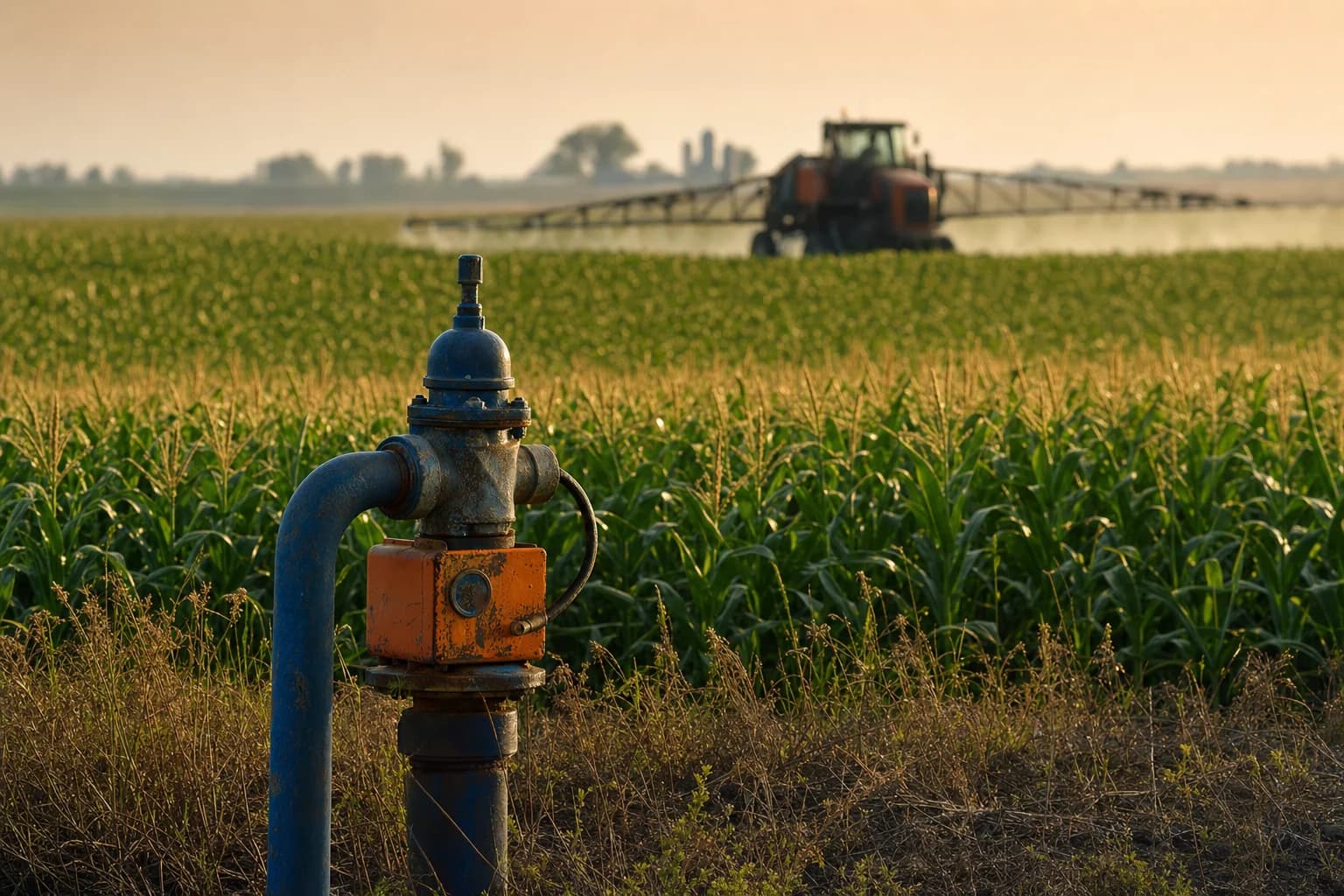
Nitrate is a highly soluble nitrogen compound. Crops do not absorb all the fertilizer applied to them - the excess dissolves in water and leaches straight down into the aquifer your well draws from.
Nitrate (NO3) and nitrite (NO2) are nitrogen-oxygen compounds. Nitrogen is an essential nutrient that cycles naturally through soil and water, and a small amount of nitrate in groundwater is normal - natural decay of plant and animal matter typically yields background concentrations under 2 mg/L. The problem starts when human activity overwhelms the soil's capacity to absorb nitrogen. When a test comes back above roughly 3 mg/L, hydrogeologists treat it as a fingerprint of human-driven (anthropogenic) contamination.
The four sources that drive elevated nitrate in private wells are:
- Agricultural fertilizer. Synthetic nitrogen spread on row crops, golf courses, and lawns is the single largest contributor to widespread nitrate plumes. Crops absorb only a fraction of what is applied; the rest dissolves in rain or irrigation water and percolates past the root zone.
- Animal feeding operations. Concentrated manure from feedlots and dairies creates intense localized nitrogen loads that seep into shallow aquifers.
- Septic systems. Aging, failing, or densely clustered septic systems discharge nitrogen-rich human waste directly into the subsurface.
- Wastewater and industrial runoff. Treated effluent and certain industrial discharges add to regional contamination.
Depth is the key variable. Shallow, older, hand-dug, or bored wells draw young, lightly filtered water from the very zone agricultural nitrate collects in. A deeper well that penetrates below a confining clay layer (an aquitard) into an older, isolated aquifer is often shielded from modern surface runoff. You can see how deep the wells around your property are drilled on our interactive well map.
Where Nitrate Is Worst: The Corn Belt and the Central Valley
Nitrate is not spread evenly. The risk is highest where heavy nitrogen loading meets a vulnerable aquifer - which concentrates the crisis in the agricultural Midwest and the irrigated West.
Roughly 7% of private wells nationally exceed the 10 mg/L EPA limit, but in heavily agricultural regions more than 20% of shallow private wells blow past it. USGS sampling found about 23% of private wells contain at least one contaminant of health concern, with nitrate the most common human-driven chemical. Where you live changes your odds dramatically.
16.9%
of 16,403 domestic wells sampled in Nebraska (2003-2024) violated the 10 mg/L nitrate health standard - and 39.4% showed human-driven contamination
Source: Nebraska DEE
The Midwest and the Corn Belt
Intensive corn-and-soybean agriculture and dense livestock operations make the Midwest the epicenter, and the geology makes it worse:
- Nebraska.Deep, sandy soils over the Ogallala aquifer plus heavy chemical use produce some of the country's highest violation rates - nearly 1 in 6 sampled domestic wells over the limit.
- Wisconsin and Iowa. Shallow, fractured carbonate bedrock (the Silurian dolostone of eastern Iowa and Wisconsin) lets surface fertilizer and manure bypass natural soil filtration and plunge into drinking water. Wisconsin estimates at least 10% of all private wells statewide exceed the nitrate limit.
- Minnesota. New wells exceeding 10 mg/L cluster densely in the central and southwestern agricultural zones; statewide, 4% of post-1992 wells pass the 3 mg/L human-impact threshold.
The West and California's Central Valley
Arid Western basins face a different mechanism: heavy irrigation evaporates at the surface and drives concentrated nitrate salts deep into the soil.
- California. The San Joaquin Valley (Central Valley), Santa Ana Inland, and San Jacinto basins sit over deep basin-fill aquifers with massive underground nitrate plumes affecting hundreds of thousands of rural residents.
- Washington State.Southeastern Washington's intensive agriculture and permeable soils give shallow groundwater a median nitrate of 9.3 mg/L - dangerously close to the federal limit before any individual well is even tested.
- Arizona and Colorado. The basin-fill aquifers near Phoenix and the San Luis Valley of Colorado are flagged by USGS models as frequent exceedances.
Even the wetter East is not immune: the Piedmont and Blue Ridge carbonate aquifers from Pennsylvania to Georgia are highly productive but vulnerable, with roughly 15% of untreated groundwater in that multi-state study area exceeding human-health benchmarks for inorganic constituents. Rules and risk vary sharply by state - our state-by-state well owner guides cover local testing requirements and programs for all 50 states.
Health Effects and the EPA Limit
The EPA set the nitrate limit on acute, life-threatening danger to infants - not on long-term risk. For babies and pregnant women, a high nitrate result is an emergency.
Pregnancy.Pregnant and nursing individuals should treat a high nitrate result with the same urgency. Elevated nitrate may restrict the oxygen carrying capacity of the mother's blood, and some studies show weak associations with specific birth defects. One reassuring fact: nitrate does not pass significantly into breast milk, so a nursing mother who drinks contaminated water still produces safe milk. Nitrate is also not absorbed through skin, so bathing and showering remain safe.
Adults and chronic exposure. Healthy adults excrete nitrate efficiently, but researchers are increasingly concerned about long-term exposure even below the 10 mg/L limit. In the body, nitrate can form N-nitroso compounds (nitrosamines), many of them known carcinogens. Recent epidemiology links prolonged ingestion to higher rates of colorectal, stomach, and bladder cancer and thyroid disease - which is why some agencies are debating whether the standard should be lowered.
10 mg/L
EPA Maximum Contaminant Level for nitrate as nitrogen (NO3-N); nitrite is limited separately to 1 mg/L. These are the benchmarks every lab report compares your water against.
Source: U.S. EPA
How to Test for Nitrate
Because private wells are exempt from the Safe Drinking Water Act, testing is entirely your job - and a certified lab is the only reliable option for a health decision.
The CDC and EPA recommend testing every private well for nitrate, coliform bacteria, and total dissolved solids at least once a year. Test more often, and before a baby arrives, if anyone in the household is pregnant or there is an infant; after a new well is drilled; or after any flooding or change in water flow, taste, or odor.
Skip the DIY strips for any health decision. Hardware-store test strips give only rough, highly variable color estimates - inadequate for protecting an infant. Use a state-certified environmental laboratory. A dedicated nitrate/nitrite certified test typically runs $16 to $60: the Nebraska public health lab charges $16, comprehensive packages elsewhere average around $50, and Iowa county programs cap testing reimbursement at $60.
Reading Your Nitrate Results: NO3-N vs. NO3
The single most dangerous misreading is confusing the two units labs use. They differ by a factor of about 4.4 - mistake one for the other and you can think toxic water is safe.
Two units appear on lab reports, and they are not interchangeable:
- Nitrate as nitrogen (NO3-N). Measures only the nitrogen atom. The EPA standard is 10 mg/L. This is what nearly all U.S. public health agencies and labs use.
- Total nitrate (NO3). Measures the whole nitrate molecule. The equivalent safety standard is 45 mg/L (common in European reporting).
The conversion: total nitrate is about 4.43 times nitrate-nitrogen, so 10 mg/L NO3-N equals roughly 44.3 mg/L NO3. Always confirm which unit your report uses before you judge a result. A reading of "40" is dangerous if it is NO3-N but safe if it is total NO3.
If Your Test Comes Back High: Do This Now
A high nitrate result calls for immediate action before any permanent treatment. The most important thing to get right: do NOT boil the water.
Immediate steps if your well tests over 10 mg/L NO3-N:
- Switch to bottled water now for all drinking, cooking, coffee, and especially infant formula. Do this the moment the result comes in.
- Do not boil the water. See the warning above - boiling concentrates nitrate and increases the danger.
- Keep using the well for everything else. Bathing, showering, flushing toilets, washing dishes, and laundry are all completely safe - nitrate does not evaporate into the air and cannot be absorbed through skin.
- Plan a permanent fix. Move to one of the proven treatment technologies below, and consider whether your well construction is letting surface nitrate in.
Treatment Options Compared
Only three technologies reliably remove nitrate: reverse osmosis, nitrate-selective ion exchange, and distillation. Carbon pitchers, softeners, aeration, and UV do nothing for it.
Reverse osmosis (RO)forces water through a semi-permeable membrane that rejects dissolved nitrate ions down the drain. An under-sink point-of-use unit is the most cost-effective fix for most homeowners: because nitrate only harms you when ingested, treating the drinking tap solves the hazard for a fraction of a whole-house system's cost.
Want the full picture across every treatment technology? Our well water treatment guide compares RO, carbon, UV, aeration, and softeners for each contaminant so you can match a system to your test results.
Distillation boils water to steam, leaving nitrate salts behind, then condenses the steam - about 99% removal. It is reliable but slow (one gallon every 4-6 hours) and energy-hungry (~$0.30/gallon), so it suits small drinking-water batches rather than whole-house needs.
Prevention: Well Construction and Setbacks
Treatment addresses the symptom; well construction addresses the source. Many shallow or older wells act as direct conduits for surface nitrate.
If nitrate is rising, inspect the wellhead before assuming the aquifer itself is the problem. Old hand-dug or bored wells, and any well with a failed seal, let surface fertilizer runoff bypass natural soil filtration entirely.
- Annular seal. The gap between the casing and the borehole must be filled with watertight cement or bentonite grout. Minimum seal depths vary by local geology (20 feet in some areas, 50-150 feet in loose basin-fill valleys). A cracked or missing seal sends surface runoff straight down to your drinking water.
- Casing height and grading. The casing should extend 12-16 inches above final grade, with the soil mounded to direct surface water away from the wellhead.
- Sanitary cap. Fit a vermin-proof, manufactured sanitary cap with a screened vent.
- Setbacks. Never store or mix fertilizer, pesticide, or manure near the wellhead. Keep a permanent grass buffer of at least 10 feet around the casing.
- Drilling deeper. Sometimes the durable fix is a new, deeper well that penetrates below a confining clay layer into an older aquifer isolated from surface runoff - the deeper, protected zone shown in the diagram above. This needs a licensed well contractor.
Financial Assistance and Grant Programs
Because nitrate treatment can be expensive, federal and state programs offer real money toward testing, treatment, and well replacement - especially in farm country.
Federal (USDA Rural Development). The Water & Waste Disposal Loan & Grant program funds rural water systems: low-interest direct loans up to $200,000, emergency grants up to $1,000,000 (or $150,000 for emergency repairs), and predevelopment planning grants up to $60,000. It primarily serves small communities, but eligible households can benefit.
Programs and limits change yearly and have income or geographic eligibility rules; confirm current terms with the agency before applying. Private well owners qualify for many of these even though large USDA programs target communities.
Frequently asked questions
Keep reading
Sources & further reading
- Chemical Contaminant Rules (Nitrate / Nitrite Maximum Contaminant Levels) — U.S. EPA (accessed June 2026)
- Estimated Nitrate Concentrations in Groundwater Used for Drinking — U.S. EPA (accessed June 2026)
- Nitrate and Nitrite Toxicity: Standards and Regulations — CDC / ATSDR (accessed June 2026)
- Contamination in U.S. Private Wells — USGS Water Science School (accessed June 2026)
- Sources and Risk Factors for Nitrate and Microbial Contamination of Private Household Wells — USGS (accessed June 2026)
- Nitrate in Drinking Water Fact Sheet — Nebraska Dept. of Environment & Energy (accessed June 2026)
- Nitrate in Well Water — Wisconsin Dept. of Health Services (accessed June 2026)
- Nitrate in Minnesota Well Water (Well Water Quality Data) — Minnesota Dept. of Health (accessed June 2026)
- Maps of Estimated Nitrate and Arsenic Concentrations in Basin-Fill Aquifers of the Southwestern U.S. — USGS (accessed June 2026)
- Addressing Nitrate in California Drinking Water — UC Agriculture & Natural Resources (accessed June 2026)
- Nitrate / Nitrite Toxicity: Health Effects (Blue Baby Syndrome) — CDC / ATSDR (accessed June 2026)
- Best Nitrate Filter for Well Water (Reverse Osmosis vs. Ion Exchange) — Mid-Atlantic Water (accessed June 2026)
- Reverse Osmosis System Cost Guide — Crystal Quest (accessed June 2026)
- Water & Waste Disposal Loan & Grant Program — USDA Rural Development (accessed June 2026)
- Private Well Water Quality Assistance (Reverse Osmosis Rebate) — Upper Big Blue NRD (Nebraska) (accessed June 2026)
- Well Compensation Grant Program — Wisconsin DNR (accessed June 2026)
- Grants to Counties Free Water Testing — Washington County, Iowa (accessed June 2026)
- Safe Drinking Water Grant (Well & Treatment Cost-Share) — Dakota County, Minnesota (accessed June 2026)
- EPA Announces Over $9 Million for Iowa to Address Drinking Water Contaminants — U.S. EPA (accessed June 2026)
- Be Well Informed: Nitrate Guidance for Private Wells — New Jersey Dept. of Environmental Protection (accessed June 2026)