
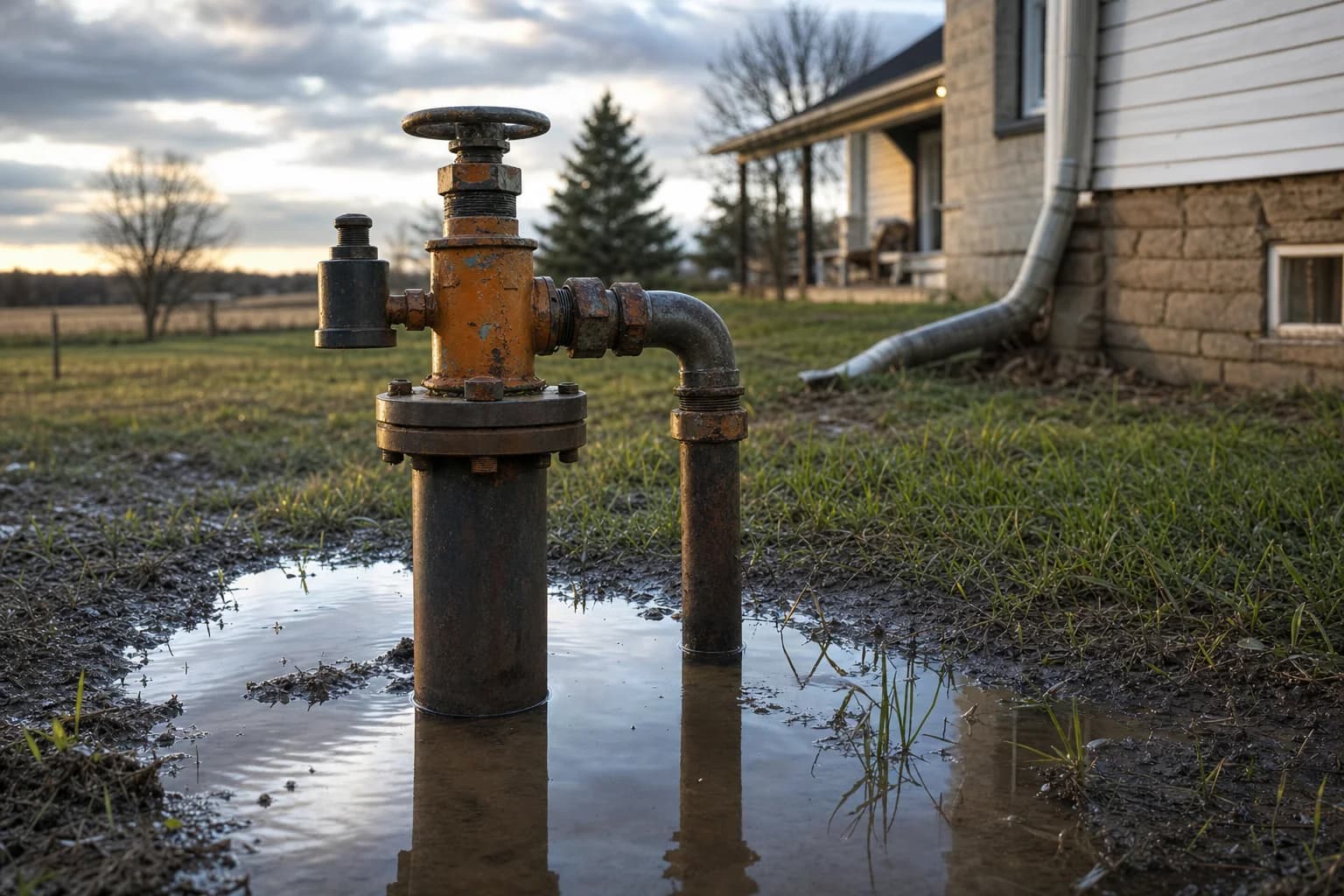
What Coliform Bacteria Are
Coliform is not one germ - it is a whole family of bacteria that labs use as a tripwire for whether your well's defenses have failed.
Water labs cannot affordably scan for every pathogen on earth, so they test for indicator organisms instead. Coliform bacteria are the classic indicator: they live in soil, on plants, and in the guts of warm-blooded animals, and they respond to a compromised well the same way dangerous viruses and parasites do. Water from a properly built, deep well should contain zero coliform. So when a test finds it, the bacteria themselves are usually harmless - but their presence proves that surface water or shallow groundwater has found a way in. That same pathway could just as easily carry sewage, pathogens, or pesticides.
43 million
Americans rely on private wells that no agency tests, treats, or monitors - the owner is solely responsible for water safety
Source: USGS
Because coliform and E. coli are colorless, odorless, and tasteless, you cannot see, smell, or taste a contamination problem. The CDC, EPA, and National Ground Water Association all recommend a bacteria test at least once a year, plus an immediate test after any flood, well repair, or change in how your water looks, smells, or tastes.
Total Coliform vs. Fecal Coliform vs. E. coli
These three terms sit inside each other like nested rings. Knowing which one your report flags tells you how serious the problem is.
Total coliform is the outer ring - the broad warning. Fecal coliform is a narrower subset that comes specifically from intestines and feces. E. coli is a single species inside the fecal group and the strongest possible sign that raw waste is in your water. Your lab report will name exactly which one it found.
Most strains of E. coli are harmless and live in healthy intestines, but its presence in a well is an alarm. Some strains - notably E. coli O157:H7 - produce toxins that cause severe gastrointestinal disease, kidney failure, and occasionally death, especially in young children, the elderly, and people with weakened immune systems.
How Bacteria Reach Your Well: Septic, Runoff, and Flood
Bacteria do not seep through hundreds of feet of clean rock. They bypass that natural filter through a direct conduit - and there are three usual suspects.
An aquifer is an excellent filter: as water trickles down through sand, silt, and clay, bacteria get stripped out. So when bacteria show up in a deep well, they almost always took a shortcut. The three dominant pathways are the septic pathway, surface runoff, and flooding.
- Failing or too-close septic systems. When a septic tank or leach field fails, or sits too near the wellhead, untreated effluent migrates into the groundwater the pump draws. This is the leading source of fecal contamination in private wells.
- Surface runoff at a bad wellhead. If the casing does not stand high enough above grade, or the well cap is not a vermin-proof sanitary seal, rain and snowmelt pooling around the well pours straight down the casing, carrying soil bacteria and animal waste with it.
- Flooding. Storms that overtop a wellhead push raw sewage, manure, and surface debris directly into the aquifer. After Hurricane Harvey, a study of more than 8,800 Texas private wells found total coliform spiking to 29.6% (1.5 times baseline) and E. coli to 11.0% (2.8 times baseline).
Notice the common thread: every pathway exploits a physical weakness at the wellhead or a contamination source placed too close. That is good news, because it means most bacteria problems are fixable - and preventable - by correcting well construction and setbacks, which we cover below.
Where Bacteria Problems Are Most Common
Geology drives risk. If you live over carbonate or karst bedrock, a positive bacteria test is not a fluke - it is the regional norm.
Nationwide, USGS data shows 20% to 25% of private wells contain at least one contaminant above EPA health benchmarks - and in agricultural areas that figure climbs to roughly 35%. But bacteria contamination is dictated heavily by the rock beneath you. The worst offenders are carbonate bedrock aquifers - limestone and dolomite - where water has dissolved the rock into "karst" networks of sinkholes, caves, and wide fractures. That plumbing lets surface water travel for miles with almost no filtration.
75%
of private wells tested in the carbonate bedrock of Pennsylvania were positive for total coliform - the highest-risk geology in the U.S.
Source: USGS
The takeaway: if you own a well in the Mid-Atlantic, the Midwest, or anywhere with prominent limestone geology, bacterial testing is a necessity, not a precaution. Local rules and well codes vary sharply too - our state-by-state well owner guides cover testing requirements and programs for all 50 states, and you can see real well depths near your address on our interactive well map.
Health Effects and the EPA Limit
There is no safe baseline. The EPA limit for coliform and E. coli is zero - a single colony is a failed test.
Zero
EPA Maximum Contaminant Level for total coliform and E. coli - any detection means the water is unsafe to drink untreated
Source: CDC
The EPA regulates municipal water under the Safe Drinking Water Act but has zero authority over private wells, so its Maximum Contaminant Levels are health benchmarks for you, not enforceable rules. For bacteria the benchmark is unambiguous: the MCL is zero, and the detection of even one colony-forming unit means the safety threshold has failed.
Drinking water contaminated with fecal pathogens causes acute gastrointestinal illness - diarrhea, cramping, nausea, vomiting, headaches, and fatigue. With dangerous strains like E. coli O157:H7, or co-occurring pathogens such as Giardia, Cryptosporidium, or Hepatitis A, symptoms can escalate to dysentery, jaundice, and lasting liver or kidney damage. Risk is not shared equally: a healthy adult may shrug off mild stomach upset, while an infant, a young child, an elderly person, or someone immunocompromised can face fatal illness from the exact same glass of water.
How to Test for Bacteria
A certified-lab bacteria test is cheap, often free, and the only result you should trust for a health decision.
Skip the hardware-store test strips for anything health-related - they are prone to user error and false results. Use a state-certified laboratory, which runs EPA-approved methods (Standard 9223B or the Colilert enzymatic test) under sterile conditions. Contact your county health department first; many subsidize testing or do it for free.
National 2025-2026 ranges from the cited research; local prices vary.
Reading Your Results
Bacteria results come back three ways - Present/Absent, MPN, or CFU. What matters is the combination of coliform and E. coli.
A basic test reports Present or Absent. More detailed reports give a Most Probable Number (MPN/100mL, a statistical estimate) or Colony Forming Units (CFU/100mL, a direct count). However it is reported, read the coliform and E. coli lines together:
If Your Test Comes Back High: What to Do Right Now
Take rapid steps to protect your household - and avoid the one mistake that can make the water far more dangerous.
The standard emergency advice is to boil - and for a purely bacterial problem, boiling does help. The CDC says a rolling boil for one full minute (three minutes above 6,500 feet) reliably kills bacteria, viruses, and parasites. But there is a critical exception.
Once the household is protected, the fix depends on whether this is a one-time event or a chronic problem - which is the next section. The first-line remedy is shock chlorination; if bacteria keep coming back, you need continuous treatment.
Treatment Options Compared: Shock Chlorination vs. UV
No single device handles every problem. The right fix depends on whether contamination is a one-time event or a recurring leak.
Shock chlorination is the DIY first response: a one-time, high-concentration chlorine dose (around 200 ppm) poured into the casing, circulated through the plumbing, left to sit 12-24 hours, then flushed out. It costs $20-$50 and is highly effective for a one-time contamination event - a flood, a recent pump repair, or a newly drilled well.
Want the full picture across every treatment technology? Our well water treatment guide compares RO, carbon, UV, aeration, and softeners for each contaminant so you can match a system to your test results.
For the full step-by-step procedure - well-volume math, exact bleach dosing, bypassing your filters, circulating, the 12-24 hour wait, and safe flushing (never into a septic system) - see our shock chlorination guide. Two safety rules worth repeating here: set carbon filters, RO units, and softeners to bypass first (chlorine destroys them), and never mix bleach with ammonia.
If the well has heavy sediment, mineral scale, or iron-bacteria slime, chlorine can't penetrate the buildup to reach the bacteria living inside it. In that case the well needs physical cleaning first - brushing, surging, or chemical rehabilitation - before disinfection can hold. Our guide to how to clean a well covers when and how that is done.
Costs are 2026 national ranges from the cited research. Reverse osmosis, softeners, and iron filters do not disinfect - they are paired with UV, not substitutes for it.
Preventing Bacteria: Well Construction and Setbacks
Almost every bacteria problem traces back to a physical defect or a contamination source placed too close. Both are preventable.
Long-term protection is mostly about the physical integrity of the well and keeping pollution sources at a safe distance. Local codes mandate minimum separation so the soil can do its filtering job:
Keeping up with these basics is the single best defense against repeat bacteria hits. Our well maintenance guide and well water upkeep guide cover the full annual routine.
Assistance Programs
Replacing a failed well or installing multi-stage treatment can top $10,000 - but federal and state programs help eligible owners.
USDA Rural Decentralized Water Systems Grant Program. This program funds long-term, low-interest loans - capped at 1% fixed interest over up to 20 years - of up to $15,000 per household to construct, refurbish, or service an individually owned household well. You must own and occupy the home in an eligible rural area (population 50,000 or less) and lack access to a public water supply.
State spill-compensation funds. Some states, such as New Jersey, maintain funds that help when a private well is contaminated by a documented, human-caused discharge of hazardous substances. Check your state health or environmental department - our state guides point to local programs.
Frequently asked questions
Keep reading
Sources & further reading
- Domestic (Private) Supply Wells — USGS (accessed June 2026)
- Coliform Bacteria and Bacterial Contamination of Ground Water in Pennsylvania — USGS (WRI 01-4206) (accessed June 2026)
- Water Quality of Private Wells in Clinton County, Pennsylvania (SIR 2020-5022) — USGS (accessed June 2026)
- Groundwater Quality in the GAMA Priority Basins (OFR 2024-1061) — USGS (accessed June 2026)
- Hurricane Harvey and Private Well Microbial Contamination — Environmental Science & Technology (ACS) (accessed June 2026)
- Private Well Water Quality in Four Maryland Counties — NIH / PMC (accessed June 2026)
- Coliform Bacteria and Indicator Organisms in Drinking Water — NIH / PMC (accessed June 2026)
- Coliform vs. E. coli in Well Water — New Hampshire Tap (NHTAP) (accessed June 2026)
- Guidelines for Testing Well Water — CDC (accessed June 2026)
- Guidelines for Treating Well Water — CDC (accessed June 2026)
- Boil Your Water (wellcare Information Sheet) — Water Systems Council (accessed June 2026)
- Sample Your Private Drinking Water Well — Nebraska Dept. of Environment & Energy (accessed June 2026)
- Public Environmental and Water Testing Prices — Wisconsin State Laboratory of Hygiene (accessed June 2026)
- Disinfecting Your Well Water: Shock Chlorination — University of Georgia Extension (accessed June 2026)
- Disinfecting Your Well Water with Shock Chlorination (442-663) — Virginia Cooperative Extension (accessed June 2026)
- Ultraviolet Disinfection for Private Well Water (white paper) — Ultraviolet.com (accessed June 2026)
- Your Water Supply: Well Construction and Protection — NC State Extension (accessed June 2026)
- Rural Decentralized Water Systems Grant Program — USDA Rural Development (accessed June 2026)