
What Iron and Manganese Are - and How They Get In
Iron (Fe) and manganese (Mn) are the most common aesthetic contaminants in U.S. private wells. They are almost always natural, dissolved out of bedrock by oxygen-poor groundwater.
Iron and manganese are abundant in the Earth's crust, and in most private wells they enter the water naturally rather than from pollution. The key driver is the aquifer's chemistry. In deep, organic-rich aquifers, decomposing material strips oxygen out of the water, creating an anoxic, slightly acidic environment. Under those conditions, solid iron and manganese minerals dissolve into the groundwater as ferrous (Fe2+) and manganous (Mn2+) ions - invisible until they reach the oxygen in your home.
Human activity can add to the load. Mining, industrial discharge, and landfill leachate mobilize these metals, and a USGS study found that in poorly buffered soils, acidic recharge from fertilizer can push manganese into shallow groundwater. But for the typical homeowner, the source is geology, not a spill - which is why prevalence tracks aquifer type more than land use.
That natural origin is also why iron and manganese are not federally regulated in private wells. For an estimated 43 million Americans on private wells, the EPA does not test, treat, or monitor the water - the homeowner does. The good news is that these two metals are among the most diagnosable and treatable problems a well can have, once you know what form you are dealing with.
Diagnose by Symptom: Stains, Slime, and the Three Forms
Before you buy a single filter, figure out two things: which metal you have (color of the stain) and which physical form it is in (how the water behaves). Treatment depends entirely on both.
Step one - read the stains. The color left on fixtures, laundry, and appliances is your first differential diagnosis:
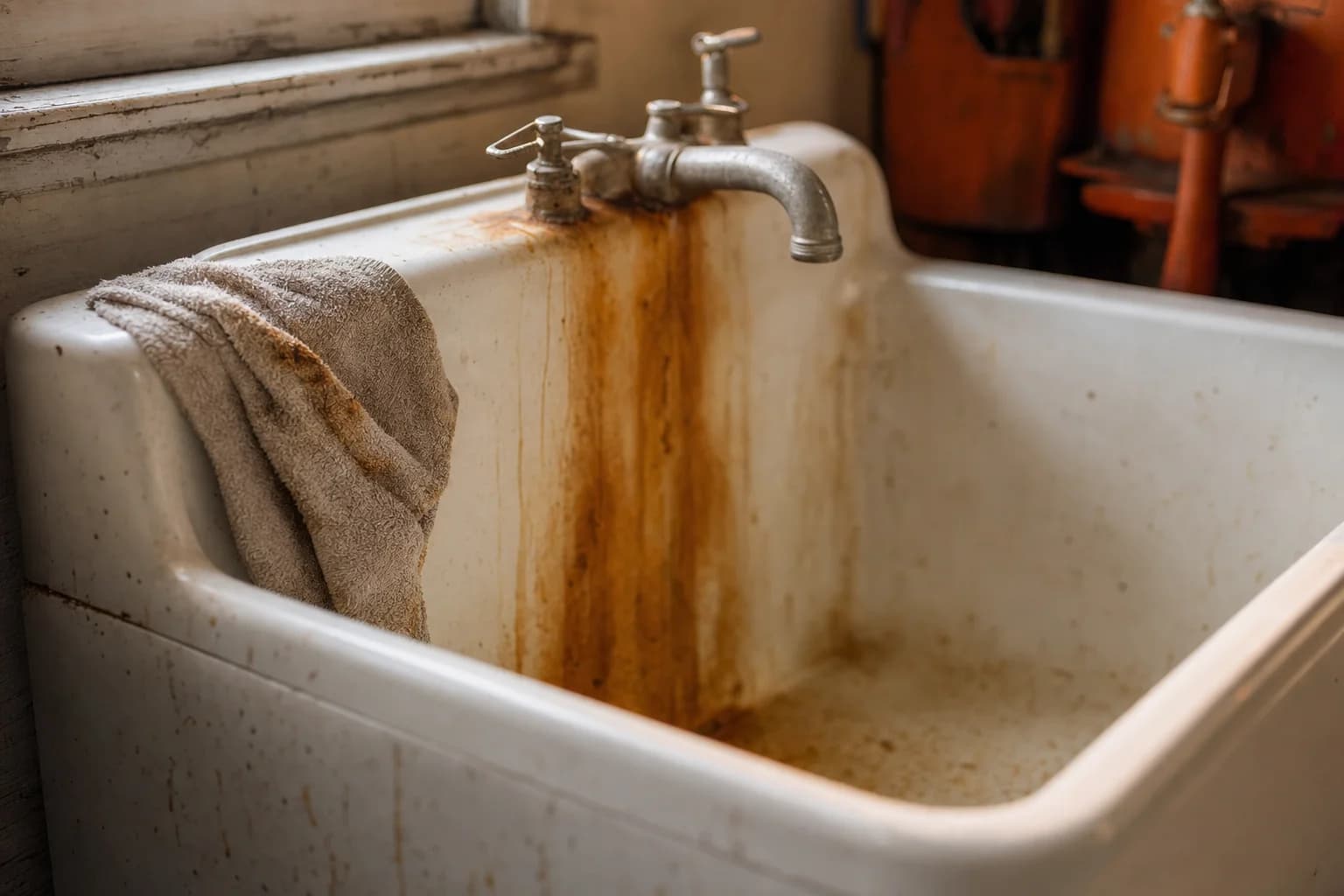
- Iron: a metallic taste and red, rust, orange, or reddish-brown staining.
- Manganese: a bitter or astringent taste and dark brown, dark gray, or black staining - classically inside the toilet tank and on dishwasher gaskets.
Because the two metals come from the same geology and travel together, most affected wells show both colors at once.
Step two - identify the form. Two wells with identical iron levels can need completely different equipment depending on whether the iron is dissolved, already particulate, or biological. This is the single most common reason a homeowner buys the wrong system.
- Dissolved (clear-water) iron/manganese: pours out perfectly clear, then turns orange or black as it oxidizes in air. Common in deep, oxygen-poor wells.
- Particulate (red-water) iron/manganese: already oxidized to solid ferric (Fe3+) and manganic particles, so it looks rusty, yellow, or black the instant it leaves the faucet. Common in shallow wells or where water sits in holding tanks.
- Iron and manganese bacteria: living organisms (such as Gallionella and Leptothrix) that eat dissolved metals and excrete a sticky biofilm. They clog pipes and screens that ordinary mineral filters cannot resolve.
Where Iron and Manganese Occur: Regional Prevalence
Iron and manganese are not spread evenly across the country. Their prevalence is dictated by regional aquifer geology, and a few zones dominate the map.
The USGS National Water-Quality Assessment program found that the Glacial Aquifer System - which underlies parts of 25 states across the northern U.S., from New England through the Midwest into the Pacific Northwest - has some of the highest occurrences of these metals anywhere. Within that system, the USGS estimates manganese is present at high concentrations relative to the secondary standard in roughly 50% of the study area, and iron in about 47%. Elevated manganese clusters along the Mississippi valley, the Great Lakes, and the eastern coast up to Maine.
Geology this localized is exactly the kind of thing your neighbors' wells can hint at. To see how deep wells run near you - a strong clue to whether your water is likely the oxygen-poor, dissolved-iron type - look up nearby wells and depths on the DrillerDB well map.
Health Effects and the EPA Limits That Matter
Toxicology has split these two metals apart: iron is treated as a nuisance, while manganese is now a recognized neurotoxic risk - especially to infants.
For public water systems, the EPA sets non-enforceable Secondary Maximum Contaminant Levels (SMCLs) for taste, odor, and staining. These do not apply to private wells, but they are the action thresholds everyone uses:
0.3 mg/L
EPA Secondary MCL for iron (the staining threshold). Manganese has a lower aesthetic SMCL of 0.05 mg/L - but its health advisory is also 0.3 mg/L
Source: EPA Secondary Standards
At those levels, iron is an aesthetic problem only- bad taste, stains, and clogged plumbing, but not a recognized health risk. Manganese is different. It is an essential nutrient in tiny amounts from food, but excessive ingestion through water is linked to neurological harm. The EPA's Drinking Water Health Advisory sets 0.3 mg/L as the lifetime-exposure threshold for adults - but infants are uniquely vulnerable.
Infants absorb more manganese and excrete less than adults because their brains and bodies are developing fast. Formula already supplies an infant's full manganese requirement, so mixing formula with manganese-laden well water becomes an overdose. Research links early-childhood manganese exposure to lower IQ, learning difficulties, and ADHD-like behavior.
How to Test: DIY Strips vs. Certified Lab
Stains tell you a problem exists; a lab tells you the exact quantities you need to size treatment - and whether the manganese is in infant-danger territory.
DIY colorimetric kits ($15-$50) give instant readings for basic parameters like pH, hardness, and rough iron. They are convenient for a quick check, but they usually cannot distinguish dissolved from particulate metal and cannot measure manganese to the precision the infant health advisory demands. For anything health-related - and for sizing equipment correctly - use a state-certified laboratory with EPA-approved methods and the sterile sample bottles it provides.
National ranges from state health-department fee schedules and industry surveys; your county may subsidize the basic panel.
Reading Your Results
Labs report iron and manganese in mg/L (the same as parts per million in fresh water). Three numbers decide what you do next: iron, manganese, and pH.
The pH line is the one most homeowners overlook and the reason expensive filters fail. If your pH is below 7.0, an oxidizing iron filter will trap the iron but let the manganese slip straight through - which is why some homes still see black stains after installing a costly system. In that case you need an acid-neutralizing (calcite) filter ahead of the iron filter to raise the pH first.
If Your Test Comes Back High
If manganese exceeds 0.3 mg/L, take action today for vulnerable household members. The most important instruction is also the most counterintuitive.
If your manganese result is above 0.3 mg/L, follow this protocol while you arrange treatment:
- Stop consumption for vulnerable groups. Immediately stop giving the tap water to infants under 6 months, and do not use it to mix formula or infant food.
- Switch to a safe alternate source. Use bottled or other safe water for drinking and cooking for sensitive people - infants, the elderly, and anyone with liver disease.
- Normal household uses are still fine. Bathing, showering, washing hands and dishes, and brushing teeth remain safe, because manganese is poorly absorbed through the skin.
The same caution applies the moment a pregnancy or new infant enters a home on an untested well: test for manganese (and nitrate) first. Coliform bacteria can ride in alongside iron bacteria, so if your test flags microbes too, see our coliform bacteria guide for the disinfection steps.
Treatment Options Compared
The right system depends on the concentration of the metals, the presence of bacteria, and your water's pH and hardness. Match the form to the fix - there is no single best answer.
A quick decision tree, then the cost comparison:
- Low iron (< 3 ppm), low manganese, hard water, no bacteria: a water softener (ion exchange) - see our water softener for well water guide for sizing with iron in the mix.
- Moderate to high iron, moderate manganese, no bacteria: an oxidizing filter (air-injection / Birm / greensand).
- Iron bacteria present: chlorination plus filtration - not a softener.
- Metals combined with rotten-egg odor or radon: an aeration system.
- Drinking-water protection only, on a budget: point-of-use reverse osmosis (RO) at the kitchen tap.
Two engineering traps are worth calling out. First, manganese fouls softener resin faster than iron - it bonds tightly and the brine cycle cannot wash it off, so it slowly "blinds" the resin and ruins the softener; oxidized iron will clog the bed outright. Second, the pH constraint: an air-injection filter will oxidize iron at pH 6.5 but leave manganese dissolved below pH 7.0, so without a calcite neutralizer ahead of it the black stains never go away. Installing whole-house treatment is licensed-pro work ($150-$500 in labor); DIY installs often void warranties and risk leaks. For drinking water, a point-of-use RO membrane and shock chlorination (with proper safety gear) are the tasks a careful homeowner can do.
Want the full picture across every treatment technology? Our well water treatment guide compares RO, carbon, UV, aeration, and softeners for each contaminant so you can match a system to your test results.
Prevention and Well-Construction Factors
Regional geology you cannot change - but iron bacteria are usually introduced by people, most often during drilling, pump installation, or servicing.
The NGWA and extension services stress that the most common entry point for iron bacteria is the well's construction or any later service. Their prevention protocols:
- Equipment hygiene: contractors should never lay pipes, pumps, or drilling tools directly on the ground, where they pick up soil-borne iron bacteria.
- Chlorinated drilling fluid: any surface water used as drilling fluid should be chlorinated to about 50 mg/L free chlorine - ordinary municipal tap water (capped near 4 mg/L) is not strong enough to prevent introduction.
- Shock chlorination: if iron bacteria take hold, periodic shock chlorination of the well and plumbing keeps the biofilm in check, though it rarely cures the problem permanently.
A common, costly mistake is oversizing: buying a 12 or 13-inch filter tank when the pump only delivers 6 GPM. The pump cannot lift and flush the heavy media during backwash, so the filter chokes on iron sludge. Sizing is a job for a contractor who has your pump's flow rate - a good reason to find a licensed well contractor before buying equipment.
Financial Assistance and Grant Programs
Remediation can run into the thousands. Federal and state programs exist to help rural well owners cover it.
USDA Rural Decentralized Water Systems Grant Program. The USDA funds qualified non-profits to run revolving loan funds for rural homeowners to construct, refurbish, or service their household wells. Terms are favorable: up to a $15,000 loan per household, a 1% fixed interest rate, and up to a 20-year term. You must own and occupy a home in an eligible rural area (population under 50,000), on tribal land, or in a Colonia, and you apply through a local participating non-profit rather than directly to the USDA.
State programs.Several states use EPA Clean Water Funds to help private well owners. Minnesota's Private Well Protection grants fund free testing for contaminants including manganese and nitrate plus direct mitigation help for eligible low-income households. New York's Clean Water Infrastructure Act funds free testing and mitigation rebates for private wells in designated areas of interest. Check your state guide for programs near you.
Frequently asked questions
Keep reading
- Well Water Testing: certified labs, sampling, and costs
- Rotten-Egg Odor: hydrogen sulfide and the bacteria behind it
- Coliform Bacteria: what a positive test means and how to fix it
- Well Water Upkeep: the year-round water-quality routine
- Well Maintenance: the mechanical side - pump, tank, and inspections
Sources & further reading
- Secondary Drinking Water Standards: Guidance for Nuisance Chemicals — U.S. EPA (accessed June 2026)
- Health Effects Support Document for Manganese (EPA Drinking Water Health Advisory) — U.S. EPA (accessed June 2026)
- Private Wells: Drinking Water from Household Wells — CDC (accessed June 2026)
- Manganese - Public Health Statement (ToxFAQs) — CDC / ATSDR (accessed June 2026)
- Manganese in Drinking Water — Minnesota Department of Health (accessed June 2026)
- Iron Bacteria in Well Water — Minnesota Department of Health (accessed June 2026)
- Iron Bacteria (technical fact sheet) — National Ground Water Association (NGWA) (accessed June 2026)
- Iron and Manganese in Groundwater (Water Science School) — USGS (accessed June 2026)
- Groundwater Quality in the North: The Glacial Aquifer System — USGS (accessed June 2026)
- Occurrence and Distribution of Iron, Manganese, and Selected Trace Elements in Ground Water in the Glacial Aquifer System (SIR 2009-5006) — USGS (accessed June 2026)
- Well Water in 80,000 New Hampshire Residences May Contain Metals Exceeding Human-Health Guidelines — USGS (accessed June 2026)
- Manganese in Drinking Water from Private Wells, Holliston, Massachusetts (PMC10727146) — National Library of Medicine (PMC) (accessed June 2026)
- Manganese Mobilized by Acidic Recharge in Poorly Buffered Soils (Environmental Science & Technology) — American Chemical Society (accessed June 2026)
- Disinfecting Your Well Water: Shock Chlorination (C 858-4) — University of Georgia Extension (accessed June 2026)
- Rural Decentralized Water Systems Grant Program — USDA Rural Development (accessed June 2026)