Water Softeners for Well Water: Sizing, the Iron Gotcha, and Real Costs
Groundwater spends years dissolving rock before it reaches your tap - which is why well water is so often hard water. Here is how softeners work, the iron problem that well owners specifically face, and how to size and price a system honestly.
10 min readUpdated July 2026
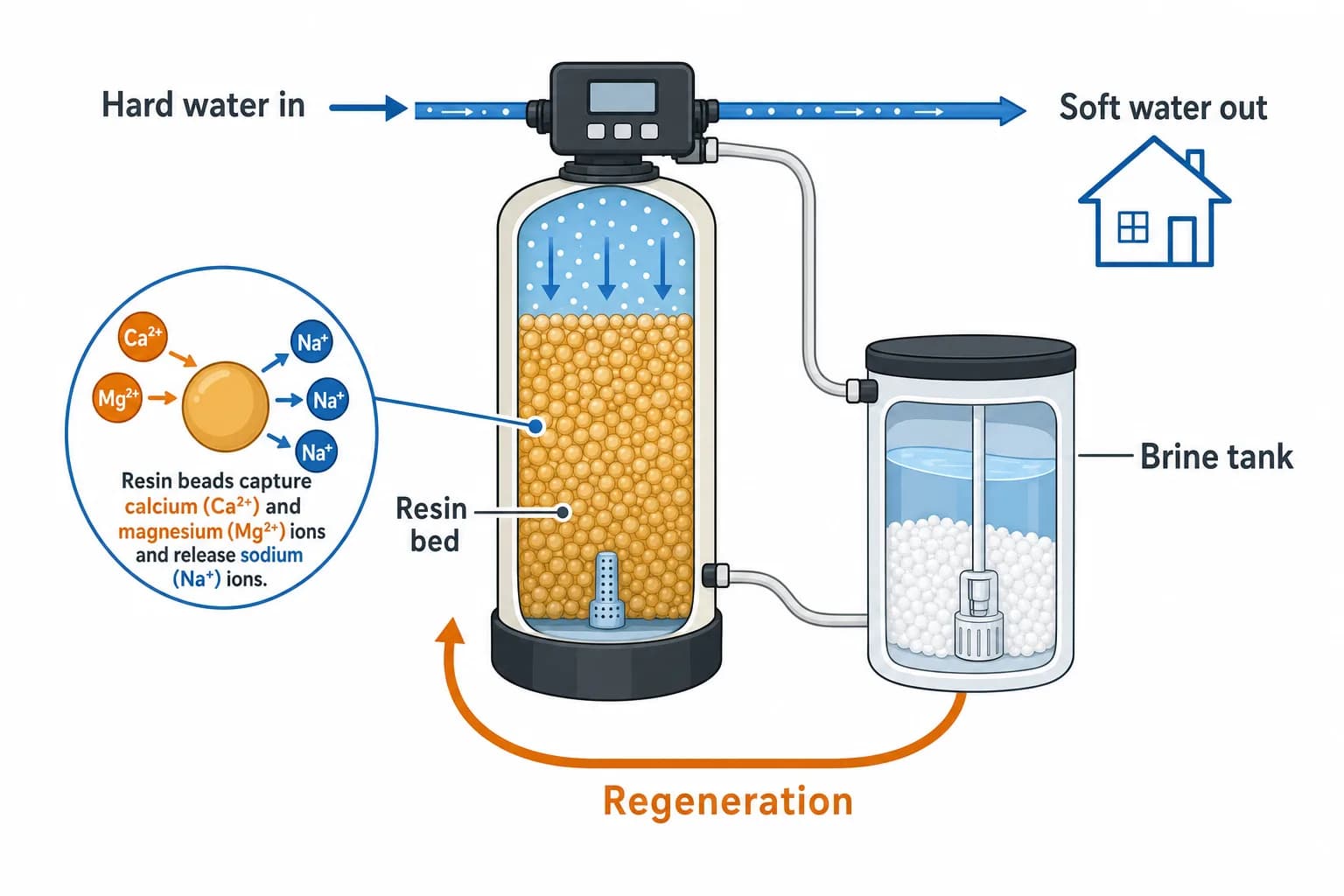
Ion exchange in one pass: hardness minerals stay on the resin, sodium rides out.
Why Well Water Runs Hard
Hardness is dissolved calcium and magnesium, and groundwater is the collector: every year underground is another year of dissolving limestone, dolomite, and gypsum.
Municipal systems often soften or blend their sources; your well delivers the aquifer as-is. The USGS classifies water by mg/L of calcium carbonate: 0-60 soft, 61-120 moderately hard, 121-180 hard, over 180 very hard - and in the limestone country of the Midwest and Southwest, wells routinely test far past the top of that scale. Divide mg/L by 17.1 for grains per gallon (gpg), the unit softeners are sold in.
Hardness is a nuisance mineral, not a health hazard - the EPA sets no limit on it. The damage is economic: scale narrowing pipes, coating heating elements, spotting dishes, and killing water heaters years early. That framing matters because it makes the softener a cost-benefit purchase, not an emergency one - which means you have time to test properly and size correctly.
How Ion Exchange Actually Works
A softener is a trading post: it swaps the minerals that scale your pipes for sodium, then flushes the take down the drain on regeneration night.
Inside the resin tank, millions of polystyrene beads carry sodium ions on their surfaces. Calcium and magnesium ions bind to the resin more strongly than sodium does, so as water flows through, the hardness sticks and sodium is released in exchange (about 8 mg of sodium per gpg removed, per Minnesota Dept. of Health). When the resin approaches capacity, the control valve runs a regeneration: brine from the salt tank washes through, the concentrated sodium reverses the trade, and the displaced hardness flushes to the drain. Then the cycle restarts.
Metered (demand) valves regenerate after a measured volume of water - the right choice for almost everyone, since they track actual use.
Timer valves regenerate on a schedule whether needed or not, wasting salt in light weeks and running hard water in heavy ones. Fine hardware a decade ago; skip it now.
Softened water and your septic system
A regenerating softener sends a salty backwash to the drain. Modern research and most state guidance find properly working septic systems tolerate it, but an old or marginal system is worth a conversation with your installer about routing the discharge - the same visit that checks your water test results can settle it.
The Iron Gotcha: The Well-Specific Problem
City water arrives iron-free. Well water often does not - and iron is the number one killer of softeners on private wells.
Softener resin will exchange small amounts of dissolved (clear-water) iron - practically speaking about 1 ppm, with some units rated for a bit more. But every regeneration leaves a little iron behind, and over months it fouls the resin, cutting capacity and eventually ruining the bed. Oxidized red-water iron (the water comes out already tinted, or leaves orange stains immediately) is worse: it is particulate, the resin cannot exchange it, and it simply plugs the system.
The decision rule well pros use:
Iron level vs equipment choice
Your water
Softener alone
Iron filter + softener
Under ~1 ppm dissolved iron, no staining
1-3+ ppm iron, orange staining
Red/orange water at the tap, iron bacteria
Rotten-egg smell alongside iron
The full chemistry - where the iron comes from, the EPA's 0.3 mg/L staining threshold, and the filter technologies - is in our iron in well water guide. If your symptoms include sulfur smell, read why well water smells like rotten eggs before buying anything - the fixes overlap.
Never buy treatment equipment before a full test
The classic well-owner mistake: buying a softener for what turns out to be an iron problem, or an iron filter for what turns out to be manganese. One comprehensive lab test before purchase - hardness, iron, manganese, pH, sulfur - is the cheapest component of the whole system.
Sizing: The Grain Math
Softeners are sold by grain capacity. The math is one line - and the marketing numbers need one adjustment.
People x 75 gal/day x hardness (gpg) = grains/day; size for ~7 days between regenerations
A family of 4 at 12 gpg: 4 x 75 x 12 = 3,600 grains/day, or about 25,000/week.
Compensate for iron: add roughly 3-5 gpg of effective hardness per 1 ppm of dissolved iron before running the math.
Discount the label:a "32,000 grain" softener only delivers its rated capacity at salt doses nobody should run. Sized at efficient salt settings, it yields roughly 24,000 usable grains - which is exactly what the example family needs. Bigger households or very hard water step up to 48,000 and 64,000 classes.
Also match the valve's service flow rate to your plumbing: an undersized valve throttles the whole house at shower hour, and on a well it interacts with the pump and pressure tanksettings. Your pump's GPM is on the well record - look it up free - and a competent installer will ask for it.
Softener vs Salt-Free 'Conditioner'
Salt-free conditioners are real technology that does a different job. The marketing blurs that line; the chemistry does not.
Ion-exchange softener vs salt-free conditioner (TAC)
Feature
Softener (ion exchange)
Conditioner (TAC/scale control)
Removes hardness from the water
Stops scale in pipes/heaters
Reduces adhesion of scale, results vary
Soap lathers / soft-water feel
Needs salt, drain, and regeneration
Adds sodium
Handles iron-bearing well water
With pre-treatment
Poorly - iron fouls the media
Template-anchored catalytic media (TAC) conditioners convert dissolved hardness into microscopic crystals that are less prone to sticking to pipes - useful scale mitigation where salt or a drain line is impractical. But the water still tests hard, still spots glass, and the media is sensitive to iron and chlorination - a rough combination on many wells. For most hard-water well households, the classic softener plus proper pre-treatment remains the answer that actually changes the water.
2026 Costs and the Maintenance Reality
A softener is a 10-20 year appliance with a monthly salt habit. Price all of it.
Water softener costs on a well system (2026 ranges)
Item
Typical Low
Typical High
Notes
Softener equipment (metered valve)
$500
$1,800
Capacity class and valve quality drive the spread.
Professional installation
$300
$1,200+
Existing loop and drain vs new plumbing runs.
Iron/sediment pre-treatment (if needed)
$600
$2,500+
The well-specific line item city homes skip.
Salt (ongoing)
$5
$10 per 40-lb bag
Typical family: a bag every 4-8 weeks.
Resin bed replacement (10-15 yrs, iron-shortened)
$200
$500
Cheaper than a whole new unit if the valve is healthy.
Ranges synthesized from 2024-2026 industry pricing. Well installs trend above city installs because of pre-treatment - budget toward the higher end of your quotes, and get 2-3 of them.
Softener maintenance (the whole list)
Monthly
Softeners are low-drama appliances if you do these few things.
Keep the brine tank at least a third full of salt
Check monthly; use the salt type your manual specifies.
Break up salt bridges
A hollow crust over the water fools the system into regenerating with weak brine - poke it with a broom handle.
Clean the brine tank every 1-2 years
Sludge from salt impurities settles at the bottom.
Use resin cleaner if you run any iron
A periodic iron-out treatment slows resin fouling.
Retest hardness at the tap yearly
Creeping hardness numbers are the early sign of a tired resin bed.
Frequently asked questions
The signs: white scale on fixtures and kettles, soap that will not lather, stiff laundry, spotted dishes, and water heaters that fail young. The proof is a test - hardness is measured in grains per gallon (gpg) or mg/L as calcium carbonate. On the USGS scale, water over 121 mg/L (about 7 gpg) is hard and over 180 mg/L (about 10.5 gpg) is very hard. Groundwater is the hard case: it has spent years dissolving calcium and magnesium out of rock.
By ion exchange: water passes through a tank of resin beads charged with sodium ions. Calcium and magnesium (the hardness minerals) stick to the resin and sodium is released in trade. When the resin fills up with hardness, the softener regenerates - flushing itself with brine from the salt tank to recharge the beads and sending the hardness down the drain.
Multiply people x 75 gallons per day x hardness in gpg to get grains per day, then size for roughly a week between regenerations. Example: 4 people x 75 gal x 12 gpg = 3,600 grains/day, so about 25,000 grains per week - a "32,000 grain" softener sized to regenerate at about 24,000 usable grains fits. On well water, add capacity for compensated hardness if you have iron: every 1 ppm of dissolved iron counts as roughly 3-5 gpg extra.
Only a little, and at a price. Softeners can exchange small amounts of dissolved (clear-water) iron - practically speaking about 1 ppm, with some units rated higher - but iron gradually fouls the resin, and red-water (already oxidized) iron just clogs it. If your water leaves orange stains or tests above about 1 ppm iron, put a dedicated iron filter ahead of the softener and let each unit do its own job.
The sodium added is proportional to how hard your water was - for most households it is a minor contribution compared to diet, but it is real (about 8 mg of sodium per gpg of hardness removed, per Minnesota Dept. of Health figures). People on sodium-restricted diets often plumb a separate unsoftened tap for drinking and cooking, use potassium chloride instead of salt, or add a reverse osmosis unit at the kitchen sink.
Equipment plus installation typically lands between $800 and $3,000+ - the spread is size, valve quality (metered vs timer), and local labor. Well systems trend toward the higher end because they more often need pre-treatment (sediment or iron filtration) plumbed in ahead of the softener. Salt is the ongoing cost: figure a 40-pound bag ($5-$10) every 4-8 weeks for a typical family.
Hardness is a nuisance, not a health risk - the EPA does not regulate it. The economics usually decide: very hard water shortens water heater life, clogs fixtures, and raises soap and energy bills, so at 10+ gpg a softener often pays for itself. At 3-7 gpg it is a comfort call. Test first, then decide - never size or buy off a guess.