
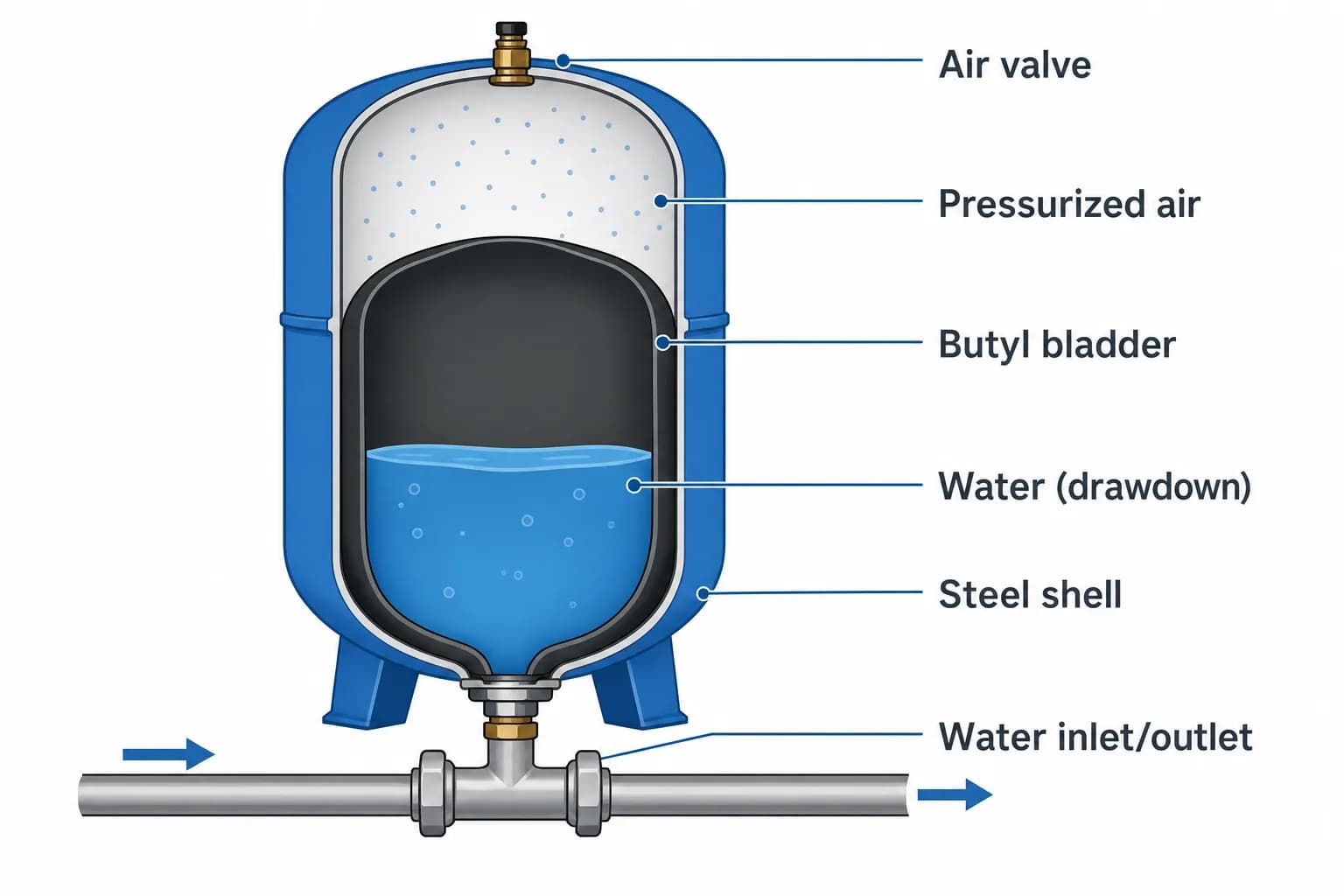
How a Well Pressure Tank Works
A well system needs a buffer between a pump that delivers water in bursts and a household that uses it in sips. The pressure tank is that buffer - a steel shell where compressed air does the pushing between pump cycles.
Inside the tank, water and a cushion of compressed air are separated (in modern tanks) by a flexible bladder or diaphragm. When the pump runs, it pushes water into the tank and squeezes the air cushion; when you open a faucet, that compressed air pushes stored water back out into the house. The pressure switch watches the system pressure and cycles the pump between two setpoints - commonly 30/50 or 40/60 PSI: the pump starts at the low number (cut-in) and stops at the high number (cut-out).
The whole point of this arrangement is to protect the pump from itself. Every motor start pulls several times the normal running current and dumps heat into the windings. Without a tank, the pump would snap on and off every time anyone rinsed a glass. With a properly sized, properly charged tank, the pump starts a handful of times a day, runs long enough to cool itself with moving water, and lasts years longer.
Bladder vs. Diaphragm vs. Air-Over-Water
Three designs do the same job with different failure modes. Almost every tank sold today is a captive-air (bladder or diaphragm) design; air-over-water tanks survive mostly on older systems.
In practice the bladder-vs-diaphragm distinction matters less than build quality and correct sizing. Both are "captive air" designs: the factory pre-charge is sealed in and only needs a yearly check. If you have an old galvanized air-over-water tank that needs bleeding or an air volume control to keep working, it is living on borrowed time - plan its replacement rather than babying it.
Sizing a Pressure Tank: Drawdown, Not the Label
The gallon number painted on the shell is total volume. What you actually get at the tap between pump cycles - the drawdown - is roughly a third of it.
Because the air cushion always occupies part of the shell, a tank's usable water is a fraction of its total volume. Sizing starts from your pump, not your house, and it rests on one rule: every start must buy enough runtime to cool the motor. A submersible motor pulls several times its running current at startup and sheds that heat into the water flowing past it - so industry sizing guidance (Water Well Journal, pump manufacturers) calls for at least 1 minute of runtime per cycle for motors under 2 HP and 2 minutes for 2 HP and larger; many pros size high-flow pumps (11-20 GPM) at 1.5x GPM to be safe.
Required drawdown (gal) = pump flow rate (GPM) x runtime target (1-2 min)
The second half of the math is how much of a tank is actually drawdown. That fraction - engineers call it the acceptance factor- falls straight out of Boyle's law and depends on your switch setting (computed with 14.7 PSI atmosphere; manufacturers like Amtrol and Flexcon publish per-model versions of the same table):
- 20/40 switch: about 37% of total volume is usable water
- 30/50 switch: about 31%
- 40/60 switch: about 27%
- 50/70 switch: about 24%
Worked example: a 10 GPM pump under 2 HP needs 10 gallons of drawdown. On a 40/60 switch that is 10 / 0.27 = roughly 37 gallons of total volume - so you buy the next standard size up, a 44-gallon tank. (Notice higher pressure settings shrink your usable water: the same tank that yields 31% at 30/50 yields 27% at 40/60. If you turn your pressure up, your effective tank got smaller.)
Total-volume ranges assume the 27-31% acceptance factors above - check the manufacturer's drawdown chart for your exact model and switch setting. When between sizes, go bigger: the only downside is floor space, fewer starts per day means a cooler motor, and cost per gallon drops as tanks get larger.
Want the exact math for your setup? The well water pressure guide includes an interactive drawdown calculator, and your pump's GPM is usually on the original well record - look yours up free if you do not have the paperwork.
The Air Charge: Cut-In Minus 2 PSI
One number keeps the whole system healthy: the air pre-charge must sit 2 PSI below the pressure switch cut-in. Wrong in either direction, and the tank quietly stops doing its job.
The 2 PSI gap is engineered, not folklore. Set the pre-charge too low and the air cushion lacks the force to push all the stored water out - drawdown shrinks and the pump cycles more, exactly as if the tank were smaller. Set it at or above cut-in and something worse happens: the bladder empties completely and bottoms out before the switch closes, so every draw ends with a momentary dead spot - pressure crashes toward zero, then the pump slams on and spikes it back. That flow stutter at the tap is the classic sign of an over-charged tank. The correct settings:
- 30/50 switch: pre-charge to 28 PSI
- 40/60 switch: pre-charge to 38 PSI
Two conditions manufacturers attach to that reading: check it at ambient temperature(a pre-charge read in a 120 degree F summer pump house reads artificially high - the air inside has thermally expanded), and remember the math assumes sea-level atmosphere. At high altitude the thinner air shifts the numbers a little - around 5,000 feet, atmospheric pressure is roughly 2.5 PSI lower - which is one more reason mountain-state installers lean on the manufacturer's altitude-corrected charts rather than the generic table.
Short Cycling: The Tank Failure That Kills Pumps
Rapid click-click-click from the pressure switch, pump snapping on and off every few seconds - short cycling is almost always a waterlogged tank, and it is the single most destructive thing that can happen to a well pump.
When the bladder ruptures, the air cushion dissolves into the water and the tank fills solid. Water does not compress, so the moment a faucet opens, pressure crashes to cut-in (pump on); the moment it closes, pressure spikes to cut-out (pump off). The pump can start hundreds of times a day. Each start pulls several times normal running current, and that repeated heat degrades the motor windings - a pump rated for 15 years can die in weeks of severe short cycling.
The pump is not the only casualty. A healthy air cushion is also the plumbing's shock absorber: when a valve snaps shut, the moving water column has to put its energy somewhere, and an abrupt stop can spike line pressure by hundreds of PSI for a fraction of a second (the physics behind banging pipes, or water hammer). A waterlogged tank is a rigid vessel - it absorbs nothing - so the shockwave hammers fittings, check valves, and pipe joints instead. Banging pipes appearing alongside rapid cycling is the same failure announcing itself twice.
Confirm the diagnosis with the three checks from the FAQ - air valve, tap test, gauge watch - then act quickly:
Short cycling has a few rarer causes - a failed check valve, a clogged switch sensor port, a big supply-line leak. The full symptom decision tree lives in our well pump troubleshooting guide.
Lifespan and 2026 Replacement Costs
A tank is one of the cheapest major components in the system - and delaying its replacement is the most expensive mistake a well owner can make.
Quality captive-air tanks typically last 10 to 15 years; bargain units can fail at 5. Iron-heavy or sediment-heavy water shortens bladder life, and chronic pre-charge neglect shortens everything. When it is time:
Ranges synthesized from 2024-2026 industry cost data (HomeAdvisor, Angi, HomeGuide) and consistent with our well pump cost guides. Budget toward the higher end of your local quotes rather than the lowest - and always get 2-3 of them.
Two rules of thumb worth carrying into the quote: quality steel tanks run very roughly $10-$15 per gallon of total volume at the hardware level, which is why upsizing during a replacement is cheap insurance for the pump. And since the system is already drained and depressurized for the swap, having the pressure switch (a $25-$75 part) and tank tee replaced at the same time adds almost nothing in labor - versus a separate service call later that starts at $100+ before any work begins.
A quote that includes draining the system, hauling the old tank, new fittings and a pressure relief valve, and setting the pre-charge correctly is worth a premium over a bare-minimum swap. If your pump is also near end of life, pricing the two jobs together usually beats two separate service calls - see the well pump replacement cost guide for that math.
Pressure Tank vs. Constant-Pressure System
Constant-pressure (VFD) systems vary the pump speed to hold one steady PSI, shrinking the tank to a fraction of its traditional size. They are a genuine upgrade - at a genuine price.
The honest tradeoffs: a VFD's soft start eliminates the inrush-current stress that wears conventional motors, and on a low-yield wellit can be programmed to cap the pump's speed so it never out-pumps the aquifer - a real advantage no tank can offer. Against that, the drive electronics are the most surge-sensitive component in the system (a hard sell on rural power without good surge protection), replacement controllers alone can run over $1,500, and the tiny buffer tank means that under constant small draws - drip irrigation, a running toilet - a VFD system can actually cycle more than a big conventional tank. There is also a purely mechanical middle option, a cycle stop valve, which throttles a standard pump to match demand; it holds steady pressure without electronics, at the cost of some pumping efficiency.
For most households a correctly sized, correctly charged conventional tank is the better-value choice. Go constant-pressure when steady PSI genuinely matters to you - and know that you are buying electronics that will someday need an electronics-literate tech. Our well pumps guide compares the pump side of that decision in detail.
Frequently asked questions
Keep reading
Sources & further reading
- Private Drinking Water Wells — U.S. EPA (accessed July 2026)
- Well-X-Trol Pressure Tanks (pre-charge and drawdown engineering) — Amtrol (accessed July 2026)
- Wellowner.org - Well System Components and Pressure Tanks — Water Systems Council (accessed July 2026)
- How Much Does Well Pump Repair Cost? (component cost ranges) — HomeAdvisor (accessed July 2026)
- Tank Selection by the Numbers (runtime rules and acceptance factors) — Water Well Journal (accessed July 2026)
- Well Tanks (per-model drawdown charts) — Flexcon Industries (accessed July 2026)