
Which Pump Do I Have? (A 30-Second Check)
Before you can troubleshoot low pressure or budget a replacement, you have to know what is already in the ground. A quick look at your wellhead and utility room tells you almost everything.
Roughly 43 million Americans - nearly 15% of the population - rely on a private well as their primary drinking water source. Unlike a city connection where the utility manages pressure and supply, a private well makes you the operator of your own water system, and that starts with knowing your hardware. Pumps are classified by where they sit relative to the water table, and you can identify yours visually.
- You see a pump motor and housing in the basement, garage, or well house. That is a jet pump. Now count the pipes running from the pump toward the well: one pipe means a shallow-well jet pump; two pipes means a deep-well jet pump.
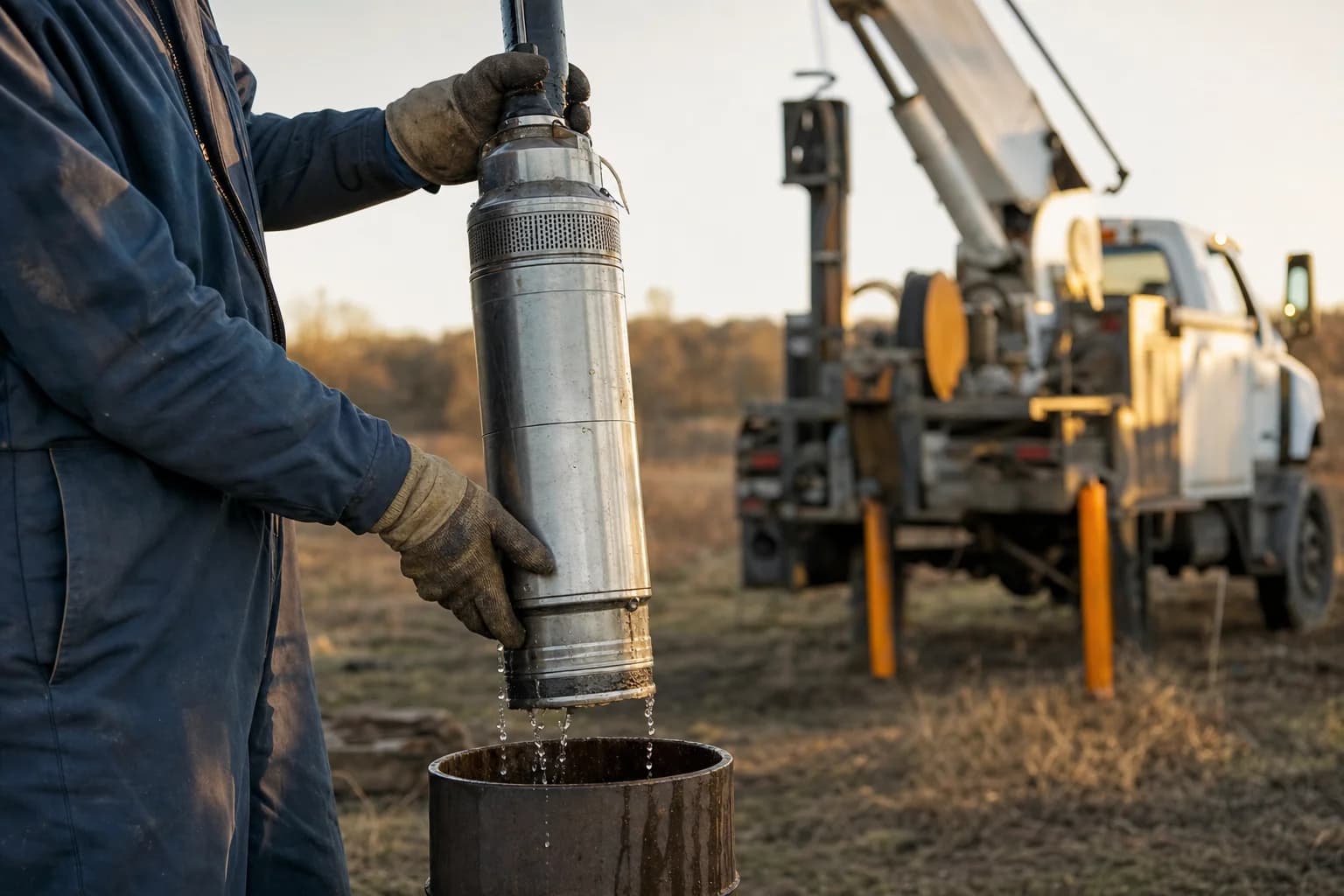
- The yard wellhead is just a sanitary cap with an electrical conduit, and your basement has a pressure tank but no visible pump motor. That is a submersible pump, sealed in a waterproof housing and suspended deep underwater inside the casing.
- A manual lever stands over the well. That is a hand pump, typically an off-grid or emergency backup.
Well Pump Types Compared
Six architectures cover almost every US home. This is the at-a-glance comparison of depth range, output, cost, lifespan, noise, and how hard each is to service - the table to read before anything else.
The US residential market is dominated by submersible pumps, jet pumps (shallow and deep), and specialized hand and solar units, with constant-pressure (VFD) systems layered on top of a submersible. Each operates on distinct mechanical principles tuned to a depth range. The installed-cost ranges below aggregate 2025-2026 contractor and hardware data; regional labor, inflation, and supply swings move the real number, so treat these as planning figures, not quotes.
The pattern is clear: submersibles carry a steeper upfront cost and harder servicing, but beat jet pumps on efficiency, noise, and depth. That is why homeowners with a failing jet pump on a moderately deep well so often upgrade to a submersible during a replacement cycle rather than replace like-for-like.
How Each Pump Type Works
Push versus pull is the whole story. Understanding the mechanism explains every cost, depth limit, and quirk in the table above.
Submersible pumps - the modern standard
A submersible pump is a hermetically sealed electric motor coupled to a pump body, lowered directly into the casing and fully submerged below the water level. Instead of sucking water up, it uses a stack of impellers (called stages) to forcefully push water up the drop pipe. Pushing takes far less energy than pulling against atmospheric pressure, so submersibles are dramatically more efficient than surface pumps. They are the engineering default for any well deeper than 25 feet and can lift from 400 to 1,000+ feet depending on horsepower. Being deep underground, they are effectively silent and cannot freeze - but if one fails, a licensed pro needs a pump hoist truck to pull hundreds of feet of water-filled pipe and wiring to reach it.
Jet pumps - shallow and deep
Jet pumps are surface-mounted units that use the venturi effect to draw water up. They force water through a narrowed nozzle, which speeds the flow and drops the pressure, creating a partial vacuum that pulls more groundwater into the stream - the same physics as putting your thumb over a garden hose. Because they rely on suction, they hit a hard physical wall: atmospheric pressure can only support a column of water about 25 feet tall. A shallow-well jet pump keeps the ejector in the surface pump body with a single suction pipe, so it cannot be used where the water level drops below 25 feet. A deep-well jet pump moves the ejector downhole using a two-pipe configuration (a drive pipe down, a suction pipe back up), extending reach to roughly 90-120 feet. Jet pumps are easy to service because the motor is above ground, but they are less efficient, must be primed with water before running, and are noticeably noisier than submersibles.
Hand pumps and solar pumps
For off-grid homes, remote sites, and emergency preparedness, hand and solar pumps replace grid-tied AC motors. A hand pump works a manual lever connected to a drive rod and downhole cylinder; shallow pitcher pumps are suction-limited to 25 feet, while deep-well hand pumps place the cylinder below the water and can lift from up to 200 feet - at very low flow (1-3 GPM) and real physical effort. Solar pumps run on DC power from photovoltaic panels; premium models like the Grundfos SQFlex accept both AC and DC and use efficient helical-rotor mechanisms to pull from depths up to 820 feet, though output varies with sunlight and setup costs are high. We cover both in depth in the hand pump guide and the solar well pump guide.
Constant-pressure (VFD) systems
A traditional system runs on a cut-in/cut-out cycle - the pump kicks on when tank pressure falls to 40 PSI and shuts off at 60 PSI - which produces the familiar swing in shower pressure. A constant-pressure system adds a Variable Frequency Drive that continuously varies the motor speed to match exactly how much water you are using: open one faucet and the pump idles slowly; open three plus a washing machine and it accelerates to hold steady pressure. VFD systems need only a small 2-to-4 gallon tank and feel indistinguishable from city water, but the electronics are surge-sensitive in lightning country.
Whatever the architecture, the pump never feeds your taps directly - it fills a pressure tank that buffers demand. If your complaint is weak or surging pressure rather than no water at all, start with the well water pressure guide, because the fix is often the tank or switch, not the pump.
What a Well Pump Costs Installed (2025-2026)
Depth is the master variable. The national average for a standard replacement is about $1,775-$1,900, but real jobs run from under $1,000 for a simple shallow repair to $4,000-$6,000+ for a deep, complex install.
The economics are dominated by how deep the water is. For a submersible, every 100 feet of depth adds roughly $500 to $1,000 to the bill, because deeper wells need larger, higher-horsepower motors to lift a taller column of water, and contractors almost always replace the full run of drop pipe and wiring at the same time (another $1-$3 per linear foot) to prevent a repeat failure. Labor scales the same way: a shallow jet swap may be one technician for two hours, while pulling a submersible from 400 feet needs a hoist truck and a crew, pushing labor past $1,500. Weekend and emergency calls routinely add a 25-50% premium.
National ranges aggregated from 2025-2026 contractor and hardware data; always get 2-3 local quotes. Standard residential replacements average about $1,775-$1,900, but deep submersible jobs (300+ ft) commonly reach $2,800-$5,500+.
Sizing Your Well Pump Correctly
"Bigger is always better" is the most expensive mistake in well pumping. An oversized pump destroys itself, the well, or both. Correct sizing balances flow demand (GPM) against the lift the pump must overcome (Total Dynamic Head).
Step 1: Household demand by fixture count
A pump must satisfy your peak demand - the busiest seven-minute window, like a morning when a shower, a toilet, and the kitchen sink all run at once. The most reliable residential method is the fixture count: NGWA guidance estimates 1 GPM per water-using fixture. Walk the house and tally every point of use. A typical three-bedroom, two-bath home looks like this:
Most 3-4 bedroom homes land in the 8-12 GPMrange. But there is an absolute limit on top of this: the pump's GPM must never exceed the well's natural recharge yield. If your home wants 15 GPM but the aquifer only yields 5 GPM, a 15 GPM pump will drain the casing, draw abrasive sediment, and burn out from running dry. In low-yield wells, you size the pump to the well's recovery rate and add an intermediate storage tank (for example 500 gallons) to bank water for peak periods.
Step 2: Total Dynamic Head (TDH) and horsepower
Knowing you need 12 GPM is half the job; the pump also has to lift that water out of the ground and into a pressurized tank. The total resistance it fights is Total Dynamic Head, the sum of:
- Static water level - depth from the surface to the resting water.
- Drawdown - how far the water drops while the pump runs.
- Elevation - lift from the wellhead to the pressure tank.
- Operating pressure - desired system PSI converted to feet of head (multiply PSI by 2.31; e.g. 50 PSI x 2.31 = 115.5 feet).
- Friction loss - resistance from water moving through pipe and fittings.
Contractors then read manufacturer pump-performance curves to find a unit that hits your GPM and TDH at high efficiency. Horsepower is the output of that math, not an input you pick first. As a rough guide for typical 10-12 GPM homes:
Brand Reputation Overview (Neutral)
The industry consolidates around a handful of engineering firms. Here is a neutral read on where each one fits - we sell no pumps and earn nothing from these names.
One useful fact frames the whole market: many pumps sold under other badges use Franklin Electric motors internally, so the motor inside often matters more than the brand on the label. Match the pump to your well conditions, not to marketing.
Franklin Electric sets the industry baseline with NEMA-compliant, interchangeable motors featuring sealed windings, stainless hex shafts, and built-in lightning arrestors - ideal for deep wells that demand reliability, less necessary for a temporary shallow install. Grundfos (SQ/SQE series) uses permanent-magnet motors with soft-start electronics and integrated dry-run protection, shining in constant-pressure and solar applications, though premium internals still suffer in extremely mineralized or abrasive water. Goulds Water Technology (Xylem) is famous for its sand-handling floating-impeller stacks - the pick for wells that produce heavy grit. Red Lion delivers reliable mid-tier 2-wire and 3-wire pumps at a budget price, well suited to shallow wells and cabins but not extreme deep-well lifts.
Installation Requirements and Safety
Installing a well pump is not standard plumbing. It crosses hydrogeology, heavy hoisting, and high-voltage electrical work - and most states regulate the downhole part.
There is a real line between what a competent DIYer can do and what legally and safely requires a licensed professional.
The invisible parts that matter
When a pro installs a submersible, several components go down the shaft that you will never see but that determine whether the system lasts:
Beyond installation, two more killers shorten pump life: sediment and sand act like liquid sandpaper on impellers (use sand-handling pumps in gritty wells), and lightning- a buried submersible is essentially a giant grounding rod, so premium motors include lightning arrestors. And never call a general plumber for downhole diagnosis: subsurface groundwater work needs a well and pump contractor's credentials.
Frequently asked questions
Keep reading
Sources & further reading
- Private Drinking Water Wells — U.S. EPA (accessed June 2026)
- Drinking Water: Private Wells (Health and Maintenance) — U.S. CDC (accessed June 2026)
- Domestic (Private) Supply Wells — U.S. Geological Survey (USGS) (accessed June 2026)
- Water Well Pumping Systems and Pump Selection — National Ground Water Association (NGWA) (accessed June 2026)
- Pump Sizing and Water System Guidance for Well Owners — Water Systems Council (accessed June 2026)
- Well Treatment and Maintenance Resources — Oregon State University (ASPIRE) (accessed June 2026)
- The Private Well Class (Pitless Adapters and Well Construction) — University of Illinois / privatewellclass.org (accessed June 2026)
- How Much Does a Well Pump Cost to Replace? — HomeGuide (accessed June 2026)
- Cost to Replace a Well Pump — Angi (accessed June 2026)
- Submersible Pump (Working Principle and Stages) — Wikipedia (accessed June 2026)
- Franklin Electric Residential Water Pumping Systems — Franklin Electric (accessed June 2026)
- Grundfos SQ / SQFlex Residential Submersible Pumps — Grundfos (accessed June 2026)
- Goulds Water Technology (Xylem) GS Series Submersibles — Goulds Water Technology / Xylem (accessed June 2026)
- Red Lion Jet and Submersible Well Pumps — Red Lion (Franklin Electric) (accessed June 2026)