
Why Put a Hand Pump on a Well?
Every powered pump shares a failure mode: no power, no water. A manual pump breaks that dependency for a few hundred to a few thousand dollars, once.
Three groups install them. Preparedness-minded homeowners add a hand pump beside the submersible as outage insurance - a multi-day grid failure with a full freezer and no water concentrates the mind. Off-grid and cabin owners use them as primary or seasonal water, sometimes paired with a solar pump that does the daily work while the handle covers cloudy weeks. Livestock and remote-site owners keep one on a pasture well where running power was never on the table.
The honest limitation up front: hand pumping is work, and output is 1-3 GPM at a sustainable pace. A hand pump is survival and basic-needs water, not business-as-usual water. That is exactly what a backup should be.
The 25-Foot Suction Limit (Physics, Not Marketing)
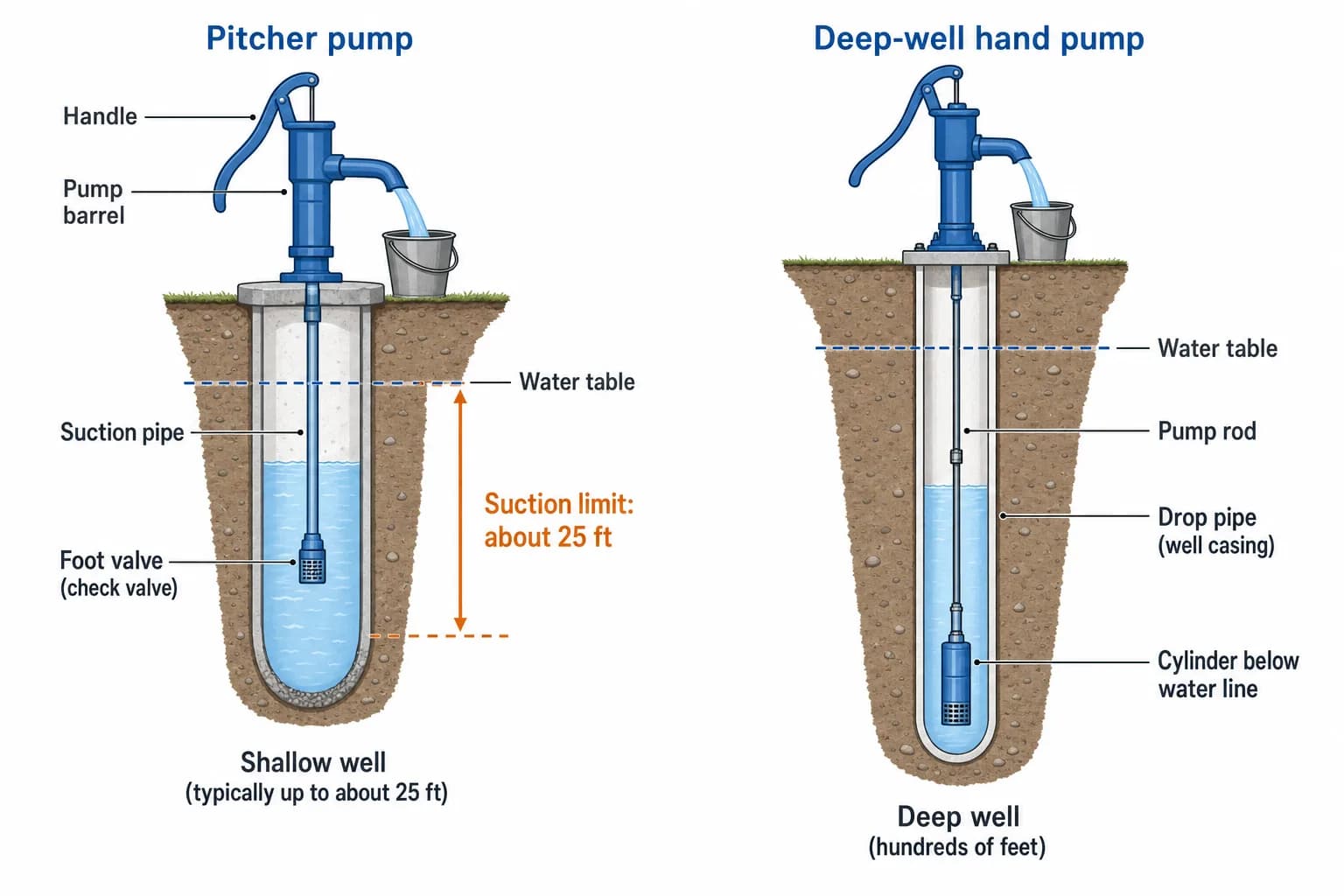
A suction pump does not pull water up - it removes air and lets atmospheric pressure push water up. At sea level, the atmosphere can only push a water column about 33 feet in theory, roughly 25 feet in practice.
This is the single most important fact when shopping: no suction-style pump, hand or electric, can lift water from deeper than about 25 feet - friction losses and imperfect vacuum eat the gap between the 33.9-foot theoretical ceiling and real-world performance, and every foot of elevation above sea level lowers it further. A $79 pitcher pump and a $500 suction pump obey the same atmosphere.
The number that matters is your static water level - how far down the water surface sits, not how deep the well is drilled. A 300-foot well whose water rises to 20 feet below grade is pitcher-pump territory; an 80-foot well with water at 60 feet is not. Your static level is on the original well record (look it up free), and neighboring wells on the well map give a good local estimate. Remember it can drop in drought and late summer - size for the deep case, the same leeway rule that applies to drilling budgets.
Shallow (Pitcher) vs Deep-Well Hand Pumps
Two families, two price classes, one decision input: your static water level.
Within deep-well pumps, the practical differences are rod and cylinder materials (stainless vs cast iron), whether the pump can also pressurize your house plumbing (some premium models can push into the pressure tank, not just pour from a spout), and rebuildability - good designs let you service the cylinder without pulling the whole rod string. If the well is also your daily driver, see the well pumps guide for how manual units compare with submersible, jet, and solar options.
Installing a Hand Pump Alongside Your Submersible
The standard residential setup is dual-pump: the electric submersible keeps doing the daily work, and the manual pump sits beside it in the same casing, waiting.
In a typical 6-inch residential casing there is room for the submersible's drop pipe and wiring plus a hand pump's cylinder and rod string. The well cap is replaced with a dual-pump sanitary cap that seals both penetrations and keeps the vermin-proof integrity of the original - the cap rules do not relax because a second pump moved in. In 4-inch casing it gets tight but is often still possible with slim-profile pumps; your contractor will confirm clearances before quoting.
Freeze-Proofing: The Weep Hole
A hand pump that holds water above the frost line is a cracked pump by February. Good installs drain themselves.
Deep-well hand pumps solve winter with a small weep holedrilled in the drop pipe below your local frost depth. After each pumping session, the water standing in the pipe above the hole slowly drains back down the well, leaving nothing in the freeze zone; the next session's first strokes re-lift the column. The trade is a few extra strokes per use for a pump that shrugs off any winter.
Pitcher pumps are the opposite: they hold their prime above ground and burst when it freezes. Seasonal properties should drain them completely in fall, and year-round shallow installs belong inside a frost-protected enclosure. Frost depth varies from inches in the South to 5+ feet in the northern plains - your state's requirements and typical depths are in our state well guides.
What a Hand Pump Costs in 2026
The pump is priced by depth: every additional section of rod and drop pipe adds cost, so your static water level writes the quote.
Manufacturer and installer pricing, 2024-2026. Depth drives everything - price the pump at your worst-case (drought) static level, not the spring one, and budget toward the higher end of quotes.
One buying tip: deal with the depth question honestly before falling in love with a price. A pump cylinder set at 60 feet because that is what the budget allowed, in a well whose late-summer level drops to 70, is a decoration. Size it like a driller would - with leeway.
Frequently asked questions
Keep reading
Sources & further reading
- Private Drinking Water Wells — U.S. EPA (accessed July 2026)
- Groundwater Wells (well construction and water levels) — USGS Water Science School (accessed July 2026)
- Deep Well Hand Pump - static water levels to 325 ft — Simple Pump (accessed July 2026)
- Wellowner.org - Well System Components — Water Systems Council (accessed July 2026)