The 2026 national average cost to drill a water well is $3,750-$15,300 - roughly $15-$30 per foot. Here is what that buys, how the cost to drill a water well changes with depth and geology, and the parts a quote often leaves out.
8 min readUpdated July 2026
The national average
For a complete, usable residential water well, most homeowners pay between $3,750 and $15,300, with a typical project around $5,500.
The "cost to drill a water well" is really two numbers. The borehole - the drilled, cased hole in the ground - runs about $15 to $30 per foot. A complete system you can actually draw water from adds a pump, a pressure tank, wiring, a well cap, and a water test on top of that. The figures on this page are national averages; geology, depth, and access in your area can move them substantially, so always get local quotes.
$3,750-$15,300
Typical 2026 cost for a complete residential drilled well (national average ~$5,500)
Source: HomeAdvisor / Angi, 2026
New to the whole project? Start with our complete guide to drilling a water well - process, timeline, depth, and DIY - then come back here to budget it.
Cost per foot
Drillers usually price by the foot. What is included in that per-foot rate is the thing to pin down.
Typical 2026 well-drilling cost per foot, by scope
Item
Typical Low
Typical High
Notes
Borehole only (drilling)
$15
$25
The drilled hole, before casing or equipment
Drilling + casing
$20
$35
Adds PVC or steel casing to line the hole
Complete system, per foot
$30
$55
Includes pump, pressure tank, and wiring
Hard rock / difficult access surcharge
+$10
+$30
Bedrock or a hard-to-reach site adds per foot
National averages. Hard-rock regions and remote sites run at the high end; get local quotes.
Cost by depth
Depth is the single biggest driver: more feet to drill, and a stronger pump set deeper in the hole.
Typical 2026 cost for a complete well, by depth
Item
Typical Low
Typical High
Notes
100 feet
$3,500
$8,000
Shallow water table
200 feet
$5,500
$12,000
Common residential depth
300 feet
$8,000
$16,000
Deeper aquifer / rural
400+ feet
$12,000
$23,000+
Deep or hard-rock wells
Complete systems (borehole + casing + pump + tank + wiring). Your local water-table depth determines how deep you must go - check your state's well-log records.
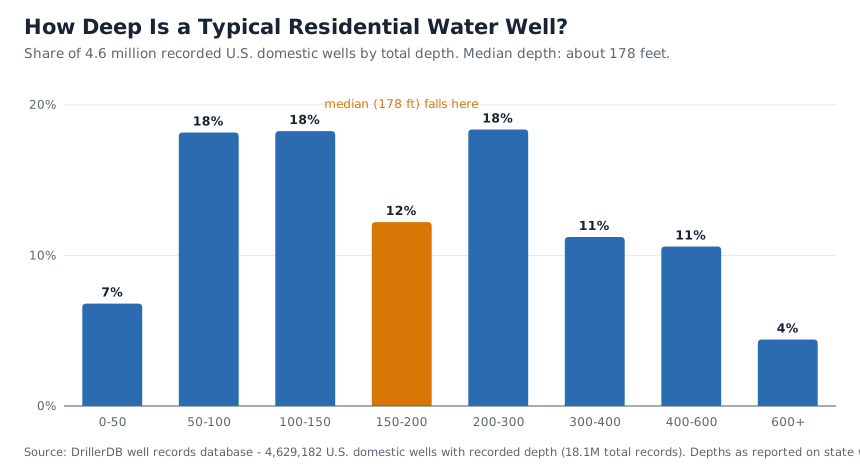
Our own data: the depth distribution of 4.6 million recorded U.S. domestic wells. Half of all residential wells run deeper than about 178 feet - so when you budget from the table above, plan for the deeper half of your local range, not the shallowest case.
A depth quote is an estimate, not a promise
No driller knows exactly how deep the water is until the drill finds it. Quotes are per-foot rates applied to an estimated depth from nearby well logs - if your well must go deeper to reach a reliable aquifer, the extra footage bills at the quoted rate. That is normal, not a bait-and-switch. Ask every contractor how overage footage is billed, and carry a 15-25% contingency above the estimate so a deeper well is a footnote, not a shock.
The most common pricing surprise: a quote that covers only the borehole.
A drilled, cased hole is not yet a working water supply. To get water to the house you also need a pump and pressure tank, electrical wiring to the pump, a sanitary well cap, and - before you drink it - a water test. When you compare quotes, confirm whether each one is hole-only or a complete, water-to-the-house system, or you will be comparing very different numbers.
Ask every contractor this
"Does this price include the pump, pressure tank, wiring, and well cap - or just the drilled and cased hole?" The answer can change a quote by several thousand dollars.
Itemized components
What the major line items typically cost in a complete well project.
Typical 2026 cost of a complete well, by component
Item
Typical Low
Typical High
Notes
Drilling the borehole
$1,500
$12,000
$15-$30/ft x depth
Well casing (PVC or steel)
$600
$2,500
Roughly $6-$10 per foot
Well pump + installation
$1,000
$5,000
Submersible or jet, by depth
Pressure tank
$300
$800
Smooths pressure to the house
Electrical / wiring
$250
$1,500
Power run to the pump
Sanitary well cap + fittings
$20
$200
Keeps contaminants out
Permits
$5
$500+
Varies widely by county
Water test before use
$50
$300
Confirm it is safe to drink
A new well should be tested before anyone drinks from it.
Three ways to put in a well, at very different price points and reliability.
How the three well types compare
Drilled
Dug / Bored
Driven (sand point)
Typical depth
100-500+ ft
10-30 ft
Under 50 ft
Typical cost
$3,750-$15,300
$1,500-$12,000
$200-$1,500
Best for
Most homes; deep, reliable water
Areas with a shallow water table
Shallow sandy soils only
Reliable in drought
Modern standard
Two special cases have their own guides: an artesian well (a drilled well that taps a naturally pressurized aquifer) and an irrigation well for lawns and crops, which is priced by yield rather than household demand.
What drives cost up
Depth. Every additional 100 feet adds drilling footage and usually a larger, deeper-set pump.
Geology. Drilling through bedrock costs far more per foot than soil or sand - hard rock can double the per-foot rate.
Site access. A drill rig needs room to set up; a tight, sloped, or remote lot raises mobilization costs.
Casing material and diameter. Steel costs more than PVC; larger-diameter wells cost more per foot.
Water-table depth. The deeper the reliable aquifer, the more you drill and the more pump you need.
Permits and local rules. County permit fees and required setbacks, grouting, or testing vary widely by state.
Cost to drill a water well by state
National averages hide a lot: the same well can cost half or double depending on your state's geology and typical depths.
Typical well depth, bedrock, water-table level, and permit fees all vary by state - which is why per-foot rates and total project costs do too. We publish a well drilling cost page for every state, each grounded in real recorded wells near you: typical local depths, what those depths mean in dollars, and licensed drillers to quote the job.
Financing & assistance
A new well is a big one-time cost; a few programs can help spread or offset it.
USDA Rural Development (Section 504) offers repair loans and, for eligible low-income elderly homeowners, grants that can cover water-supply work in rural areas.
State and county programs. Some health departments and conservation districts offer cost-share or low-interest loans for private well construction or replacement.
Home-improvement financing. Many drilling contractors partner with lenders, or you can use a home-equity line for a well that adds value and is required for the property to be habitable.
Before you sign
Get at least two or three itemized quotes, confirm each is for a complete system, and check that the contractor is licensed and pulls the required well permit. Find a licensed well contractor near you.
Frequently asked questions
The national average cost to drill a water well in 2026 runs $3,750 to $15,300 for a complete, usable residential system, with most homeowners landing near $5,500. The borehole alone is about $15 to $30 per foot; depth, geology (soil vs. rock), and the pump and casing you need are the biggest swings.
Expect roughly $15 to $30 per foot for drilling and casing in normal soil, rising to $30 to $65 per foot in hard rock or where access is difficult. The borehole by itself is usually $15-$25 per foot; adding casing, a pump, a pressure tank, and wiring brings the all-in figure to $30-$55 per foot.
As a complete system: a 100-foot well typically runs $3,500-$8,000, a 200-foot well $5,500-$12,000, and a 300-foot well $8,000-$16,000. Deeper wells cost more not just for the extra footage but because they need a more powerful pump set deeper in the hole.
A dug or bored well is cheaper up front ($1,500-$12,000) but only reaches shallow water (10-30 feet), so it is more vulnerable to drought and surface contamination. A drilled well costs more ($3,750-$15,300) but reaches deeper, cleaner, more reliable water and is the modern standard for most homes. Driven "sand point" wells are the cheapest ($200-$1,500) but only work in shallow sandy soil.
Often not - many "cost to drill" quotes cover only the borehole and casing. A well you can actually use also needs a pump and pressure tank ($1,300-$5,800 installed), electrical wiring, a well cap, and a water test. Always ask a contractor whether their quote is for the hole only or a complete, water-to-the-house system.
The big cost drivers are depth (more feet and a bigger pump), geology (drilling through bedrock costs far more than soil), site access (a rig needs room to work), casing material, how deep the water table sits, and local permit requirements. Remote or rocky regions routinely run at the high end of the per-foot range.
Most private water wells are between 100 and 500 feet deep, with around 150 feet being common for residential use. The right depth depends on how far down a reliable, clean water-bearing layer (aquifer) sits in your area - a local driller, or your state well-log records, can tell you what is typical nearby.
The drilling itself is usually 1 to 3 days for a typical residential well, though permitting, scheduling, and installing the pump and plumbing can stretch the full project to a few weeks. Hard rock or very deep wells take longer.
Because nobody knows exactly how deep the water is until the drill finds it. Most well quotes are per-foot estimates built on an assumed depth from nearby well logs - if your well has to go deeper than estimated to reach a reliable aquifer, the extra footage is billed at the quoted per-foot rate. That is normal and not a sign of a dishonest driller. Protect yourself by asking how overage footage is billed, and budget a 15-25% depth contingency above the estimate.