
What an Irrigation Well Is
Same drilling, different job description: volume over purity, and flow over pressure.
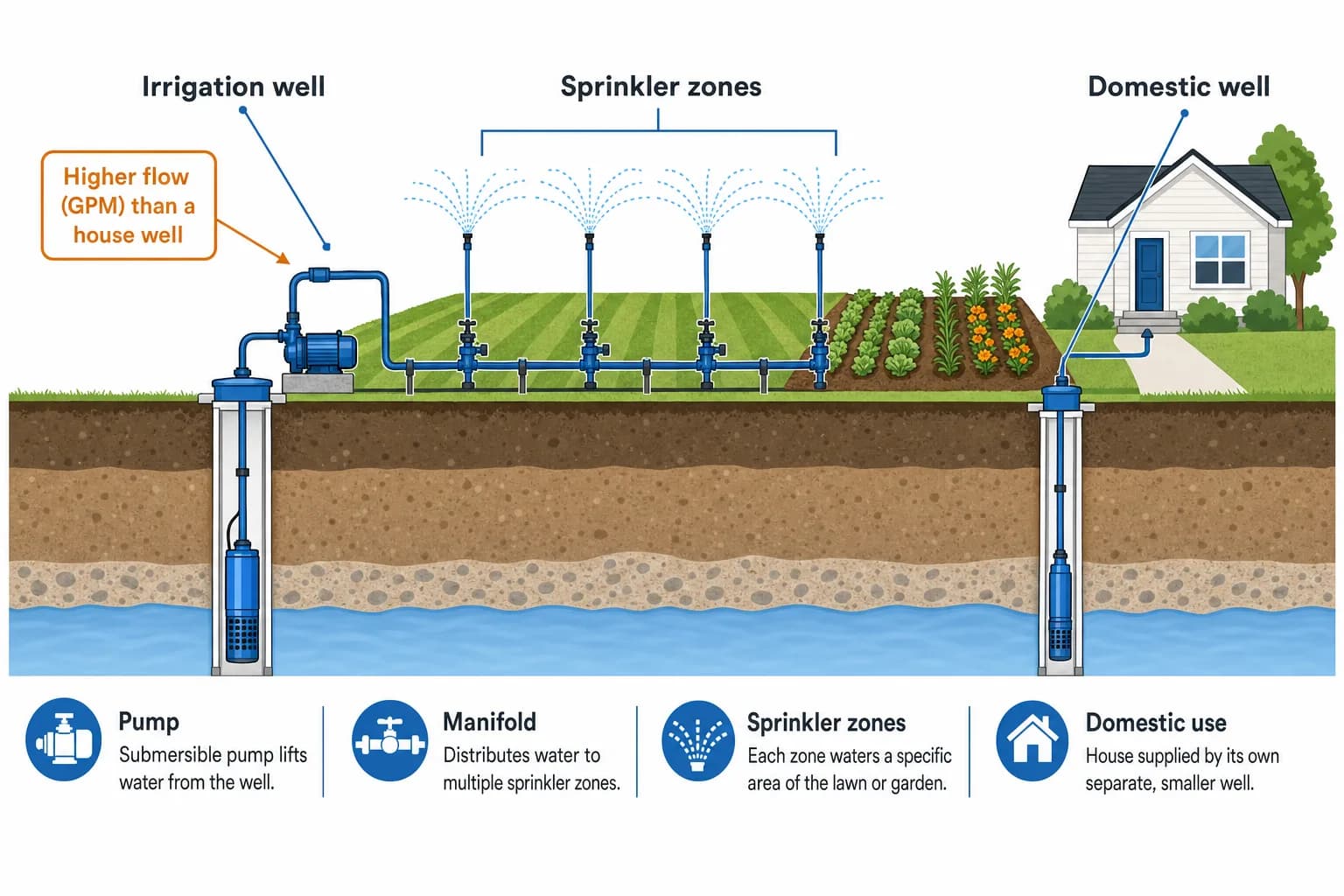
An irrigation well is a water well whose only job is landscape or crop watering. It is drilled with the same methods and by the same licensed contractors as a drinking-water well - what changes is the design brief. The water never enters the house, so it does not need to meet drinking-water standards; what it must do is deliver sustained flow, hour after hour, on summer's hottest weeks.
That flips the priorities. A domestic well is designed around modest, bursty household demand and sanitary protection. An irrigation well is designed around gallons per minute: the well targets whatever aquifer yields the most water, the pump is selected for volume, and treatment is usually skipped entirely.
Irrigation Well vs. Domestic Well
Households with city water often add an irrigation-only well and keep the two systems fully separate - utilities prohibit cross-connections between private wells and public mains, so the well feeds the sprinklers and nothing else. (Weighing full independence instead? See well water vs. city water.)
How Much Flow You Actually Need
Sprinkler design starts from available GPM. The well's tested yield - not the pump on it - is the hard ceiling.
- Residential sprinkler zones are commonly designed in the 8-15 GPM range. More lawn does not need more GPM - it needs more zones and longer run windows.
- Small farms and market gardens (up to about 5 acres) typically want 20-40 GPM, per University of Minnesota Extension guidance; sandy soils need roughly 6 GPM per acre for full-season irrigation.
- A typical house well pump delivers around 10 GPM - which is why bolting a serious sprinkler system onto the domestic well so often disappoints.
When the aquifer cannot keep up with the sprinklers in real time, the standard workaround is a storage tank: the well fills the tank slowly around the clock, and a booster pump feeds the zones at full flow from storage. It adds equipment but lets a modest well irrigate a serious landscape.
Permits and Water Rights
The well needs a permit almost everywhere. Whether the WATER needs one depends on how much you pump - and which state you are in.
Three layers of rules apply, from universal to regional:
- Well construction: essentially every state requires irrigation wells to be drilled by a licensed contractor to the same construction code as any well - permitted or registered, cased, grouted, and logged.
- Water-use thresholds:many states add a water-use or appropriation permit above a volume threshold. Minnesota's kicks in above 10,000 gallons per day; other states set their own lines. Lawn systems usually stay under these thresholds; farm irrigation frequently crosses them.
- Western water rights:in prior-appropriation states, groundwater is allocated by right, and the "exempt well" carve-out that covers household use is deliberately narrow for irrigation - Washington's exemption, for instance, caps non-commercial lawn and garden watering at one half acre. Irrigating beyond the exemption means acquiring a water right.
None of this should scare you off - contractors in your area file this paperwork weekly and will tell you in one phone call which rules apply to your acreage. The permits section of your state well guide is the place to start reading, and our question list for drillers includes the permit questions worth asking.
Water Quality Pitfalls (Yes, Even for Irrigation)
You are not drinking it - but your driveway, siding, and tomatoes have opinions.
- Iron staining: the classic irrigation-well regret. Groundwater iron that would be a taste nuisance indoors becomes bright orange staining wherever overspray hits concrete, fences, and siding. Test for iron before designing the system; if it is high, keep spray off hardscapes or treat it - see iron in well water.
- Hardness and minerals: heavy mineral water can spot windows and clog drip emitters and spray nozzles over time. An annual nozzle check is usually all the maintenance this demands.
- Bacteria on food crops: lawns do not care; lettuce does. If the well waters produce eaten raw, run the same coliform test a drinking well gets - see the well testing guide.
- Salinity (regional): in some coastal and arid basins, groundwater can be salty enough to stress turf and plants. Local drillers know if your area has this problem.
All three pitfalls share one fix: know your water before you design the system. An irrigation-oriented water test (iron, hardness, and coliform if food crops are involved - kits in our water test store) costs less than repainting one iron-stained fence.
What an Irrigation Well Costs - and When It Pays Off
Same per-foot economics as any well, often less depth - and the payback is measured against your summer water bills.
Irrigation wells are quoted like every well: a per-foot rate applied to an estimated depth, plus the pump system. Because the well can stop at the first adequate aquifer, many lawn irrigation wells are shallower - and therefore cheaper - than the drinking wells around them. Working against that: high-yield designs may need larger casing, and farm wells with big pumps carry bigger equipment budgets. University of Minnesota Extension pegs new small-farm irrigation wells (5-20 acres) at roughly $5,000-$30,000 all-in, with local quotes the only real answer.
Depth quotes are estimates from nearby logs - actual depth is confirmed by the drill. Budget a 15-25% contingency; overage footage billed at the quoted per-foot rate is normal practice.
The payback math is simple and personal: what does a summer of irrigation cost you at utility rates (check whether sewer charges ride on top), and what does the well quote total? Heavy irrigators in high-rate markets can recoup a lawn well surprisingly fast - and a well-watered lawn is typically exempt from municipal watering restrictions. For the full drilling-cost picture, see the cost to drill a water well and your state's well guide.
Frequently asked questions
Keep reading
- Cost to Drill a Water Well - per-foot rates and full budgeting.
- Well Pumps Guide - pump types and sizing for any well.
- Well Water vs City Water - the full independence question.
- Iron in Well Water - the staining problem, solved.
Sources & further reading
- Digging or Expanding a Well (irrigation flow rates, casing sizes, permits) — University of Minnesota Extension (accessed July 2026)
- Groundwater Permit Exemption — Washington State Department of Ecology (accessed July 2026)
- Learn About Private Water Wells — U.S. EPA (accessed July 2026)