
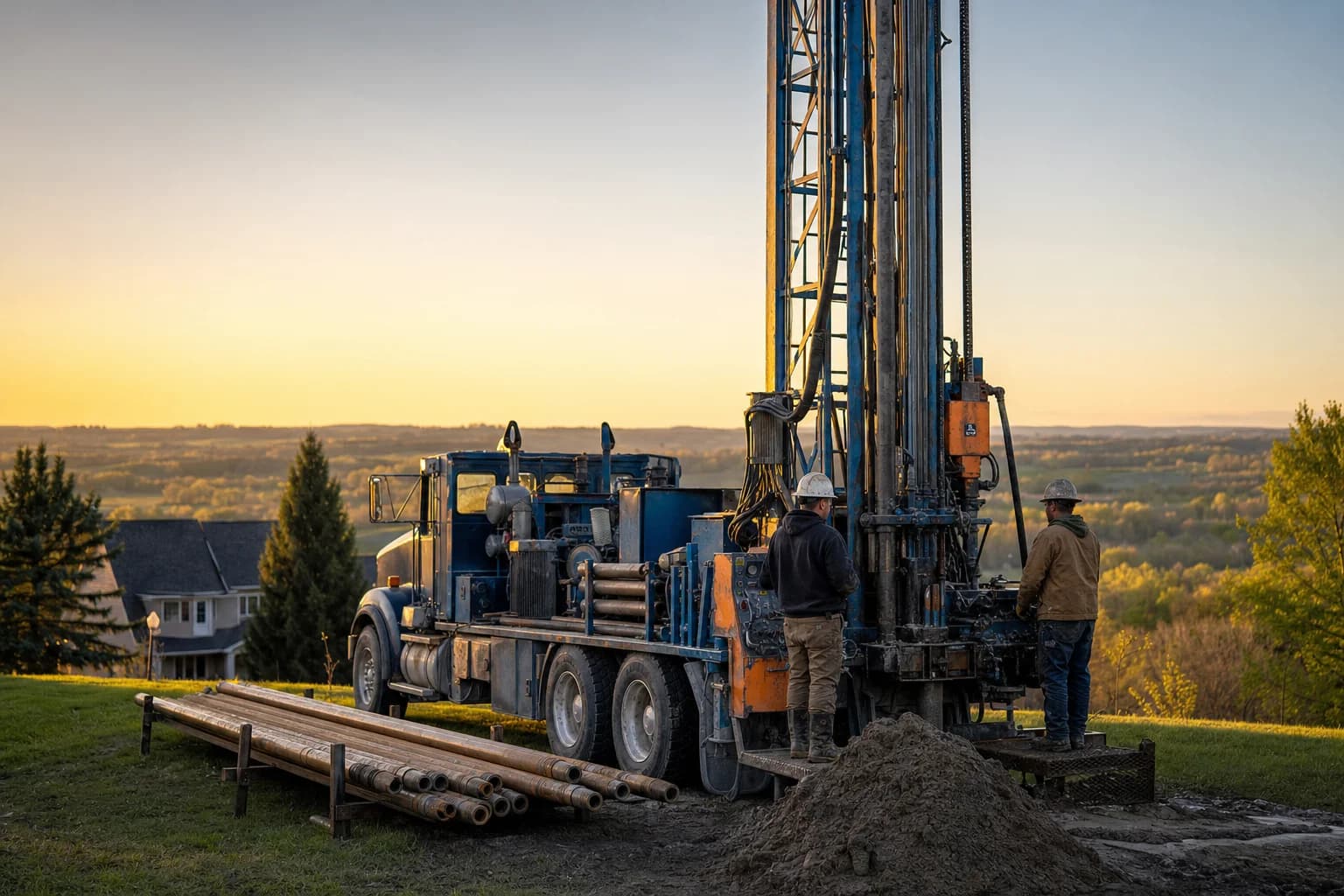
How Water Wells Are Drilled
More than 23 million US households - about 15 percent of the population - get their drinking water from a private well. Every one of those wells started with one of three mechanical ideas: spin, smash, or shake.
Humans have been engineering their way down to groundwater for roughly 8,000 years - from hand-dug pits, to the chisel-on-bamboo percussion rigs of ancient China, to the engine-driven rotary rigs of the 20th century. Every modern drilling method descends from one of three lineages:
- Rotary methods spin a bit on the end of a steel drill pipe while a circulating fluid - bentonite mud, compressed air, or water - cools the bit and carries the cuttings back to the surface. Air rotary, mud rotary, reverse circulation, and the DTH hammer all belong to this family.
- Percussion methods crush the formation by repeatedly lifting and dropping a heavy bit. Cable tool rigs still do this today, about once per second, with a bit that can weigh 1,200 pounds.
- Vibration methods are the newest branch: sonic rigs oscillate the drill string at 100 to 200 Hz, fluidizing a thin layer of soil so the casing slides into the ground with almost no friction.
Which family wins on your property is decided by lithology - the rock and soil sequence under your lot - not by preference or price. Fractured granite calls for compressed air and a hammer; 200 feet of coastal sand calls for drilling mud that holds the hole open. That is why the same 300-foot well can cost $4,000 in a Florida sand aquifer and $20,000 in New England bedrock. You can read more about how regional formations shape wells on our geology hub, and see what a finished well looks like inside in the drilled well guide.
Master Comparison: All 8 Drilling Methods
Every method, one table: ideal geology, working depth, daily speed, drilling-only cost, and the US regions where each one dominates.
Costs reflect 2026 averages for the drilling work alone. Turnkey systems - casing, pump, pressure tank, wiring, and permits - push effective per-foot pricing to the $65-$100+ range. Sources: SC Well Service, The Well Guide, WellDrillingCosts.com (see sources below).
Air Rotary: The Hard Rock Standard
A truck-mounted rig spins the bit while a massive diesel compressor - 600 to 1,000 CFM at 250 to 350 PSI - blasts air down the drill pipe, cooling the bit and blowing cuttings up the hole.
Air rotary is the method you will almost certainly see if your property sits on consolidated rock: it dominates New England, the Mountain West, eastern Washington basalt country, and the Southern California foothills. In good rock it makes 100 to 500 feet per day - up to 1,000 in ideal conditions - so most residential bedrock wells are drilled in a single day or two.
Its homeowner-facing superpower is instant feedback: with no mud masking the hole, the driller sees the moment a water-bearing fracture is struck and can estimate yield in gallons per minute on the spot. The trade-offs are noise, rock dust and foam around the site, and $45 to $85 per foot driven by compressor fuel and bit wear. In loose sand and collapsing ground it struggles badly - that is mud rotary territory.
Keep reading: the full air rotary drilling guide covers the rig layout, foam injection, casing strategy, and the questions to ask an air rotary contractor.
Mud Rotary: The Soft Formation Workhorse
Same spinning drill string, different lifeblood: a pump circulates bentonite drilling mud down the pipe and back up the hole, carrying cuttings to a settling pit and plastering the borehole walls so they cannot collapse.
Mud rotary is the undisputed champion of unconsolidated ground - loose sand, gravel, silt, and clay - which makes it the standard method in the alluvial valleys of the Midwest, the Gulf Coast, and Florida. The mud's hydrostatic pressure and bentonite "wall cake" hold the hole open until casing goes in, there is essentially no practical depth limit, and at $25 to $55 per foot it is usually the cheapest rotary option. Expect 50 to 100 feet per day and a messier site: the crew digs suction and settling pits next to the rig.
The catch is that the same wall cake that saves the hole also seals off the aquifer. The driller finds water with geophysical logs instead of eyesight, and the finished well needs aggressive development - surging and flushing to strip the bentonite away. Skipping that step can permanently cut yield by 30 to 60 percent, which is why development belongs in the contract, in writing.
Keep reading: the full mud rotary drilling guide walks through the mud circuit, the pits in your yard, and how to verify proper well development.
Cable Tool: Slow, Precise, and Still Working
The oldest method still in commercial use: a chisel bit weighing up to 1,200 pounds hangs from a cable and drops about once per second, pulverizing the formation while a bailer scoops out the slurry.
Cable tool (also called percussion or churn drilling) advances only 10 to 30 feet per day, so a deep well can take weeks instead of days. So why does it survive? Because it is unbeatable in two situations: boulder-laden or cavernous ground where rotary rigs lose circulation, and marginal aquifers where precision matters. With no pressurized mud or air masking the hole, the driller gets perfectly clean formation samples and knows to the inch when water appears - the best possible odds of capturing a weak water zone instead of drilling past it.
It is also the lightest-footprint method going: virtually no water, no mud, and less than 10 gallons of diesel a day, at a budget-friendly $30 to $55 per foot. Cable tool remains a working method in the Pacific Northwest - Washington drillers still use it in complex gravel aquifers and basalt - and on older East Coast properties with tight access.
Keep reading: the full cable tool drilling guide covers the derrick, the bailer cycle, drive casing, and when slow is actually the smart choice.
DTH Hammer: Air Rotary's Rock-Crushing Upgrade
When air rotary meets dense bedrock, the driller swaps in a down-the-hole (DTH) hammer: a pneumatic piston riding just above the bit that adds thousands of rapid hammer blows to the rotation.
The DTH hammer is technically part of the air rotary family, but it deserves its own entry because it is the tool that actually conquers granite. Compressed air drives the piston directly against the back of the bit, so the percussive energy is delivered at the rock face instead of dissipating down hundreds of feet of drill pipe. The combination - rapid striking plus rotation - pulverizes formations that would glaze or stall a conventional tricone bit. For exceptionally deep holes, drillers add high-pressure boosters pushing up to 500 PSI to keep the hammer cycling against the water column.
For the homeowner, the experience looks like air rotary: the same rig, compressor, dust, noise, and instant yield feedback, with typical residential depths of 150 to 400 feet and capability past 1,500. The white foam blowing out of the hole is water and surfactant injected to suppress dust - normal, not a problem.
Keep reading: the full down-the-hole drilling guide explains the hammer mechanism, air requirements, and how DTH pricing compares with conventional air rotary.
The Specialists: RC, Sonic, Bucket Auger, and Jetted Wells
Four more methods round out the toolbox. You will meet them less often on a residential job, but each one owns a niche the big three cannot touch.
Reverse circulation (RC)
RC flips the plumbing of a rotary rig: air or fluid travels down between the walls of a dual-wall drill pipe and blasts the cuttings up the center tube. The cuttings never touch the borehole wall, so samples come up perfectly clean, the hole stays stable without bentonite mud, and wells develop faster with higher yields. At 80 to 150 feet per day and large diameters to 1,000 feet, it is the go-to for municipal and irrigation wells in the Southwest, Florida, and Hawaii - but the rig footprint is enormous and pricing runs $80 to $150+ per foot, so it rarely visits a quarter-acre lot.
Sonic drilling
A sonic head vibrates the drill string at 100 to 200 Hz, fluidizing about 5 millimeters of surrounding soil so casing slides through ground that defeats everything else: heaving sand, glacial till, cobbles, and mixed boulders. It is fast (50 to 260 feet per day to about 700 feet), produces up to 80 percent less drilling waste, and returns a nearly continuous undisturbed core of everything it passes through. The price - $70 to $300 per foot - keeps it out of most residential budgets unless the geology is truly hostile (think boulder-filled till in Alaska or the northern Midwest); its day job is environmental and geotechnical drilling nationwide.
Bucket auger
Picture a giant post-hole digger: a rotating 24-to-48-inch bucket with cutting blades shaves the soil, fills up, and is hoisted out and dumped. It needs no drilling fluid at all, but it only works in cohesive clay and dense silt that stand open on their own, and torque limits cap it around 100 feet. Its niche is agricultural regions with thick clay layers, where huge-diameter boreholes double as underground water storage. Costs run $42 to $100 per foot depending on diameter; one large boulder can end the job.
Jetted, driven, and dug wells
At the shallow end, jetting (washboring) uses a high-pressure stream of water to wash a narrow hole 10 to 50 feet into loose sand at just $15 to $30 per foot. Driven wells hammer a screened "sand point" pipe 30 to 50 feet into soft earth, and dug wells - the 8,000-year-old original - reach 10 to 30 feet. A complete driven or dug well costs $1,500 to $4,000, the cheapest path to water there is. The trade-off is serious: all three tap the shallowest aquifer with minimal sanitary casing, carry the highest contamination risk from septic and fertilizer runoff, and go dry first in a drought. Our types of water wells guide compares drilled, driven, and dug construction in depth.
How the Method Changes Your Bill
The drilling method sets off a chain reaction through your project: per-foot rate, casing length, development time, and who carries the risk if no water shows up.
Depth is the great multiplier. A 100-foot well in sandy soil at mud rotary's $25 per foot is $2,500 of drilling labor; the same 100 feet of granite at $65 per foot of air rotary work is $6,500. A complete turnkey system - drilling, casing, pump, pressure tank, wiring, and permits - averages about $7,500 nationally and stretches from $3,000 past $30,000 at the extremes.
Casing is the hidden variable. A mud rotary well through 200 feet of sand needs casing the whole way down; an air rotary well in solid bedrock may need only 50 feet through the topsoil before running "open hole" in self-supporting rock - a difference worth thousands. PVC casing runs $6 to $18 per foot installed, steel $12 to $130. Development differs too: air rotary and cable tool leave the aquifer clean, while mud rotary wells need extensive flushing to strip the bentonite cake. See how the parts fit together in our well components guide.
Drilling labor only. Driven and dug wells price as complete projects ($1,500-$4,000) rather than per foot. National ranges; always get 2-3 local quotes.
And if the well hits water but yields poorly, two proven fixes exist - hydrofracking and cistern storage. Both are covered in the FAQ below.
Predict Your Method Before the Quote
You cannot pick the drilling method, but you can predict it - and check your contractor's homework - using the same public well logs the pros use.
Reputable drillers choose the method from neighboring well logs - the state-filed records of exactly what every nearby well hit, foot by foot. You can read those records yourself before anyone steps on your property: the DrillerDB well map puts real nearby well logs - depth, geology, and yield - on one map. Logs showing fractured rock mean an air rotary or DTH quote; deep unconsolidated sand means mud rotary. Note the casing materials and the depths where neighbors struck water, too - that is your baseline for a fair quote.
Frequently asked questions
Keep reading
- Air Rotary Drilling: the hard rock standard, in depth
- Mud Rotary Drilling: pits, mud, and well development
- Cable Tool Drilling: why the slowest method still wins
- Down-the-Hole (DTH) Drilling: the hammer that beats granite
- Types of Water Wells: drilled vs. driven vs. dug
- Drilled Wells: what actually gets built on your property
- Well Components: casing, screen, pump, and pressure tank
Sources & further reading
- Learn About Private Water Wells — U.S. EPA (accessed June 2026)
- Private Drinking Water Wells — U.S. EPA (accessed June 2026)
- How Much Does It Cost to Drill a Well? — WellDrillingCosts.com (accessed June 2026)
- Well Drilling Cost Guide — The Well Guide (accessed June 2026)
- Well Drilling Methods Compared — SC Well Service (accessed June 2026)
- Choosing the Right Drilling and Well Development Method — Water Well Journal (NGWA) (accessed June 2026)
- Groundwater and Wells: Well Drilling Methods (R. Sterrett) — Western Oregon University (course reading) (accessed June 2026)
- Water Well Drilling Methods — Lone Star Drills (accessed June 2026)
- A Guide to Mud Rotary Drilling — Lone Star Drills (accessed June 2026)
- Mud Rotary Drilling — C.S. Garber & Sons (accessed June 2026)
- Cable Tool Drilling — Holt Services Inc. (accessed June 2026)
- Well Drilling Methods — Guardino Well Drilling (accessed June 2026)
- Understanding Sonic Drilling — Royal Eijkelkamp (accessed June 2026)
- Sonic Drilling (fact sheet) — Mississippi Department of Environmental Quality (accessed June 2026)
- The Expanding World of Reverse Circulation Drilling — Water Well Journal (NGWA) (accessed June 2026)
- Advantages and Disadvantages of Bucket Auger Drilling — Raeli Hydro (accessed June 2026)
- Well Jetting (Washboring) — Rural Water Supply Network (accessed June 2026)
- Hydrofracking for Water Wells vs. Deepening — Wragg Brothers Well Drilling (accessed June 2026)
- Hydrofracking: A Solution for a Low Yield Well — Well Manager (accessed June 2026)