
The Three Types of Water Wells at a Glance
Every residential well in America is one of three things: a hole drilled by a rig, a pipe hammered into sand, or a pit dug into the ground. The method of construction - not the brand of pump or the age of the house - determines the well's depth, yield, cost, and contamination risk.
A well is just an engineered path down to an aquifer - an underground layer of water-bearing rock, gravel, or sand, as the USGS defines it. What separates the three well types is how far down that path goes and how well it is sealed against everything between the surface and the water. Drilled wells reach deep, confined aquifers through a continuous grouted casing. Driven (sand point) wells stop at the shallow water table with no seal beyond packed earth. Dug wells barely break the water table at all, through linings that were never watertight to begin with.
That single difference cascades into everything else, and the federal government will not catch a problem for you: private wells serving fewer than 25 people fall outside the Safe Drinking Water Act entirely. The EPA and CDC put the responsibility for water safety squarely on the well owner - which starts with knowing what kind of well you actually own.
Risk rankings follow the EPA's private well guidance; depths, diameters, and yields are typical residential ranges - your local geology sets the real numbers.
2026 national ranges from WellDrillingCosts.com, Angi, and SC Well Service data; get 2-3 local quotes. Well costs rose 28.4% from 2020 to 2026.
Drilled Wells: The Modern Standard
If your well was built in the last few decades by a licensed contractor, it is almost certainly a drilled well - a deep, narrow, sealed bore that is the only type still routinely approved for new drinking-water construction.
Drilled wells are constructed by truck-mounted rigs using rotary or percussion methods - compressed air or drilling mud to bore through soil and rock, or a heavy chisel bit dropped repeatedly in the traditional cable tool style. Which rig shows up depends on your geology; our guide to well drilling methods walks through each one. The result is a bore 100 to 400+ feet deep (1,000+ feet in arid or mountainous country) lined with a continuous 4-to-8-inch steel or PVC casing - 6 inches is the national standard.
The detail that separates a drilled well from everything else is the annular seal. The gap between the casing and the raw borehole wall is pumped full of neat cement or bentonite clay grout from the bottom up, creating an impermeable vertical barrier. Surface water - and whatever it picked up on the way - physically cannot run down the outside of the casing into the aquifer. In sand and gravel formations, a screen at the bottom of the casing filters sediment; in bedrock, the hole below the casing often runs open through the water-bearing fractures. Our drilled well guide covers the full anatomy, and the well components guide explains every part from cap to pump.
The payoff is performance: typical yields of 5 to 15+ gallons per minute from deep, drought-resistant aquifers, and a 40-to-50-year service life with routine maintenance. The cost is the catch - the 2026 national average for a complete system is $15,750, swinging from roughly $6,200 in Mississippi (shallow water table, soft alluvial soil) to $38,500 in California and $45,000+ in Hawaii, where volcanic basalt pushes drilling to $85-$150 per foot. Before you panic at the average, check what wells near you actually look like: real depth, geology, and yield data from neighboring well logs is free on the DrillerDB well map, and our geology hub explains the formations underneath you.
Driven Wells (Sand Point Wells)
A driven well is the simplest well that still works: a narrow pipe with a pointed, screened tip hammered straight down into sandy soil until it reaches the water table. No rig, no borehole, no grout.
Driven wells - sand points, drive points - are not excavated at all. A 1.25-to-2-inch steel pipe tipped with a pointed sand point (a hardened tip wrapped in fine stainless steel mesh) is pounded into loose sand or gravel, by hand to about 25-30 feet or by machine to roughly 50 feet. The mesh screen lets water in and keeps coarse sand out. The only thing sealing the pipe is the friction of the earth packed against it. If this sounds like your situation, our dedicated sand point well guide covers the driving process, where they are legal, and realistic yields.
They are strictly creatures of geography. You need loose, permeable sand or gravel and a water table within about 25 feet of the surface - the above-ground jet pump that serves them works by suction, and atmospheric physics caps suction lift around 25-30 feet. That makes sand points a real option in coastal plains, river valleys, and the sandy outwash country of the Upper Midwest, and a non-starter on bedrock or clay. At $1,500 to $5,000 installed, they are by far the cheapest functioning well - which is why they survive as irrigation and cabin wells even where codes discourage them for drinking water.
The trade-offs are real: yields typically run 1 to 5 GPM (occasionally up to 15 GPM in highly permeable gravel), the screens clog with mineral scale and silt over 10 to 20 years, and a drought that drops the water table below suction range leaves the tap dry. And because the water comes from the shallow, unconfined aquifer with no grout seal, the EPA rates driven wells at moderate-to-high contamination risk.
Dug and Bored Wells: The Outdated Hazard
Before drilling rigs existed, the only way to reach groundwater was to dig. The wide, shallow, stone-lined wells that resulted still dot rural America - and by modern health standards, nearly all of them are liabilities.
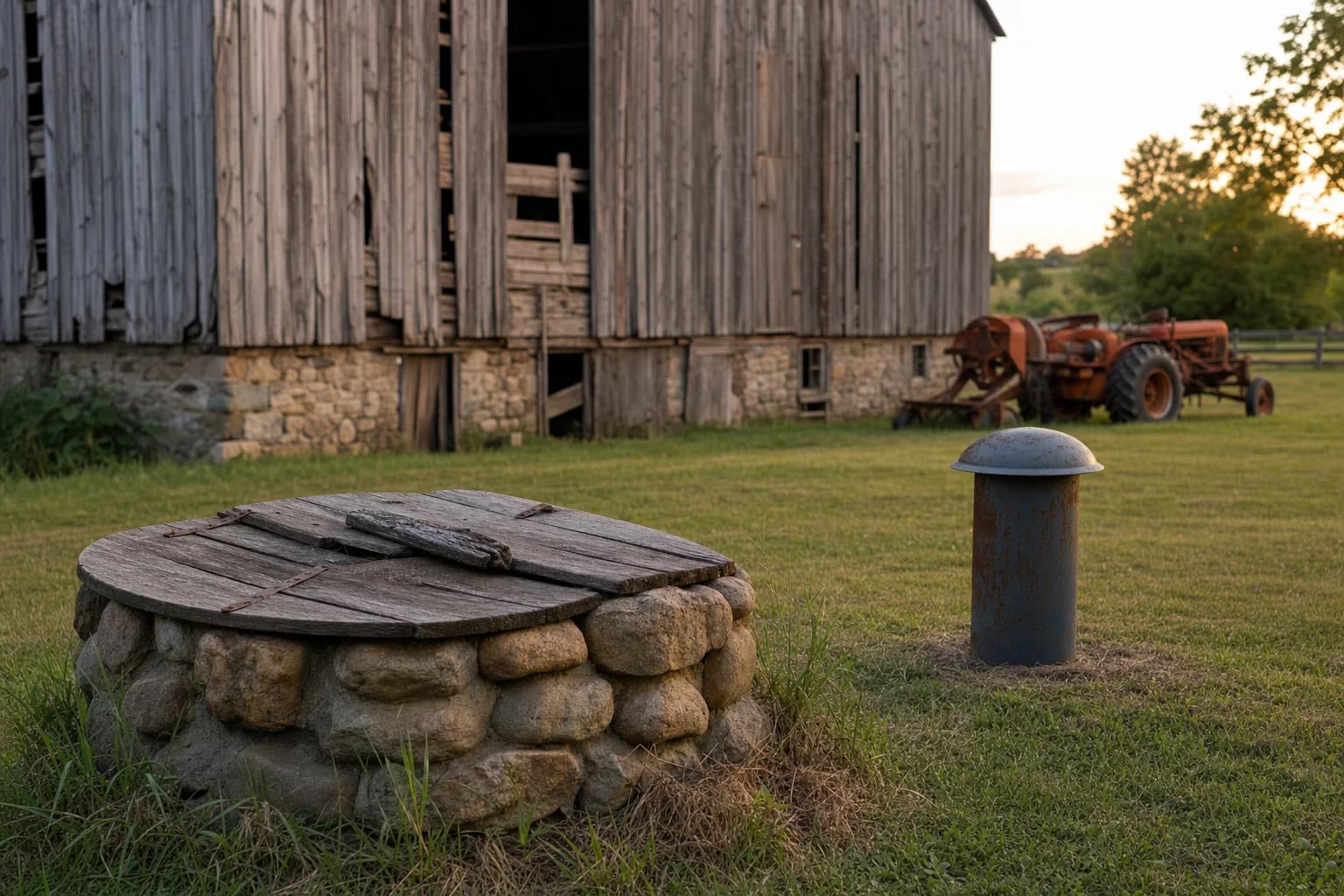
A dug well is a large hole - 3 to more than 10 feet across - excavated by hand or backhoe until it punches a few feet below the water table, then lined with fieldstone, brick, wood, or stacked concrete ring tiles to keep it from collapsing. A bored well is the mechanized cousin: a large-diameter earth auger doing the same job slightly deeper. Either way the well ends 10 to 30 feet down, collecting water slowly from the very top of the water table - typically around 2 GPM, and frequently nothing at all in a dry summer.
The lining is the fatal flaw. Stacked stone and ring tiles are not watertight and were never meant to be; there is no casing and no grout seal. Every gap is a door for surface water. That is why dug wells fail coliform and E. coli tests more often than any other type and why the EPA ranks them at the highest contamination risk of the three - more on that below.
Which Type Do You Have? Visual Identification
Most people who inherit a well with a rural property get no paperwork. The wellhead itself usually tells you everything in about thirty seconds.
The administrative route works too, and it gives you depth, geology, and yield - not just the type. Most states require drillers to file a well construction report, and millions of those logs are searchable. Start with our guide to finding your well record, or browse the logs of wells around your property on the well map- if every neighbor's record says "6-inch drilled, 240 feet," yours probably matches.
Contamination Risk by Well Type
The CDC and EPA frame all three well types on a single axis: how much of the surface environment can reach your water. Depth and sealing are the whole story.
The CDC estimates that roughly 1 in 8 Americans drinks from a private well, and historical sampling has found about 1 in 5 private wells containing at least one contaminant at levels that could affect health. The distribution is not random - it tracks well type almost perfectly.
1 in 5
private wells sampled contained at least one contaminant at levels of potential health concern
Dug wells fail first and fail worst. When rain washes over septic drain fields, barnyards, and fertilized fields, the contaminated water only has to percolate 10 to 30 feet through soil before a porous stone lining catches it. The consequences are documented in the outbreak record - the CDC traced a severe 1956 Salmonella typhimurium outbreak directly to an old dug well - and in routine testing, where total coliform and E. coli hits are rampant in dug wells. Nitrate from fertilizer and septic leachate follows the same shallow path.
Driven wells sit in the middle. The continuous steel pipe keeps debris out, but the well still drinks from the same shallow, unconfined aquifer, and with no grout seal, surface water can channel down the outside of the pipe to the screen. The EPA rates them moderate-to-high risk.
Drilled wells are the safest - not immune.Hundreds of feet of earth filter the recharge water, and the grouted casing blocks the shortcut from the surface. What deep wells trade for that protection is geology's own chemistry: naturally occurring arsenic, radon, and uranium dissolve out of some bedrock formations regardless of how well the well was built. Know what is in your rock - our well water contaminants guide maps the usual suspects by source.
Whatever type you own, the testing baseline is the same: coliform bacteria and nitrate every year, and a broader panel including arsenic and lead every 3 to 5 years - shallow wells warrant more, not less. Our well water testing guide covers what to test, when, and what the results mean.
The Modern Code Reality: Dug Wells Are Being Regulated Out
You can still own a dug well almost everywhere. Building a new one for drinking water is a different story - state by state, the codes are closing that door.
Because of their bacteriological failure rates, many states now heavily restrict or effectively prohibit new dug wells for potable use:
- Wisconsin- the DNR explicitly discourages dug wells as "a safety hazard and a threat to groundwater quality." New ones require written department approval, and existing dug wells may stay in service only while they continually produce water completely free of coliform bacteria - one bad test and the well is done.
- Virginia - administrative code (12VAC5-630) regulates separation distances tightly; where a contamination source could affect a dug well and no preventive measure exists, the well is prohibited outright.
- Local jurisdictions - many townships go further than their states. Butler Township, PA, for example, bans well pits entirely and treats any well not constructed by a licensed driller as inadequate for a new building permit.
The practical takeaway for buyers: a home served by a dug well may be uninsurable, unfinanceable, or unpermittable for renovation in a growing number of places - price the replacement well into your offer. State rules differ enough that it is worth checking your own: our state-by-state well guides cover construction codes, testing rules, and permitting for all 50 states.
Replacing and Sealing an Old Dug or Driven Well
There is no upgrade path from a dug well to a drilled well - you cannot drill through the old hole. The fix is always the same two-step: legally seal the old well, then drill new at a safe setback.
An abandoned well is not just dead weight - it is an open pipe from the contaminated surface straight into the aquifer your neighbors drink from, which is why every state enforces decommissioning rules. The sequence runs:
- Permit both ends of the job. The local health department or environmental agency permits the new well and the abandonment of the old one - usually as one package.
- Have a licensed contractor seal the old well.This is not a DIY job anywhere: the column must be grouted full of bentonite or cement from the bottom up. Minnesota law flatly prohibits property owners from sealing their own wells. Washington (WAC 173-160-381) requires a licensed driller to remove debris, perforate the casing, pressure-seal the column, and file a report with the Department of Ecology within 30 days - and has fined a contractor $90,000 for skipping proper decommissioning. Maryland's COMAR 26.04.04 spells out the dug-well-specific fill: wells over 24 inches across get filled to 5 feet below grade, capped with a 3-foot sealing plug, then backfilled with soil.
- Drill the new well at the mandated setbacks from the sealed well, the septic drain field, and property lines - then test before you drink. A licensed pro handles all of this; find well drillers near youwho know your county's rules.
Artesian, Geothermal, and Irrigation-Only Wells
A few well types do not fit the three-bucket scheme - one because of what the water does, two because of what the water is for.
An artesian well is not a fourth construction method - it is a drilled well that happens to tap a confined aquifer, one sandwiched under pressure between impermeable rock layers. The natural pressure pushes water up the casing on its own; if it rises all the way above the ground surface, you have a flowing artesian wellthat delivers water with no pump at all. The USGS's Water Science School has the classic illustration. Flowing wells are prized but regulated - most states require flow-control devices so the aquifer is not bled continuously. Our full artesian well guide covers flowing vs non-flowing wells, the regulations, and what they cost.
Geothermal wellsproduce no drinking water at all: they are loops of drilled boreholes that circulate fluid through the earth's stable ~55 degree F subsurface to heat and cool a house via a heat pump. Irrigation-only wells water lawns and crops without ever touching household plumbing - because nobody drinks from them, codes typically allow them to be shallower and cheaper (a sand point is often the right tool), which keeps demand off the deep potable aquifers. See our irrigation well guide for yield requirements, permits, and costs. And for how the casing, pump, and pressure tank work together once any of these wells is in service, start with how a well works.
Frequently asked questions
Keep reading
Sources & further reading
- Learn About Private Water Wells — U.S. EPA (accessed June 2026)
- Protect Your Home's Water — U.S. EPA (accessed June 2026)
- Private Water and Public Health — U.S. CDC (accessed June 2026)
- Aquifers and Groundwater (Water Science School) — U.S. Geological Survey (accessed June 2026)
- Artesian Water and Artesian Wells (Water Science School) — U.S. Geological Survey (accessed June 2026)
- Wells - Private Well Information — Wisconsin Department of Natural Resources (accessed June 2026)
- Private Well Construction Regulations (12VAC5-630) — Virginia Administrative Code (accessed June 2026)
- Sealing Unused Wells and Borings — Minnesota Department of Health (accessed June 2026)
- Well Water Quality and Testing — Minnesota Department of Health (accessed June 2026)
- WAC 173-160-381: Decommissioning Procedures for Water Wells — Washington State Legislature (accessed June 2026)
- COMAR 26.04.04: Well Construction Regulations — Maryland Department of the Environment (accessed June 2026)
- Well Drilling Costs (2026 Pricing Guide) — WellDrillingCosts.com (accessed June 2026)
- How Much Does Well Drilling Cost? — Angi (accessed June 2026)
- Air Rotary vs. Mud Rotary Drilling — SC Well Service (accessed June 2026)
- Determining the Yield of Your Well — Water Systems Council (accessed June 2026)