
Is My Well Water Safe?
Clean-looking water is not proof of safe water. The contaminants that actually hurt people are usually invisible, tasteless, and odorless.
If your home runs on a private well, you are your own water utility. City water systems are tested constantly and held to enforceable federal standards. Private wells are different: the Safe Drinking Water Act does not cover the well that serves a single household, so no agency samples your water, flags a problem, or fixes it. Testing, treatment, and upkeep are entirely on you.
That matters because contamination is more common than most owners assume. The U.S. Geological Survey, which has sampled private wells across the country, found that roughly one in five contained at least one contaminant at a level of potential health concern. The specific risks depend on your geology, what happens on the land nearby, and how your well is built - but the headline is simple: do not assume your water is clean because it looks clean.
~1 in 5
private wells sampled by the USGS contained a contaminant above a health benchmark
Source: USGS
Contaminants fall into a few broad families: biological (bacteria), heavy metals and inorganics, nutrients like nitrate, radiological elements, nuisance or aesthetic issues you can taste and smell, and synthetic man-made chemicals. The directory below covers each one, with a link to a full guide. Some contaminants - uranium, or iron and manganese - show up in more than one family because they are both a health and a nuisance issue.
The Contaminant Directory
Every contaminant we cover, grouped by family. Tap any card for the full guide - what it is, where it comes from, how to test, and how to treat it.
Biological
Bacteria and microbes that signal surface water or sewage reaching your well.
Heavy Metals & Inorganics
Naturally occurring or plumbing-derived metals that build up with long-term exposure.
Nutrients
Fertilizer, septic, and manure runoff that concentrates in shallow wells.
Radiological
Radioactive elements from the rock the water passes through.
Nuisance & Aesthetic
Problems you can taste, smell, or see - usually a quality issue, sometimes a clue to something worse.
Synthetic & Man-Made
Industrial and treatment-byproduct chemicals that do not belong in groundwater at all.
How to Know What Is in YOUR Water
The directory tells you what is possible. Two things tell you what is actually in your well: a test, and your local context.
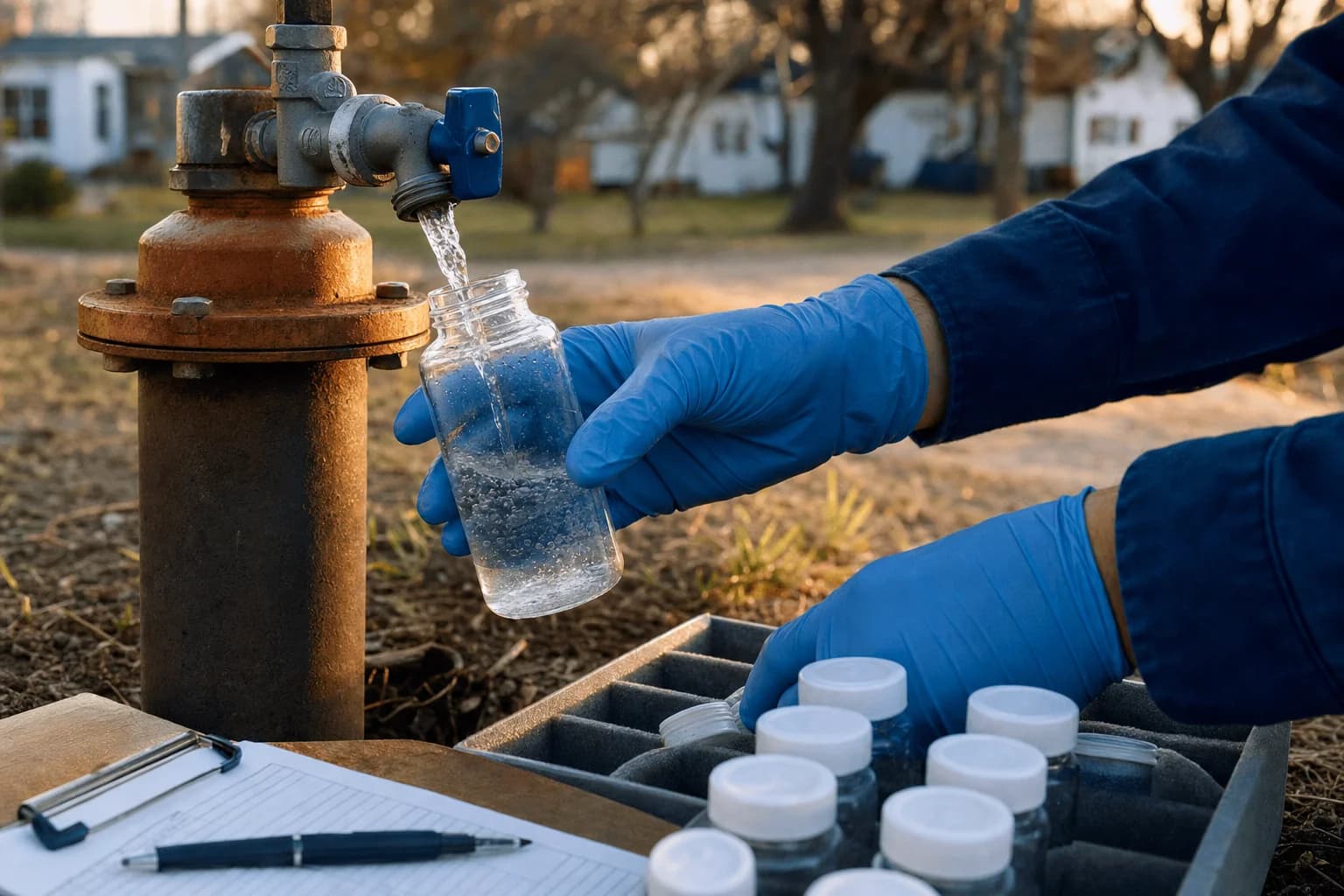
Test it. A state-certified laboratory or your local health department is the definitive source. At a minimum, the CDC recommends an annual test for total coliform bacteria and nitrate, plus anything of local concern, and a fresh test after any flood, repair, or change in taste, odor, or color. Which panel makes sense depends on where you live and what is around you. Our well water testing guide walks through choosing a lab, building the right panel, and collecting a clean sample.
Know your context.Geology and land use drive risk. Bedrock and granite aquifers raise the odds of arsenic, uranium, and radon; farm country raises nitrate; older plumbing raises lead; nearby industry, landfills, or fuel tanks raise PFAS and VOCs. You can use DrillerDB's well map to see wells near you, their depths, and the aquifer you share - a useful clue to what your water might contain (though never a substitute for an actual test).
If a Test Comes Back High
A high result is a call to action, not a panic. Work the problem in order.
- Confirm it. Re-test with a certified lab before you spend money. Sampling and lab errors happen, and a second test tells you whether the problem is real and how big it is.
- Reduce exposure now. While you sort out treatment, switch to bottled or known-safe water for drinking and cooking for the affected contaminant. (Note that for radon and some VOCs, breathing the vapor during showers matters too, not just drinking.)
- Find the source. Lead usually points to plumbing, not the aquifer; bacteria points to a compromised well cap, casing, or nearby septic; nitrate points to land use. Fixing the source sometimes fixes the water without any treatment system.
- Match treatment to the contaminant. There is no universal filter. Choose a technology proven for what you found, sized to your water chemistry and usage - see the overview below and the individual guides.
- Verify and maintain. Re-test after installing treatment to prove it works, then keep testing on schedule. Treatment systems need upkeep; an unmaintained filter can do nothing or make things worse.
Treatment Overview: Which Method Handles What
A quick map of the main home treatment technologies and the contaminant classes each one is suited to. Use it to narrow options, then confirm sizing and selection against your test on the specific contaminant page.
General guidance only. Actual performance depends on water chemistry, concentration, and system design - confirm with a certified product (NSF-rated) and your test results.
For the specifics - target levels, certified product types, and the tradeoffs of point-of-use versus whole-house - follow the contaminant guide that matches your result: arsenic, nitrate, lead, uranium, radon, PFAS, VOCs and MTBE, trihalomethanes, coliform bacteria, iron and manganese, or the rotten-egg smell guide for hydrogen sulfide.
To compare the technologies themselves - how RO, carbon, UV, aeration, and softeners work, what they cost installed, and how to combine them - see our full well water treatment guide.
Treatment is one half of keeping a well healthy; routine care is the other. Our well water upkeep guide covers the maintenance and testing rhythm that keeps contaminants from sneaking up on you in the first place.
Frequently asked questions
Keep reading
Sources & further reading
- Protect Your Home's Water (Private Wells) — U.S. EPA (accessed June 2026)
- Human Health Benchmarks and Private Well Water Quality — U.S. EPA (accessed June 2026)
- Well Testing - Private Water Systems — CDC (accessed June 2026)
- Drinking Water - Private Wells — CDC (accessed June 2026)
- Quality of Water from Domestic (Private) Wells — USGS (accessed June 2026)
- National Primary Drinking Water Regulations — U.S. EPA (accessed June 2026)