
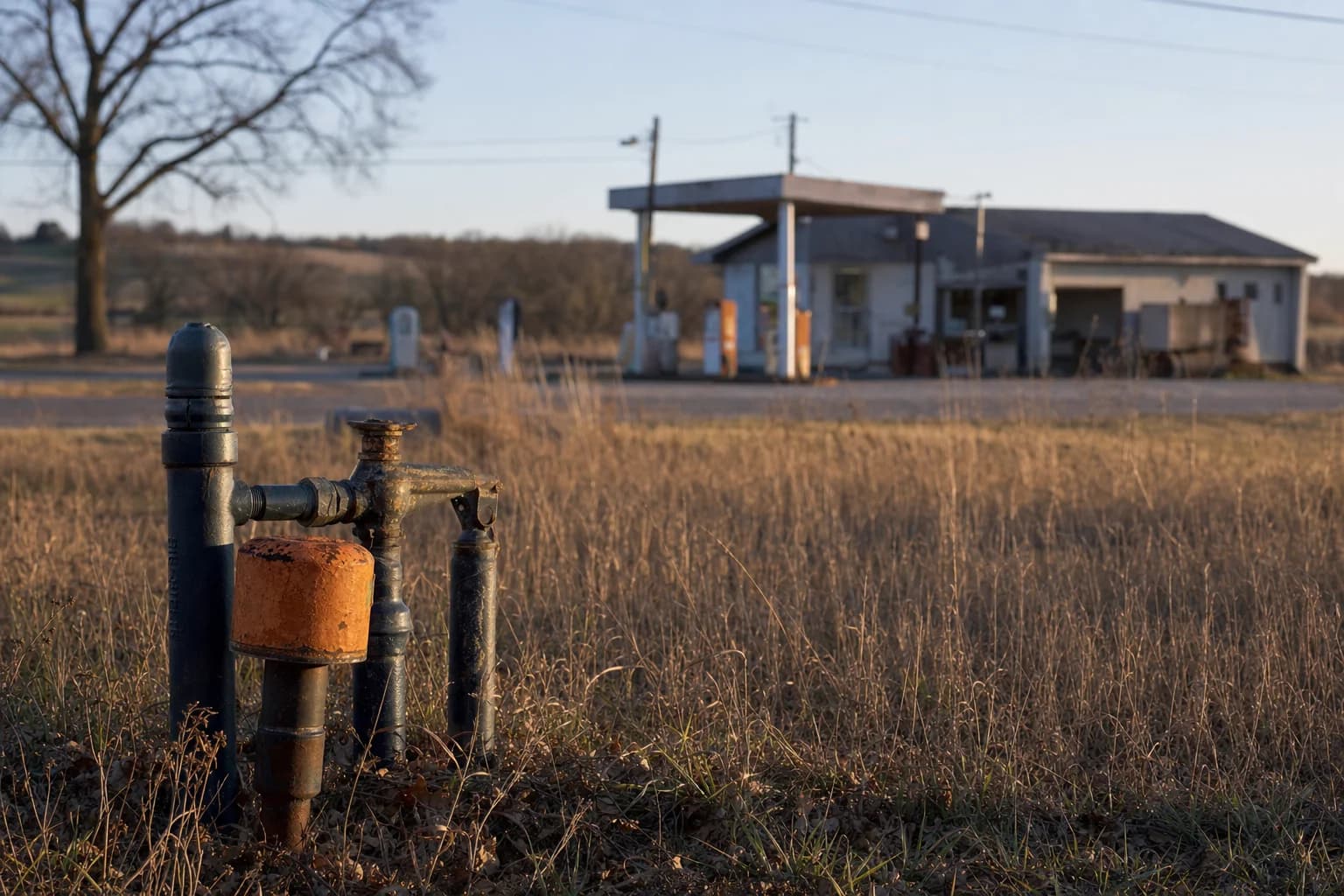
What VOCs and MTBE Are, and How They Reach Your Well
Unlike arsenic or radon, fuel and solvent contamination is almost never natural. It is a spill - and a mobile one.
Volatile Organic Compounds (VOCs) are carbon-based chemicals with high vapor pressure and low boiling points: they slip easily from liquid into gas at room temperature. The VOCs that turn up in private wells - gasoline constituents, industrial degreasers, dry-cleaning fluids, paint thinners - are overwhelmingly anthropogenic (human-caused). They enter groundwater from leaking underground storage tanks (LUSTs), industrial and dry-cleaner spills, agricultural chemical runoff, and improper household disposal.
Methyl tert-butyl ether (MTBE) is the most notorious of the fuel additives. After the 1990 Clean Air Act mandated reformulated gasoline to cut tailpipe emissions, MTBE use skyrocketed - and then it became a catastrophic groundwater contaminant. MTBE is highly soluble in water, does not bind to soil, and strongly resists natural biodegradation. So when gasoline leaks, MTBE separates from the rest of the fuel and races through the aquifer at nearly the same velocity as the groundwater itself.
The four analytes that matter most
- Benzene - the toxic backbone of gasoline; a known human carcinogen. Comes from LUSTs and petroleum spills.
- Trichloroethylene (TCE) - a metal degreaser and industrial solvent; a carcinogen that damages the liver, kidneys, and immune system.
- Tetrachloroethylene (PCE) - the classic dry-cleaning solvent; a likely carcinogen. PCE and TCE also break down into vinyl chloride, an even more potent liver carcinogen.
- MTBE - the fuel oxygenate; a possible human carcinogen with a powerful turpentine-like taste and odor that can destroy a water supply aesthetically long before it poses an acute health risk.
Proximity Risk and the US Hotspots
With VOCs, your single biggest risk factor is not your state - it is what sits within a half-mile of your wellhead.
Because this is spill contamination, the geography that matters most is local. Wells within roughly 500 to 1,000 feet of a gas station, dry cleaner, auto-salvage yard, landfill, or industrial park - current or former - carry an exponentially higher risk of VOC contamination. Shallow wells in sand-and-gravel aquifers are the most exposed, but deep bedrock wells are not immune: the USGS has shown that fractured bedrock can act as a high-speed conduit, funneling MTBE deep underground.
Regionally, VOC and MTBE prevalence is skewed toward areas with a high density of LUSTs, historical reformulated-gasoline mandates, and dense traffic. USGS monitoring detected MTBE in groundwater in at least 24 states, with the highest prevalence in the Northeast and in high-traffic parts of Texas and California.
21%
of private wells sampled in Rockingham County, New Hampshire tested positive for MTBE in a landmark USGS study (40% of public wells); near historical fuel sites, occurrence rose to 52-71%
Source: USGS
If your well sits in a dense Northeastern county or within a mile of historical commercial activity, your statistical vulnerability is elevated. Use the DrillerDB well map to see wells and depths near you and gauge how shallow local wells run, and check your state well guide for region-specific programs.
Health Effects and EPA Limits
VOCs are a dual threat: dangerous to drink and, because they vaporize, equally dangerous to breathe in your own bathroom.
When contaminated well water is used for showering, bathing, or running the dishwasher, VOCs vaporize into the confined indoor air. The CDC and environmental-health researchers warn that, for many VOCs, the dose absorbed by inhalation and skin contact during a hot shower can equal or exceed the dose from drinking two liters of the same water. Vapor intrusion - volatile chemicals migrating from shallow groundwater up through the soil into a home's foundation - is a second exposure pathway that bypasses the tap entirely.
Long-term exposure to fuel and solvent VOCs is linked to central nervous system damage, liver and kidney toxicity, and increased cancer risk. Private wells are not federally regulated, so the EPA's Maximum Contaminant Levels (MCLs) - the enforceable limits for municipal water - are the safety benchmark to use. The EPA regulates 23 specific VOCs.
Testing: The Zero-Headspace Mandate
The most common - and most dangerous - homeowner mistake is testing for VOCs the same way you test for bacteria. Do that, and the chemicals literally vanish before the lab can see them.
VOCs constantly seek equilibrium between liquid and air. If a sample is collected in a bottle with any air pocket (headspace) at the top, the dissolved VOCs off-gas into that pocket - and when the lab opens the bottle, that gas escapes, producing an artificially low or entirely non-detect result. To prevent this, EPA Method 524.2 requires VOCs to be collected in specialized 40 mL glass VOA vials with Teflon-lined caps, filled with zero headspace.
Many county health departments subsidize VOC kits to roughly $190. Test every 3-5 years - or annually if within a mile of a gas station, dry cleaner, or industrial site.
Reading Your Results
VOC results are reported in micrograms per liter (ug/L) or parts per billion (ppb) - for water testing these are identical (1 ug/L = 1 ppb). Three categories tell you what to do:
- Non-detect (ND) - the compound is absent or below the lab's method detection limit (usually 0.2-0.5 ppb). Good news, but VOC chemistry can shift as plumes migrate, so keep to your retest schedule.
- Below the MCL - if benzene reads 2 ppb (MCL 5 ppb), the water is technically "compliant" by municipal standards. But any detectable level of a known carcinogen carries long-term risk, and a detection means a source is nearby - treatment is still strongly advisable, and a detection trend can rise as the plume arrives.
- Above the MCL - stop using the water for ingestion immediately and move to a treatment system. Go to the next section.
If Your Test Comes Back High: Do This Now
The instinct to boil the water is exactly wrong for VOCs - it converts a drinking hazard into an airborne one.
- Cease ingestion. Switch to verified bottled water for all drinking, cooking, infant formula, and food preparation.
- Do not boil. See the warning above - heat makes the inhalation exposure worse.
- Mitigate inhalation. Keep showers under 5 minutes with lukewarm (not hot) water, run the bathroom exhaust fan during and after, and open windows when weather allows.
- Halt the high-off-gas appliances. Stop using the dishwasher and washing machine, which aggressively agitate hot water and vent large quantities of VOCs into the home. Use paper plates and wash essential cookware only with safely heated bottled water.
- Document the source. Note any nearby gas station, dry cleaner, or industrial site - that record matters for both treatment selection and any responsible-party claim (see below).
Treatment Options Compared: GAC vs Aeration
Because VOCs vaporize in the shower, whole-house Point-of-Entry treatment is effectively mandatory. The right technology then depends on whether you are fighting standard VOCs or an MTBE plume.
Point-of-Use (POU) systems treat a single tap. They are fundamentally inadequate for high-level VOC contamination because they leave shower and dishwasher water untreated - ignoring the inhalation risk. Point-of-Entry (POE) systems treat all the water as it enters the home, which is what you need for volatile chemicals. The two workhorse POE technologies are granular activated carbon and aeration.
Want the full picture across every treatment technology? Our well water treatment guide compares RO, carbon, UV, aeration, and softeners for each contaminant so you can match a system to your test results.
Granular Activated Carbon (GAC) - best for standard VOCs
GAC acts as a chemical sponge: water flows through a bed of porous carbon, and uncharged organic chemicals are trapped by adsorption. It is excellent for benzene, TCE, and PCE. The catch is MTBE - it has a low affinity for carbon and exhausts GAC media up to 20 times faster than other VOCs, leading to rapid "breakthrough" where the chemical bypasses the filter. True POE GAC also needs large tanks: water must stay in contact with the carbon for 7-10 minutes (Empty Bed Contact Time) to strip VOCs effectively, so small under-sink cartridges and pitchers flow far too fast.
Packed-Tower Aeration / Air Strippers - best for MTBE
For heavy VOC loads or MTBE legacy plumes that exhaust carbon too fast, aeration is the industrial standard scaled down for the home. Water is sprayed down through a tower of plastic media while a blower forces clean air upward; the turbulence physically strips the volatile gases out of the water and vents them safely above the roofline. Aeration gives continuous reduction and is immune to the breakthrough exhaustion that plagues carbon - so for MTBE, it is usually the superior long-term choice.
National ranges; get 2-3 local quotes. Ion exchange and standard oxidation/filtration do NOT remove VOCs - they are listed here only to rule them out.
Prevention and Well Construction
You cannot stop a legacy plume, but good construction keeps a localized surface spill from washing straight down into your aquifer.
- Setbacks. The NGWA and state codes call for private wells to sit a minimum of 300 to 1,000 feet from any underground storage tank, depending on local hydrogeology.
- Annular sealing. The gap between the casing and the borehole must be professionally sealed with bentonite grout or neat cement, so surface chemicals cannot run down the outside of the casing into the water.
- Casing depth. Where shallow unconsolidated zones are known to be contaminated, a licensed driller can case the well deep into bedrock, sealing off the polluted shallow zones and drawing only from deeper, isolated fractures.
Casing work, sealing, and aeration installs are not DIY. You can find a licensed well contractor near you for the construction side, and see our well maintenance guide and well water upkeep basics for ongoing care.
Who Pays: Trust Funds, State Grants, and Litigation
A $6,000 treatment system is an unfair bill for a homeowner who did not cause the spill. When a polluter is identifiable, this stops being a home-treatment problem and becomes a responsible-party cleanup.
Several public funds exist specifically because fuel contamination is so often someone else's fault. The federal Leaking Underground Storage Tank (LUST) Trust Fund, financed by a fraction-of-a-cent tax on motor fuels, helps states clean up abandoned sites - and many states run subsidiary programs aimed directly at private homeowners.
- Maine - the Well Water Abatement Program (MaineHousing) provides up to $15,000 for POE remediation systems and $3,000 for POU systems to eligible single-family homeowners.
- California - the Site Cleanup Subaccount Program and the Drinking Water Treatment and Research Fund supply resources for POE systems targeting MTBE from fuel oxygenates.
- Texas - the PST State Lead Program (TCEQ) funds remediation of leaking petroleum storage tank sites when the responsible party cannot or will not act.
- New York - the Environmental Protection and Spill Compensation Fund (the Spill Fund) can disburse money for cleanup and third-party damages when no responsible party can be identified.
When the polluter pays: responsible-party cleanup and litigation
If a nearby gas station, industrial facility, or salvage yard is the documented source of your plume, the burden of mitigation falls on the polluter. Under state environmental law, the responsible party is typically required to provide emergency bottled water, pay for the installation and perpetual maintenance of a POE system, or finance a new well into a clean aquifer. The historical record shows the stakes: a 2001 gasoline release in Pascoag, Rhode Island drove MTBE to 1,100 ppb and cut off about 4,000 residents, leading to multi-million-dollar settlements; and New York City recovered $120 million from oil companies after MTBE contaminated five groundwater wells.
Frequently asked questions
Keep reading
Sources & further reading
- Volatile Organic Compounds (VOCs) and Our Water — USGS Water Science School (accessed June 2026)
- MTBE in Fuels — U.S. EPA (accessed June 2026)
- MTBE Occurrence and Effects in Ground Water (Fact Sheet 2004-3119) — U.S. Geological Survey (accessed June 2026)
- National Primary Drinking Water Regulations (VOC MCLs) — U.S. EPA (accessed June 2026)
- Method 524.2: Measurement of Purgeable Organic Compounds (GC/MS) — U.S. EPA (accessed June 2026)
- Method 524.2 Summary (sampling, preservation, holding time) — National Environmental Methods Index (NEMI) (accessed June 2026)
- ToxFAQs for Benzene — U.S. CDC / ATSDR (accessed June 2026)
- ToxFAQs for Trichloroethylene (TCE) — U.S. CDC / ATSDR (accessed June 2026)
- ToxFAQs for Tetrachloroethylene (PCE) — U.S. CDC / ATSDR (accessed June 2026)
- Contact Information for Certification Programs and Certified Drinking Water Labs — U.S. EPA (accessed June 2026)
- Leaking Underground Storage Tank (LUST) Trust Fund — U.S. EPA (accessed June 2026)
- Well Water Abatement Program — MaineHousing (accessed June 2026)
- Site Cleanup Subaccount Program (SCAP) — California State Water Resources Control Board (accessed June 2026)
- Petroleum Storage Tank (PST) State Lead Program — Texas Commission on Environmental Quality (TCEQ) (accessed June 2026)
- Chemical and Petroleum Spills: Response and Remediation — New York State Dept. of Environmental Conservation (accessed June 2026)
- Pascoag's water supply was spiked with gasoline additive (case study) — ecoRI News (accessed June 2026)
- AG announces additional multi-million-dollar MTBE settlement — Rhode Island Office of the Attorney General (accessed June 2026)
- New York City fights to make a water source safe to drink again (MTBE litigation) — SL Environmental Law Group (accessed June 2026)