
What an Artesian Well Actually Is
Artesian is not a brand of water or a type of drilling rig. It describes one specific geologic situation: a confined aquifer under pressure.
Most residential wells tap an unconfined aquifer - a water-bearing layer of sand, gravel, or fractured rock whose top surface (the water table) is open to the atmosphere through the soil above it. Drill into it, and the water in your well sits at the same level as the water table. A pump does all the lifting.
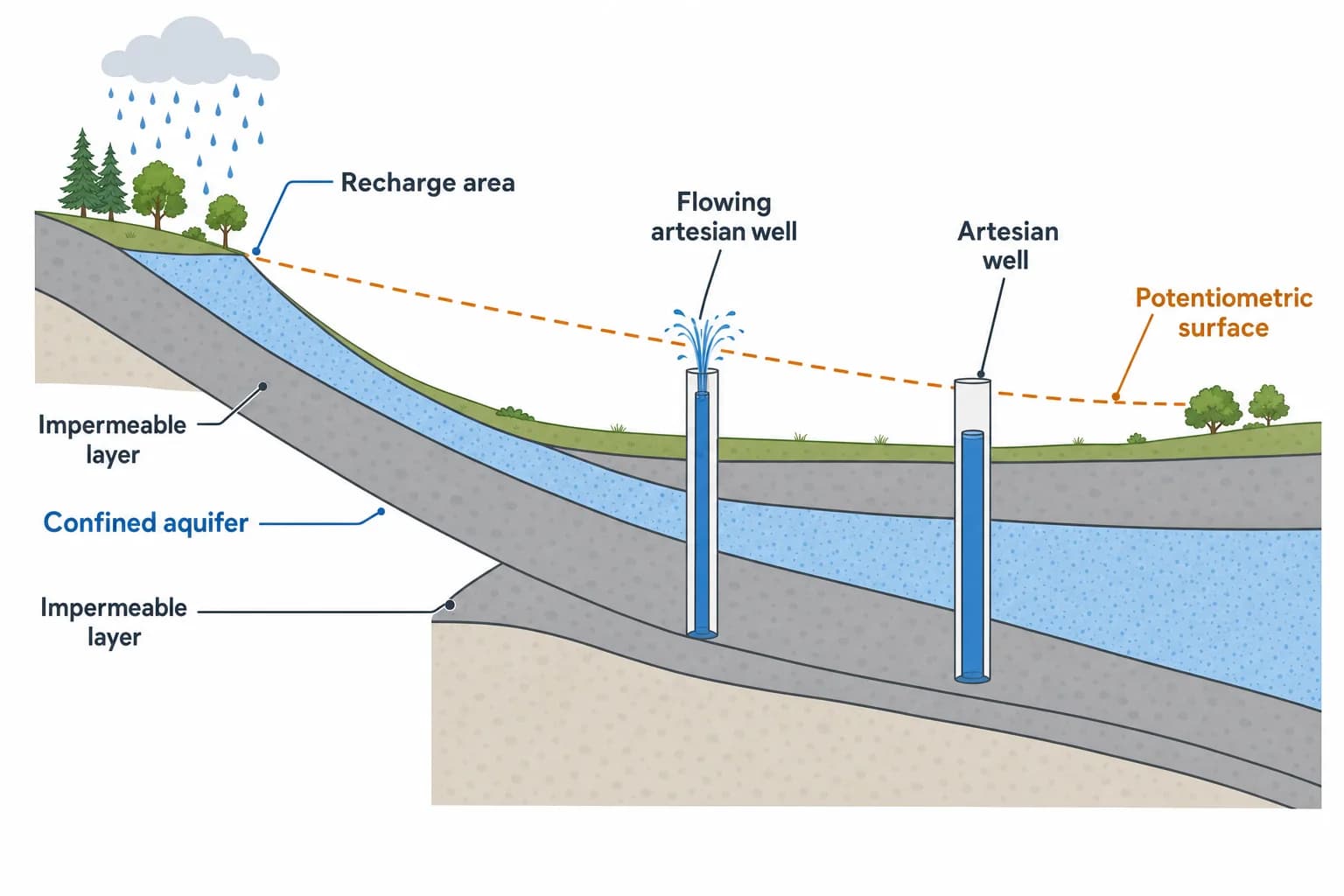
An artesian well taps a confined aquiferinstead: a water-bearing layer sandwiched between two poorly permeable layers, such as clay or shale. The aquifer's recharge area - where rain and snowmelt enter it - sits at a higher elevation, often miles away. Because the water is trapped under that impermeable lid, the weight of the water upslope puts the whole aquifer under pressure, the way a water tower pressurizes a city main.
When a drill punches through the confining layer, that pressure is released into the borehole and the water rises above the top of the aquifer on its own. The height it would rise to is called the potentiometric surface. If that surface is below ground level, you have a standard (non-flowing) artesian well. If it is above ground level, water pushes all the way up and out - a flowing artesian well.
Flowing vs. Non-Flowing Artesian Wells
Every flowing well is artesian, but most artesian wells never flow at the surface.
The difference is simply where the pressure surface sits relative to your wellhead:
- Non-flowing artesian well: water rises partway up the casing - say, from an aquifer at 300 feet up to 60 feet below grade - and stops. You still need a pump, but it lifts water from 60 feet instead of 300, which reduces pumping costs and lets a smaller pump do the job.
- Flowing artesian well: the pressure surface is above ground level, so water discharges at the surface with no pump. Flow can range from a trickle to hundreds of gallons per minute in strong confined aquifers.
The same well can move between these states. Pressure in a confined aquifer changes with season, drought, and how heavily neighboring wells draw on it - so a well that flowed when it was drilled may need a pump years later.
Whether your area has flowing wells is a question your local aquifer answers. Valley floors below upland recharge areas are classic flowing-well territory, and many states map known flowing-well areas. You can also look at logged wells near you on the well map to see local depths and aquifer types.
How an Artesian Well Is Drilled
The drilling is ordinary. The difference is what the crew must be ready for when the bit breaks through the confining layer.
Artesian wells are drilled with the same rotary and cable-tool methods as any other drilled well. The crew advances the borehole through the overburden and the confining layer, sets steel or PVC casing, and seals the annular space with grout.
The critical difference is pressure management. In a known or suspected artesian zone, an experienced contractor will:
- Seal the annulus against upward flow.The grout seal has to start at or near the base of the confining layer and run continuously to the surface, so pressurized water cannot migrate up the outside of the casing and erode a path around the well. New Mexico's artesian well rule, for example, spells this out and requires the sealing to be witnessed by the state engineer's office.
- Control the flow at the wellhead. If the well flows, the crew installs valves or a sealed cap rated for the shut-in pressure, rather than letting water discharge uncontrolled.
- Case into the flowing aquifer.Codes for flowing wells (Minnesota's is a good example) require casing to extend into the flowing aquifer itself so the confining layer is not eroded from below.
This is one of the situations where contractor experience really matters. When you are hiring a well drilling contractor in an area with known artesian conditions, ask directly whether they have completed flowing wells and how they handle flow control - it is a fair question to ask a well driller before signing.
Artesian Well vs. Regular Drilled Well
One thing that is not different: the water itself. Artesian water is groundwater. Its chemistry reflects the rock it has traveled through, exactly like any other type of water well.
Pros and Cons of an Artesian Well
- Pro - reduced pumping lift.Water rises on its own pressure, so the pump works against less head. That can mean a smaller pump, lower electric draw, and less wear over the pump's life.
- Pro - extra contamination barrier. The confining layer shields the aquifer from surface spills and runoff that threaten shallow unconfined aquifers.
- Pro - stable supply. Confined aquifers are typically large, slow-moving systems that ride out dry seasons better than a shallow water table.
- Con - you cannot order one. Artesian conditions are a fact of your local geology. If there is no confined aquifer under your land, no contractor can drill you an artesian well.
- Con - flowing wells need control. If the well flows, you own the responsibility (and cost) of controlling that flow permanently - valves, sealed caps, and in some states, reporting requirements.
- Con - not immune to quality problems.Deep confined aquifers can carry naturally occurring arsenic, iron, sulfur odor, or radon. The confining layer keeps surface problems out; it does not filter the rock's own chemistry.
Can an Artesian Well Run Dry?
The honest answer: the flow can stop, but the water rarely disappears.
A flowing artesian well flows because of pressure, and pressure is the first thing to decline when a confined aquifer is heavily used. As more wells tap the same aquifer - or after a run of dry years reduces recharge - the potentiometric surface drops. A well that once flowed at the surface may fall back to a non-flowing artesian well, and the fix is straightforward: install a pump, like any other well.
Complete failure is much rarer and usually means the well, not the aquifer: a clogged screen, mineral scaling, or casing problems. If your artesian well's performance is fading, start with our pump and pressure troubleshooting guide before assuming the water is gone.
The Rules on Flowing Wells
States treat an uncontrolled flowing well as waste - and in most places you are required to control it.
Water flowing freely out of a well and across the landscape is groundwater nobody gets to use. Minnesota's DNR, for example, classifies uncontrolled flow as waste - the lowest priority use of water under state law - and the state runs a special construction program for known flowing-well areas with specific casing, sealing, and flow-control requirements. New Mexico requires artesian wells to be sealed so groundwater cannot move between layers or flow uncontrolled at the surface.
The common threads across state codes:
- Flow control is mandatory. Valved discharge or a sealed, pressure-rated cap - a flowing well cannot simply be left running.
- Special construction in mapped areas. Where flowing wells are known, states may require notification, permits, specific casing depths, or pressure grouting before drilling.
- Sealing abandoned flowing wells is a specialist job. An old flowing well cannot be plugged like a standard well; pressure has to be controlled during sealing. See our guide on properly abandoning a well.
Requirements vary a lot by state - check the permits section of your state well guide before drilling in artesian country.
What an Artesian Well Costs
Drilling is priced per foot either way. Artesian conditions change the depth you need and the hardware at the top.
There is no separate "artesian price list." Your quote will be built the same way as any drilled well - a per-foot rate applied to an estimated depth, plus the pump system and wellhead hardware. Two artesian-specific factors move the total:
For per-foot rates, itemized components, and what quotes leave out, see our national cost guide.
Full national pricing - per-foot ranges, itemized components, and budgeting worksheets - is in our guide to the cost to drill a water well.
Frequently asked questions
Keep reading
- How Does a Well Work? - the whole system from aquifer to faucet, explained.
- Types of Water Wells - drilled, dug, and driven wells compared.
- What Aquifer Am I In? - identify the aquifer under your property.
- Cost to Drill a Water Well - per-foot rates and what quotes leave out.
Sources & further reading
- Artesian Water and Artesian Wells (Water Science School) — U.S. Geological Survey (accessed July 2026)
- Confined or Artesian Groundwater — National Ground Water Association (accessed July 2026)
- Flowing Well and Boring Special Construction Area — Minnesota Department of Health (accessed July 2026)
- Flowing Wells in Minnesota (factsheet) — Minnesota Department of Natural Resources (accessed July 2026)
- Well Drilling - Artesian (Confined) Well Requirements (N.M. Admin. Code 19.27.4.31) — New Mexico / Cornell Legal Information Institute (accessed July 2026)
- Learn About Private Water Wells — U.S. EPA (accessed July 2026)