
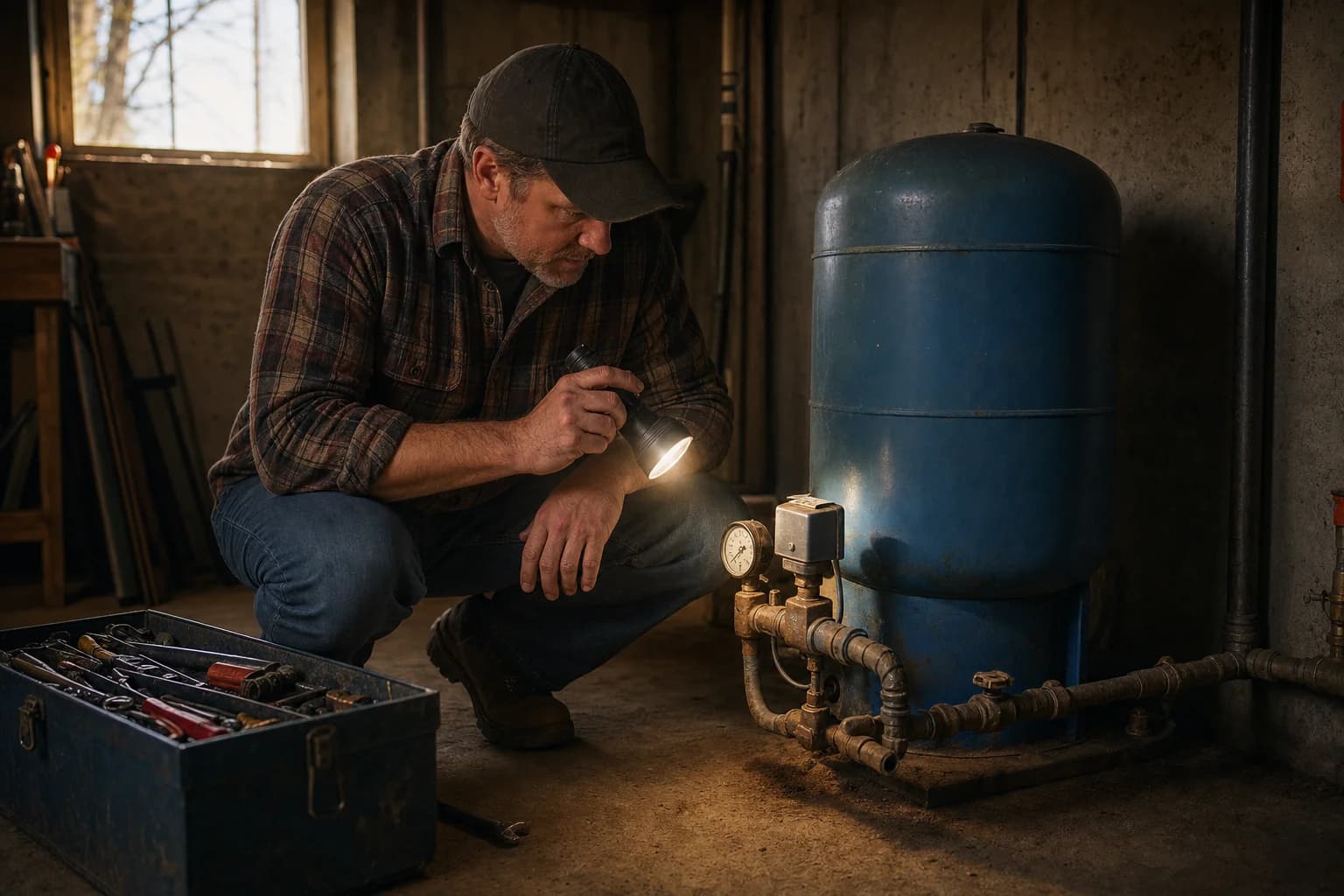
No Water? Do These Three Things First
Before you diagnose anything, get the system into a safe state. Two of these steps protect the equipment; the third protects you.
Roughly 23 million American households draw their water from a private well, and unlike a city connection, nobody is on call to fix yours. The good news from the field is that the majority of well failures announce themselves with a clear physical symptom - sputtering, constant running, rapid clicking - that lets you isolate the problem to the pressure tank, the switch, the control box, or the well itself before a pro ever arrives.
- Kill the pump breaker if it is running dry or short cycling. A pump that runs with no water to cool it can melt its windings in under 30 minutes, and a short-cycling pump cooks itself a little more with every start. Turning off the double-pole breaker stops a minor problem from becoming a $977-$2,827 replacement.
- Close the main isolation valve if you have lost all water. That keeps the water still in your house plumbing from draining backward while you work.
- Check - but only reset once - a tripped breaker. A tripped 240V double-pole breaker is the most common cause of a dead pump. Reset it a single time. If it trips again instantly, stop and read the safety section below.
The Hard 240V Stop Line: What You Can and Cannot Touch
Modern submersible pumps run on 230 to 240-volt single-phase power. That voltage is lethal. The line between safe DIY and a call to a pro is bright and absolute - know exactly where it is.
Symptom-to-Cause Decision Tree
A well system is a closed loop: electrical activation, mechanical lift, pressure regulation, storage. When the loop breaks, the symptom at your tap points straight to the broken link. Match your symptom below.
Symptom A: No water at all
A total loss of water is urgent, but it does not prove the pump is dead - several upstream causes are cheaper and more common:
- Power / breaker. A tripped 240V double-pole breaker is the top culprit. A breaker that trips again the instant you reset it signals a dead short - usually a failed capacitor or grounded motor.
- Pressure switch. If the contacts are welded shut by a power surge or heavily corroded, the switch cannot send the start signal to the pump. See the pressure switch guide for symptoms and safe replacement.
- Control box / capacitor. On 3-wire submersible pumps, the start capacitor lives in an above-ground control box. A blown capacitor causes about 90% of start failures: the motor hums but will not spin, drawing locked-rotor amperage (the massive surge a motor pulls when it is powered but physically jammed) until the thermal overload trips to keep it from melting.
- Dry well or broken drop pipe. If the motor runs at normal current but no water surfaces, the static water level may have dropped below the pump intake, or the drop pipe inside the casing has ruptured and is recirculating water back down the well.
Symptom B: Sputtering faucets (air in the system)
Water that blasts out erratically with bursts of air means air is being introduced into a closed, pressurized system:
- Dropping water level. The most serious cause. The pump intake is pulling an air vortex along with water - the well is effectively running dry. This is especially common in shallow wells (the USGS puts these at roughly 10 to 50 feet, tapping vulnerable unconfined aquifers).
- Failed check valve. The check valve keeps water from falling back down the well when the pump stops. If it fails, the water column drops and pulls air into the lines (lost prime).
- Waterlogged pressure tank. A ruptured tank bladder lets the air cushion dissolve into the water, producing severe sputtering and pressure swings.
Symptom C: Pump runs constantly
A pump built to cycle on and off but running nonstop is in a runaway state - and it can melt its internal components in under 30 minutes for lack of cooling water. Shut off the breaker first, then look at:
- System leaks. A large underground supply-line leak or a failed pitless adapter bleeds pressure continuously, so the pump never catches up.
- Failed pressure switch. A switch jammed or with its sensor port clogged by iron sediment never registers that cut-out pressure was reached.
- Low yield or pump wear. The well may produce water slower than the pump demands, or a sediment-worn impeller can no longer push to the 50 or 60 PSI cut-out.
Symptom D: Rapid clicking (short cycling)
A rapid click-click-click from the pressure switch, with the pump snapping on and off every few seconds, is short cycling - and it is almost exclusively a waterlogged pressure tank. The air bladder has ruptured and filled the tank with water. Because water cannot be compressed, opening a faucet crashes the pressure instantly (pump on) and closing it spikes the pressure instantly (pump off). Left alone, it forces the pump to start hundreds of times a day and destroys the motor. Our pressure tank guide covers diagnosis and replacement in detail.
Interactive Symptom Triage
Pick the symptom you are actually seeing and the tool lays out the likely causes plus the split between safe DIY checks and call-a-pro tasks.
Use this to narrow the conversation before you call anyone. The pressure switch, for example, can be visually inspected and continuity-tested with the breaker off - but a standard residential switch is factory-set to 30/50 or 40/60 PSI, and once you are checking its drained contacts you have done everything safe a homeowner can do. Anything live belongs to a pro.
Emergency No-Water Triage: Livestock and Medical Needs
When a well fails for days, water becomes a continuity problem for livestock and home medical equipment. Triage in order: shut down, source water, protect the vulnerable.
Step one is always the same: turn off the pump breaker and close the main isolation valve. Leaving a dry system energized invites the pump to run continuously and incinerate its windings, turning a repair into a full replacement.
Livestock and agriculture
Cattle need water continuously. The LSU AgCenter puts adult beef and dairy cattle at 10 to 15 gallons per head per day, rising to 20 to 25 gallons for lactating cows or hot weather; the University of Illinois Extension calculates peak summer demand at nearly 2 gallons per 100 pounds of body weight. In an outage, ranchers haul water with portable trailers (500+ gallons) and their own transfer pumps, or install a manual deep-well hand pump alongside the electric pump to draft 1.5 to 3 GPM during a total grid failure. Some states help: North Dakota's Emergency Water Supply Program can reimburse hauling and equipment costs during severe droughts.
If the well was flooded or the wellhead was damaged
Treat the water as bacteriologically compromised. The CDC's emergency protocol says do not drink it until it has been tested, and to disinfect with shock chlorination: use 5.25% unscented household bleach (never splash-less or scented), circulate it through the casing and every tap until you smell chlorine, let it stand 12 to 24 hours, then purge it to a safe outdoor area away from the septic leach field. Re-test the water 7 to 14 days later to confirm it is safe.
What to Tell the Pro (and Save a Trip Charge)
An accurate phone description lets the technician load the right parts onto the truck the first time. The wrong description means a second trip - and a second trip fee.
Give the contractor three things and you will usually avoid a repeat visit:
- System specs. Pump horsepower, voltage (115V or 230V), and wire configuration (2-wire vs. 3-wire) - all printed on the control box or pump nameplate.
- Well dimensions. Total depth and static water level, found on the original well log. Deep pumps need a crane to pull, so depth changes both the parts and the crew the pro brings.
- The specific symptom, precisely.Not "no water" but, for example, "the pressure gauge reads zero, the breaker is not tripped, and the 40/60 switch contacts look heavily corroded."
Common mistakes that turn a cheap repair into an expensive one
- Repeatedly resetting a tripped breaker on a shorted motor - it melts wiring and destroys the pump.
- Ignoring the rapid click. A roughly $300 tank left waterlogged short cycles the pump to death - and into a $2,000 replacement.
- Sampling water from a dirty faucetaerator gives a false-positive coliform result and triggers unnecessary shock chlorination, per Public Health Madison & Dane County.
- Over-charging the pressure tank. The air pre-charge must sit exactly 2 PSI below cut-in; set it too high and no water can enter the tank at all.
What Well Pump Repairs Cost in 2026
Knowing the going rates keeps an emergency repair from becoming an overcharge. Depth is the single biggest driver of pump-replacement cost.
$977 - $2,827+
typical cost to replace a submersible well pump, driven mostly by well depth
Source: HomeAdvisor
National ranges synthesized from 2024-2026 industry data; always get 2-3 local quotes. A minor motor failure at 400 ft depth costs far more in labor than the same fault on a shallow jet pump.
Cheap prevention beats expensive emergencies
State agencies including Michigan EGLE and the Illinois EPA publish the same basic schedule: inspect the wellhead monthly, test for coliform and nitrate annually (and verify the tank pre-charge sits 2 PSI below cut-in), and have a licensed contractor run a full mechanical and flow inspection every 5 to 10 years. Catching a slow bladder leak early is a $300 fix; ignoring it is a $2,000 pump.
Repair or Replace? The 50% Rule and the Age Math
Before authorizing a big fix, run two quick calculations that pump contractors use themselves.
- The 50% rule. If the quoted repair exceeds half the cost of a comparable new pump installed, and your pump is past 10-12 years old, replacement is almost always the better spend - the remaining components carry the same decade of wear as the part that just failed.
- The age-times-repair test.Multiply the pump's age in years by the repair quote. Past about $5,000, lean toward replacement: an 8-year-old pump facing a $700 downhole repair (8 x $700 = $5,600) is a strong replace candidate, because pulling the drop pipe is most of the labor either way and the motor could fail independently soon after.
- Lifespan context. Submersible pumps average 8-15 years; jet pumps 8-10. A pump that short-cycled for years on a waterlogged tank sits at the short end of those ranges.
If the math says replace, see our well pump replacement cost guide for what a fair installed price looks like by depth and pump type, and get quotes from licensed well contractors near you. If the math says repair, you can find a well repair company near you.
Frequently asked questions
Keep reading
Sources & further reading
- Private Drinking Water Wells — U.S. EPA (accessed June 2026)
- Secondary Drinking Water Standards: Guidance for Nuisance Chemicals (Iron 0.3 mg/L, Manganese 0.05 mg/L) — U.S. EPA (accessed June 2026)
- Drinking Water - Private Wells: Safety and Maintenance — U.S. CDC (accessed June 2026)
- How to Disinfect Wells After an Emergency (Shock Chlorination) — U.S. CDC (accessed June 2026)
- Water Emergency Toolkit for Healthcare and Dialysis (AAMI water standards) — U.S. CDC (accessed June 2026)
- Aquifers and Groundwater (shallow wells generally 10-50 ft) — USGS Water Science School (accessed June 2026)
- Information for Private Well Owners During a Drought — Massachusetts Dept. of Environmental Protection (accessed June 2026)
- Using Low-Yielding Wells — Penn State Extension (accessed June 2026)
- Water Requirements and Safety for Cattle (10-25 gal/head/day) — LSU AgCenter (accessed June 2026)
- Sustainable Water Management for Beef Cattle During Drought — University of Illinois Extension (accessed June 2026)
- Emergency Water Supply Program (hauling reimbursement) — North Dakota Dept. of Agriculture (accessed June 2026)
- Drinking Water Well Maintenance for Well Owners (maintenance schedule) — Michigan EGLE (accessed June 2026)
- Private Well Users: Well Maintenance — Illinois EPA (accessed June 2026)
- What's a Well Owner to Do? (avoiding false-positive water tests) — Public Health Madison & Dane County (accessed June 2026)
- Well Maintenance and System Components (tank pre-charge, GPM sizing) — Water Systems Council (accessed June 2026)
- How Much Does a Well Pump Cost to Replace? (2024-2026 cost ranges) — HomeAdvisor (accessed June 2026)