Chat with us, powered by LiveChat
NewDrillerDB Enterprise SalesSee it

Well Repair Near Me

Find licensed well repair companies in your area. Common repairs $150–$600 · Pump replacement $1,000–$5,000 · Emergency no-water response available.

Common repairs & costsRepair or replace?No water? Start hereFAQ

Loading contractors…
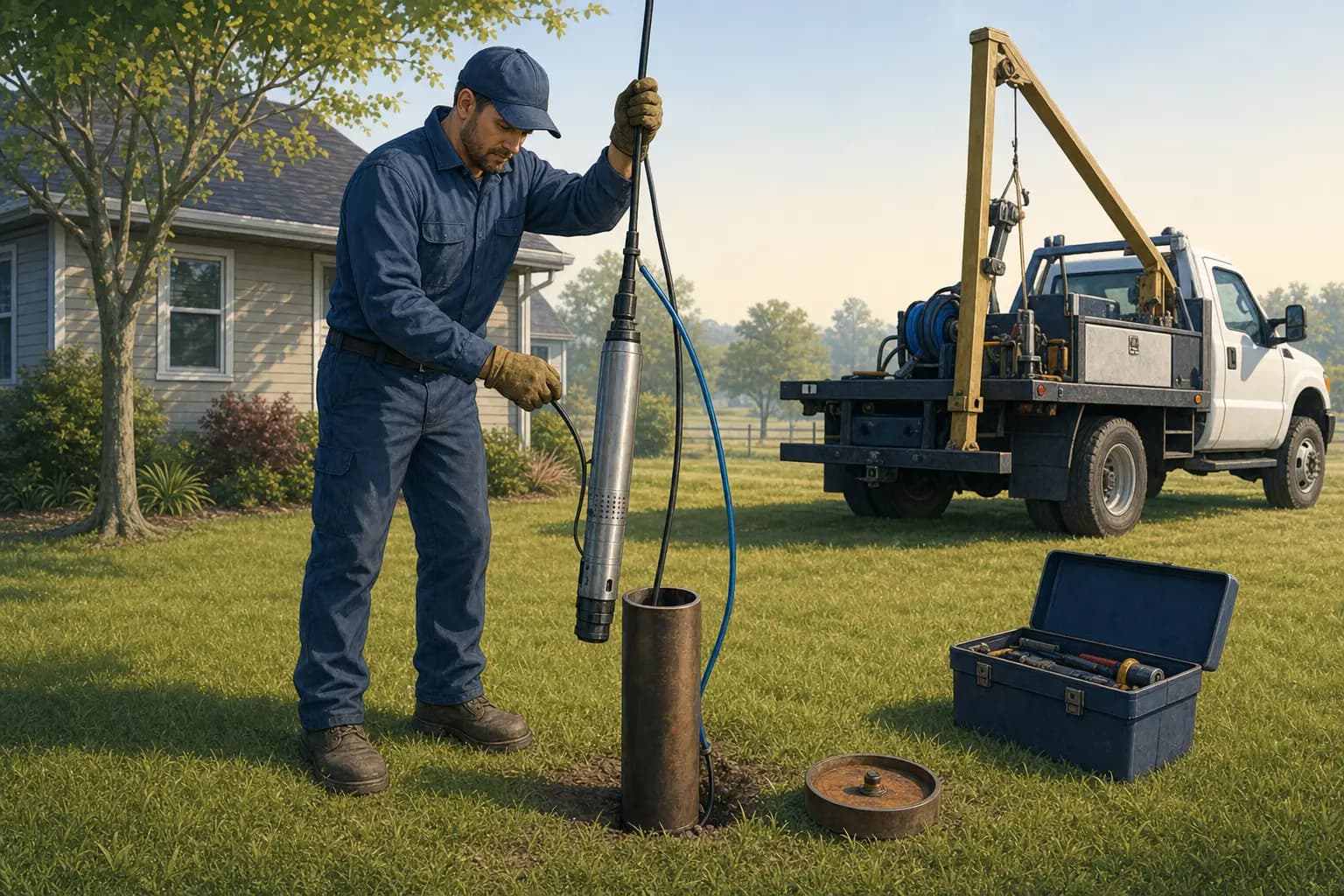
Well service technician pulling a submersible pump from a residential well casing, service truck with hoist in the background

Common well repairs and what they cost

Well systems fail at predictable points. The table below maps the symptom you're seeing to the repair it usually means and the typical cost range. Two caveats: a repair quote is an estimate, not a promise— the true scope isn't known until the system is opened up — and well depth drives pump-related labor, so the same repair costs more on a 400-foot well than a 100-foot one. Budget some contingency above any quote.

SymptomLikely repairTypical cost
Pump clicks on/off rapidly (short cycling)Pressure tank re-charge or replacement; pressure switch$150–$1,500
No water, pump silentPressure switch, wiring, or control box$150–$600
No water, pump runs constantlyPump replacement or drop-pipe leak$800–$5,000
Low pressure everywherePressure switch adjustment, tank, or worn pump$150–$2,500
Air spitting from faucetsDrop pipe crack or falling water level (lower pump)$500–$2,000
Sand or grit in waterScreen/casing issue or pump set too low$500–$3,000+
Cracked or missing well capSanitary cap replacement + disinfection$100–$400
Yield dropped gradually over yearsWell rehabilitation (brushing, treatment, redevelopment)$800–$3,000
Casing damage or surface leakCasing patch, liner, or grout repairA few hundred to several thousand — inspection required

Diagnosing pump symptoms yourself first? Work through our well pump troubleshooting guide — it walks symptom-by-symptom and flags which fixes are homeowner-safe. For tank and switch specifics, see the pressure tank guide and pressure switch guide.

Repair it or replace it?

The two rules contractors actually use: the 50% rule — when a repair quote passes half the cost of new equipment installed, replace — and age. Submersible pumps typically last 8–15 years and jet pumps 8–10; pressure tanks run 10–15 years. A major repair on equipment near the end of that window buys you very little runway. Repeat failures matter too: a second significant repair within two years is a strong signal the system has a root problem (often a waterlogged tank that's been beating the pump to death, or a pump sized wrong for the well).

If the math points to replacement, our well pump replacement cost guide breaks down pricing by pump type and depth so you can sanity-check quotes before signing.

No water? Check these four things before you call

  1. The breaker. The pump has its own circuit. If it tripped, reset it once. If it trips again, leave it off — repeated resets can burn out a failing motor.
  2. The pressure gauge. Find the gauge near the pressure tank. Zero pressure with a silent pump points at the switch or electrical; normal pressure with no flow points at plumbing, not the well.
  3. The pressure switch. Look (don't poke) for burned contacts or a switch stuck mid-cycle. Switch replacement is one of the cheapest well repairs.
  4. The neighbors. If nearby homes on wells also lost water, the issue may be regional — power quality or a dropping water table — not your equipment.
Before the technician arrives

Turn the pump circuit breaker off if the pump is running but delivering no water — a pump running dry destroys itself quickly. Never open the pressure switch or control box housing while powered: well pumps run on 240V. Have your well log ready (depth, pump type, install date) — it changes what the technician brings and can save a second trip. You can look yours up free with our well record finder.

Six questions to ask a well repair company

Repair work happens fast — often the same day you lose water — which is exactly when it's easiest to skip due diligence. These six questions take five minutes on the phone and separate licensed well professionals from generalists.

Need broader service — maintenance plans, inspections, water testing — rather than a one-off fix? See well service near me. Pump-specific problem? The well pump service hub goes deeper on pump repair and replacement.

Frequently asked questions about well repair

How much does well repair cost?
Most common well repairs fall between $150 and $600 — that range covers pressure switch replacement, pressure tank re-charging or bladder service, wiring fixes, and well cap replacement. Bigger jobs cost more: pressure tank replacement runs $300 to $1,500 depending on tank size, jet pump replacement $800 to $2,500, and submersible pump replacement $1,000 to $5,000 driven mostly by well depth. Well rehabilitation for a low-yield well typically runs $800 to $3,000. Treat every number as an estimate, not a promise: the technician can't see what's failing until the system is opened up, and deeper wells mean more labor to pull and reset equipment. Most contractors charge a $75–$150 diagnostic fee and credit it toward the repair. Get an itemized quote for anything over $500 and budget some contingency above it.
Who repairs water wells?
Licensed well contractors and pump installers repair water wells — not general plumbers. A plumber's license typically stops at the pressure tank: from the tank into the house is plumbing, but the well itself, the drop pipe, the submersible pump, and anything inside the casing is regulated well work in most states, requiring a licensed well or pump contractor. Many states also require repairs to be reported or filed with the state well program. Well drilling companies usually offer repair service, and dedicated pump service companies handle the most common failures (switches, tanks, pumps). If your problem is low pressure at one fixture, call a plumber; if the whole house has low pressure, air spitting, or no water, call a well repair contractor. The directory on this page lists licensed well and pump contractors by location.
Should I repair or replace my well pump?
Use two tests. First, the 50% rule: if the repair quote exceeds half the cost of a new pump installed, replacement is usually the better money. Second, age: submersible pumps typically last 8–15 years and jet pumps 8–10, so a $700 repair on a 12-year-old submersible buys you the tail end of its life, while the same repair on a 4-year-old pump makes sense. Also weigh repeat failures — a second major repair inside two years is a strong replacement signal — and whether the motor or wet end is what failed (motors are usually not economically rebuildable at residential sizes). A good contractor will quote both paths. Replacement also lets you correct sizing problems that caused the original failure, like a pump that short-cycled for years against a waterlogged tank.
What should I do if my well suddenly has no water?
Check the cheap stuff first. (1) Breaker: the well pump has its own circuit — see if it tripped, and reset it once only; if it trips again, stop and call a pro. (2) Pressure switch: look at the pressure gauge by the tank; if it reads zero and the pump isn't running, the switch may have failed or its contacts burned. (3) Power event: after an outage, some systems need the pump circuit cycled. (4) Ask a neighbor on a well whether they have water — a regional water-table drop shows up street-wide. If none of that restores water, turn the pump breaker OFF to protect the motor from running dry and call a well repair contractor. Most 'no water' calls turn out to be electrical, switch, or pump failures — genuinely dry wells are the least common cause.
Does homeowners insurance cover well repair?
Usually only for sudden, accidental damage from a covered peril — a lightning strike that burns out the pump motor, fire, falling trees, or vandalism are the classic covered scenarios. Normal wear and tear, age, corrosion, sediment damage, and gradual failure are excluded on standard policies, and those account for the large majority of well repairs. Some insurers offer equipment breakdown or service line endorsements that broaden coverage for well equipment and buried lines, typically for a modest annual premium. If your pump fails right after a thunderstorm, it's worth a claim inquiry — lightning damage to well pumps is a recognized claim category. Document the failure (photos, the contractor's written diagnosis) before repairs begin, and check your specific policy language rather than assuming either way.
How long does a well repair take?
Most single-component repairs are same-day once the technician is on site: a pressure switch swap takes under an hour, a pressure tank replacement two to four hours, and a full submersible pump replacement typically half a day — pulling several hundred feet of drop pipe, setting the new pump, and re-pressurizing the system. Deep wells, seized fittings, or wire failures inside the well can stretch a pump job to a full day. Well rehabilitation (brushing, chemical treatment, redevelopment for a low-yield well) usually runs one to two days including disinfection. After any repair that opens the well, plan on shock chlorination and a bacteria test before drinking the water — the chlorination and flush cycle adds a day or two of bottled-water living even though the mechanical work is done.
Can a low-yield well be fixed without drilling a new well?
Often, yes. Well rehabilitation — mechanical brushing, chemical treatment to dissolve mineral scale and bacterial buildup, and redevelopment by surging or jetting — can restore much of a well's original yield when the problem is a clogged screen or encrusted borehole rather than a depleted aquifer, and typically runs $800 to $3,000. Hydrofracturing (pumping high-pressure water to open bedrock fractures) is another option for low-yield bedrock wells. Lowering the pump, adding storage, or deepening the existing well are further steps before a full new well. The right choice depends on why yield dropped: a well that declined gradually over years is a rehabilitation candidate, while one that dropped suddenly may have a pump or drawdown issue instead. A licensed contractor can run a flow and drawdown test to tell the difference.

Browse well repair pros by state

Each state directory lists licensed well contractors, and each state guide covers licensing rules, typical cost ranges, and state agency contacts for well owners.

Popular metros with local well data

These cities have local geology reports and contractor coverage. DrillerDB is actively expanding coverage to additional metros.

Sources and methodology

Repair cost, lifespan, and triage guidance on this page aggregate data from DrillerDB's 50 state well-owner guides and our pump and pressure-system resource guides. Those guides cite primary sources: state environmental and water agencies, EPA private drinking water guidance, NGWA maintenance standards, and state health departments. Cost ranges reflect typical residential repair pricing across the 50 states; actual pricing varies with well depth, equipment, access, and local labor rates — treat quotes as estimates and budget contingency. Contractor directory is populated from publicly listed licensed drillers and well service technicians.

Most-cited primary sources

Reviewed byDrillerDB Editorial TeamLast updated