
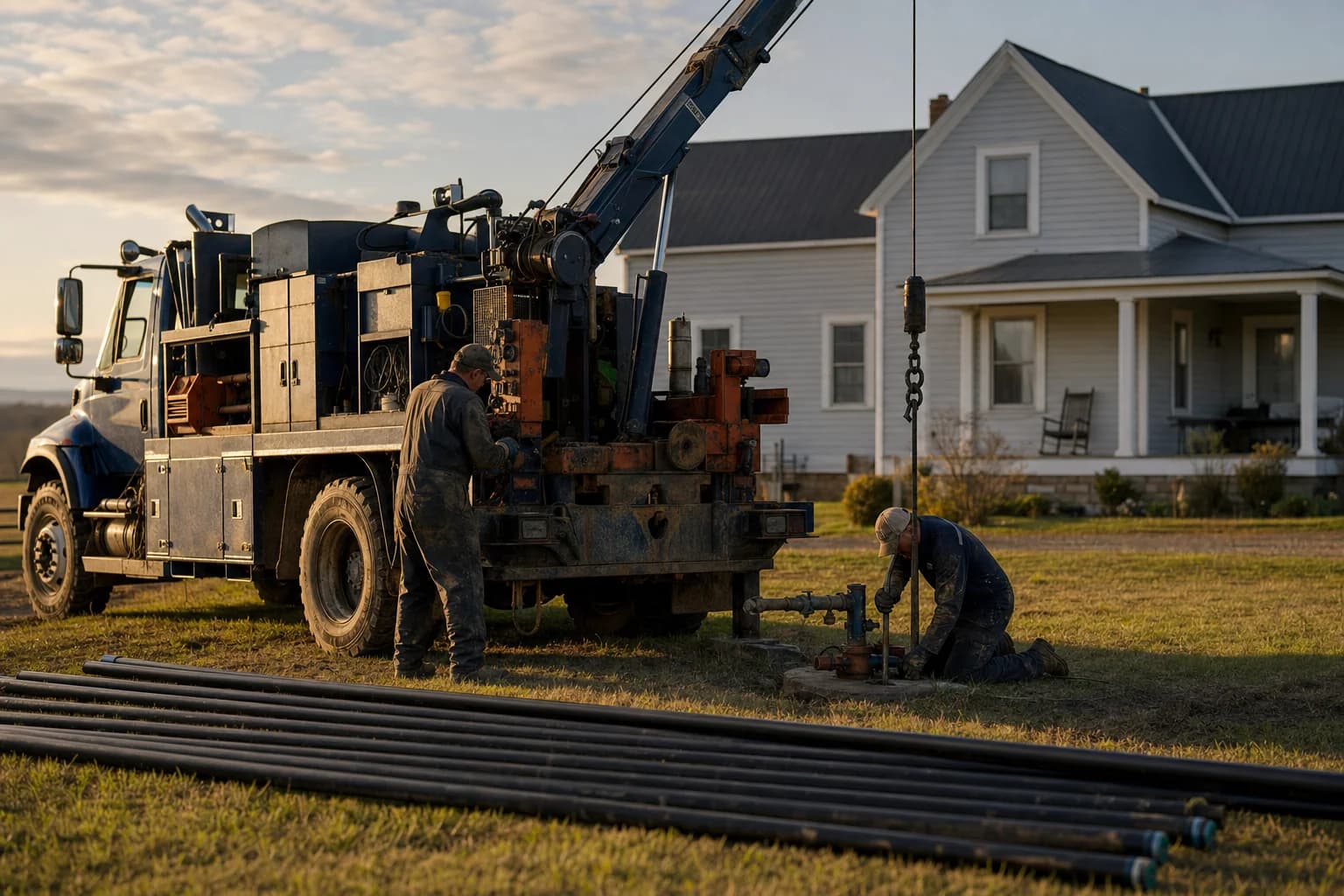
What a Well Pump Replacement Costs in 2026
The headline number first, because that is what you came for - then the variables that move it.
For the more than 43 million Americans - about 15% of the population - who rely on a private well, the pump is the heartbeat of the house. When it fails, you are your own water utility, and the full cost lands on you. The good news is the price is predictable once you know two things: the type of pump and how deep it sits.
$1,500-$2,827
national average to fully replace a well pump in 2026 (range spans $160 for a manual pump to $5,000+ for a deep constant-pressure system)
Source: HomeGuide / HomeAdvisor
That average covers a complete replacement with standard labor and basic materials. The single biggest lever is depth: every 100 vertical feet of well adds roughly $500 to $1,000 to the job, because a deeper pump needs a mechanized hoist, heavier drop pipe, and more wire. A shallow above-ground jet pump can be a few-hundred-dollar swap; a deep submersible with a constant-pressure controller can approach $5,000.
Before you talk to anyone, it helps to know your own well's depth and what kind of pump it has. Your original drilling record lists both. Look up your well's record for free to walk into the quote conversation knowing whether you have a 60-foot jet pump or a 300-foot submersible - that one fact reshapes the whole estimate.
Cost by Pump Type and Depth
Well pumps are not one product. The market splits cleanly by mechanism and depth, and each tier has its own price band.
Two physics families drive every residential pump. Centrifugal pumps - including the submersibles in most modern drilled wells - spin an impeller to fling water outward and build pressure, handling the high-volume needs of a household. Positive-displacement pumps trap a fixed slug of water and force it out, which suits low-volume, high-pressure jobs like solar and hand pumps. A shallow jet pump simply cannot overcome atmospheric pressure to lift water from more than 25 feet, which is why depth dictates the pump - and the price.
National ranges synthesized from 2024-2026 contractor data; always get 2-3 local quotes. Windmill pumps ($5,000-$21,500 installed) exist but are rare for residential use.
Premium vs. budget pumps: the real return on the extra $400-$600
When you buy the pump unit itself, you choose between budget brands (Flotec, Red Lion, Wayne) at roughly $200-$400 for a 3/4 HP unit and premium brands (Grundfos, Franklin Electric, Goulds/Xylem) that command an extra $400 to $600, landing at $600-$1,000. The premium pays off: budget pumps use lower-grade plastic or cast iron and last 5 to 10 years, while premium pumps use all-stainless construction and floating impellers to reach 15 to 25+ years - and run 15% to 30% more efficiently, trimming your electric bill the whole time.
What Is Actually on the Invoice
A pump replacement is a systemic overhaul, not a single part. When a submersible comes out of the well, the wire, pipe, and fittings beside it are usually due too.
The headline pump price is only one line on a real invoice. Pulling a pump exposes the supporting infrastructure, and best practice is to replace the consumables that share its lifespan while everything is already out of the ground. Here is what each piece costs in 2026:
Components vary by well; a low headline bid that omits pipe and wire often re-adds them as surprise line items once the pump is pulled.
Repair or Replace? The 50% Rule
Not every failure is a $3,000 job. Often the pump is fine and a cheap peripheral part died - so diagnose before you replace.
A burnt-out pressure switch produces the exact same symptom as a dead pump: no water. That is why the most expensive mistake homeowners make is authorizing a full replacement for a $150 fix. Work the decision in two steps - first identify what actually failed, then, if it is the pump or motor, apply the 50% Rule.
Repair costs by failure mode
Many "dead pump" calls are really one of these peripheral failures, fixable without ever pulling the pump from the well:
A pump older than 10-12 years with a dead motor is usually a replace, not a repair - a new motor on a worn wet end tends to fail again.
What Drives the Price Up
The national average assumes a straightforward job. These site conditions push the final invoice hundreds or thousands of dollars higher.
- Vertical depth. The dominant driver. Pulling a pump from 400 feet needs a mechanized hoist rig, heavy-duty pipe, and far more wire than a 100-foot job. Budget about $500 to $1,000 per additional 100 feet.
- Emergency, weekend, and after-hours service. Because no water is a true emergency, immediate dispatch carries a 25% to 50% labor markup. If you can safely wait a day, you may save hundreds.
- Access limitations. A wellhead buried in an overgrown field, a tight enclosure, or under decking can block the pump truck, forcing slower manual pulling and more billable hours.
- Corroded infrastructure. In older systems, galvanic corrosion can fuse the pitless adapter to the steel casing, sometimes requiring excavation to cut the casing - a major cost add.
- Regional geology. Coastal and Southern wells are often shallow (50-150 ft) and cheapest; the Midwest sits at the median (100-300 ft); arid mountain and drought regions can exceed 300-500+ ft, demanding high-horsepower pumps. Full system projects range from the lowest national tier in the Southeast up to far higher averages in the West.
Curious how deep wells run in your area? Browse nearby wells on the well mapto see the depths and pump types your neighbors report - a useful reality check before a contractor tells you how deep yours "must" be.
How to Compare Quotes Without Getting Ripped Off
The well-service industry is fragmented, from multi-generational fleets to single operators in unbranded trucks. A few rules keep you out of the predatory traps.
Aim for at least three itemized bids, verify credentials, and treat payment terms as a test of the contractor's legitimacy. The National Ground Water Association lets you confirm whether a contractor holds a Certified Pump Installer (CPI) or Certified Well Driller (CWD) designation - prioritize one who does.
Does Insurance or a Home Warranty Cover It?
The most agonizing surprise is discovering, mid-emergency, that your homeowners policy will not pay a dime. Here is what actually covers a pump.
Standard homeowners policies (the HO-3) are named-peril for mechanical systems. They cover sudden, accidental damage from specific events - a direct lightning strike frying the control box, a fire, vandalism, or a tree falling on an above-ground jet pump. They unequivocally deny claims for normal wear-and-tear, age, gradual corrosion, sediment buildup, or a pump that burned out because the well ran dry. If your 14-year-old motor simply quits, you pay 100%.
Two ways to actually get coverage for mechanical failure: add an Equipment Breakdown Endorsement or Service Line Coverage rider to your homeowners policy, or buy a third-party home warranty with a well-pump add-on (these typically pay up to a set limit such as $1,500 per term). Note that even manufacturer warranties usually cover only the hardware - you still pay the $500-$1,000 labor to pull and return the pump - and are voided by improper installation, lightning, grid surges, or running the pump dry.
Financing and Government Assistance
A sudden multi-thousand-dollar emergency is not the end of the road for lower-income rural homeowners. The federal government treats water as a health necessity.
The USDA Section 504 Home Repair program targets rural homeowners facing a health-and-safety hazard - a failed well pump qualifies. It offers two instruments that can be combined:
- 1% interest loan up to $40,000 for very-low-income owners (below 50% of Area Median Income), repaid over 20 years.
- Lifetime grant up to $10,000 for homeowners aged 62 or older who cannot repay a loan - this does not have to be paid back.
- Combined, the loan and grant can total up to $50,000 in assistance.
Why This Is a Pro Job
Pulling and rewiring a submersible pump is genuinely dangerous. The DIY line is clear.
Even a 100-foot pull can exceed 200 pounds once you add the pump, wire, and a pipe full of water. Lose your grip and the assembly crashes to the bottom of the casing, turning a routine job into an expensive "fishing" operation or a dead well. Combine that with 240 volts in standing water and the math is simple: this is a licensed-pro job. Get quotes from local pump pros rather than risking it. For how the pump fits into the larger system, see our well components guide.
Frequently asked questions
Keep reading
Sources & further reading
- Learn About Private Water Wells (well types and construction) — U.S. EPA (accessed June 2026)
- Domestic (Private) Supply Wells — U.S. Geological Survey (USGS) (accessed June 2026)
- Depth to Groundwater Used for Drinking-Water Supplies (median 142 ft) — U.S. Geological Survey (USGS) (accessed June 2026)
- Single Family Housing Repair Loans & Grants (Section 504) — USDA Rural Development (accessed June 2026)
- Contractor Certification & Certification Exams (CWD / CPI) — National Ground Water Association (NGWA) (accessed June 2026)
- Private Wells: Testing Recommendations — U.S. CDC (accessed June 2026)
- How Much Does Well Pump Replacement Cost? — HomeGuide (accessed June 2026)
- Cost to Repair or Replace a Well Pump — HomeAdvisor (accessed June 2026)
- Well Pump Replacement Cost (national pricing breakdown) — LawnStarter (accessed June 2026)
- Well Pump Replacement Cost Guide (components, depth pricing) — The Well Guide (accessed June 2026)
- Well Pump Cost Guide (repair vs. replace, warranties) — Well Pump Authority (accessed June 2026)
- Contractor Deposit Rules by State — QuoteChecker (accessed June 2026)
- Does Homeowners Insurance Cover Well Pump Repair? — Policygenius (accessed June 2026)
- Does Homeowners Insurance Cover Well Pumps? — Tri County Pumps (accessed June 2026)
- Well Pump Coverage (home warranty add-on) — American Home Shield (AHS) (accessed June 2026)
- Water Well Maintenance and Rehabilitation — Penn State Extension (accessed June 2026)
- Scrap Metal Market Pricing (copper, brass, stainless) — Sadoff Iron & Metal (accessed June 2026)