Chat with us, powered by LiveChat
NewDrillerDB Enterprise SalesSee it
Well Components

Well Casing

The casing is your well's skeleton and its first line of sanitary defense. Here is what it does, how steel and PVC compare, how deep it should run, and what to do when it fails.

9 min readUpdated July 2026
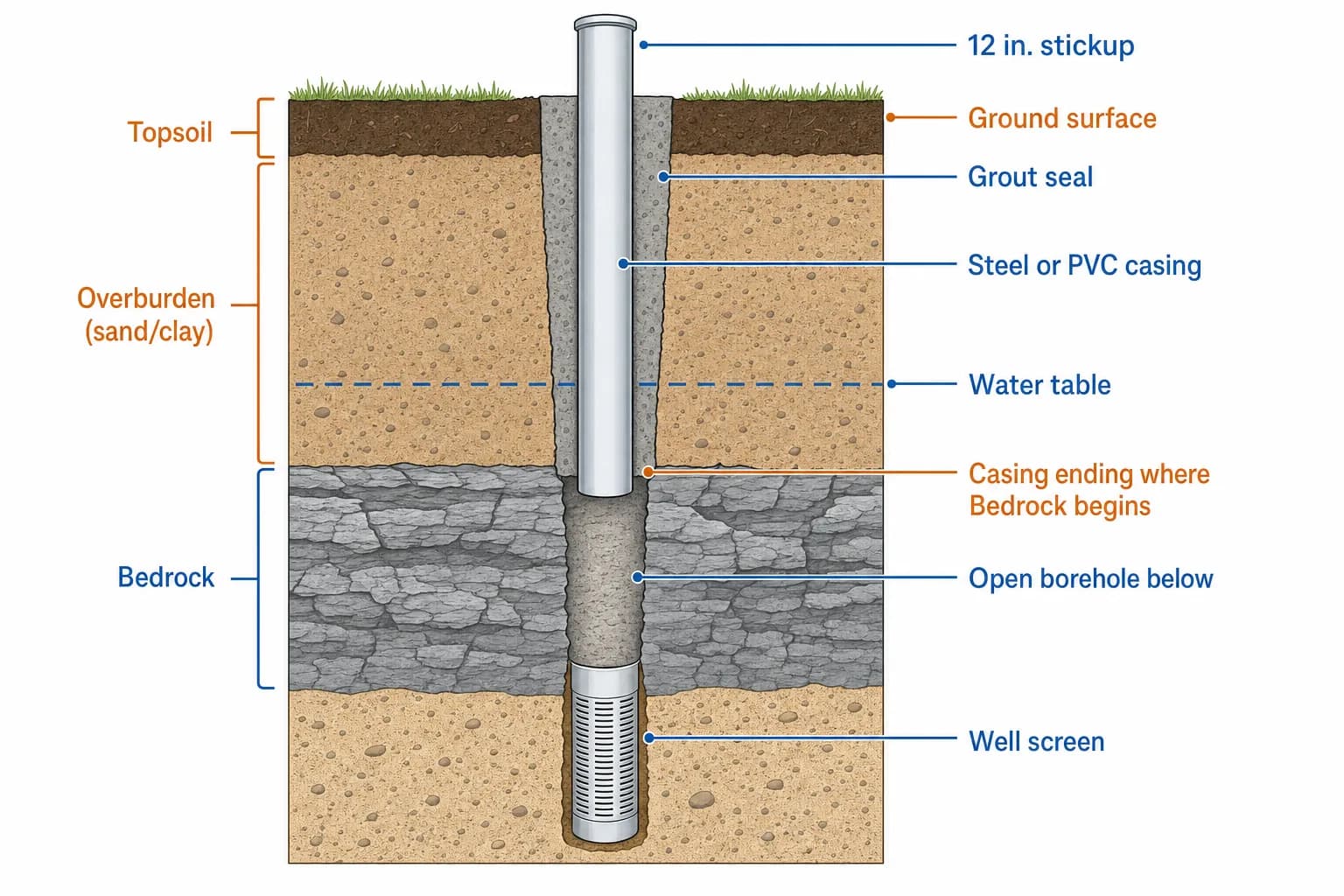
Vertical cross-section of a drilled well showing 12-inch casing stickup, grout seal in the annulus, steel or PVC casing through overburden, water table, casing seated at bedrock with open borehole below, and a well screen
The casing system: stickup, grout seal, casing, and water entry - drawn as a composite of the two common completions (open bedrock bore and screened interval).

What Well Casing Does

Four jobs in one pipe: hold the hole open, seal contamination out, protect the pump, and anchor the wellhead.

Well casing is the pipe - steel or PVC in nearly all modern wells - that lines the borehole from the surface down. It is easy to think of the well as "the hole," but in loose soil a raw borehole would slump shut in hours. The casing is what makes the hole permanent.

  • Structure: it keeps soil, sand, and gravel from collapsing into the well, for the life of the well.
  • Sanitation: together with the grout seal around it and the well cap on top, casing blocks surface water, shallow contaminated groundwater, insects, and debris from reaching your drinking water.
  • Protection: the pump, drop pipe, and wiring all live inside the casing, shielded from the formation.
  • Structure at the top: the casing carries the sanitary cap and the pitless adapter - the below-frost-line fitting that routes water to your house.

For how the casing fits into the rest of the system - screen, pump, pressure tank - see how a well works and the full well components guide.

Steel vs. PVC Casing

The right material is mostly decided by your geology and water chemistry - not by preference.

Steel vs. PVC well casing
FactorSteelPVC
Strength / rocky groundExcellent - can be driven and seated in bedrockLower - brittle under impact, not driven
CorrosionCan corrode in acidic or aggressive waterImmune to rust and corrosion
Weight / handlingHeavyLight, easy to handle
Typical useBedrock wells, driven casing, rocky overburdenCorrosive water areas, sand/gravel wells, many southern states
Life expectancyDecades; shorter where water is corrosiveDecades; UV-protected below grade

Regional convention is strong here. In much of New England and other bedrock country, steel casing driven to rock is the standard. In parts of the South and Midwest with deep sand aquifers or corrosive groundwater, PVC dominates. State well codes specify approved materials, wall thicknesses, and joint methods - your state well guide covers the local rules, and a licensed local driller will know the convention cold.

Corrosive water shortens steel casing life
If your water is acidic (low pH), it quietly attacks steel casing and metal plumbing alike - USGS has mapped potentially corrosive groundwater in half of US states. A standard water test that includes pH tells you if your casing lives in a hostile environment. See our well testing guide.

How Deep Casing Runs (and How High It Sticks Up)

Casing depth follows the geology; casing height follows the code.

In a bedrock well, the casing's job is to get you cleanly through the loose material on top. It runs through the soil and overburden and is seated firmly into solid rock; below that, the borehole is typically left open, because the rock holds its own shape. A 300-foot bedrock well might carry only 40 or 60 feet of casing.

In a sand-and-gravel well, there is no self-supporting rock, so the casing runs essentially the full depth and ends in a well screen - a slotted section that admits water while holding the formation back.

Minimum casing depths, materials, and seating requirements are set state by state in the well code. What is nearly universal is the rule at the top: casing should terminate at least 12 inches above finished grade, higher in flood-prone spots, so runoff can never pond over the top of your well. Wells that terminate in below-grade pits are a legacy design most states no longer allow for new construction.

Your well's original casing depth, diameter, and material are usually recorded on its construction log - look up your well record if you have never seen yours, or explore logged wells around you on the well map.

The Grout Seal: The Half of the System You Cannot See

Casing without grout is a pipe in a leaky hole.

When a well is drilled, the borehole is slightly larger than the casing. That ring of space - the annulus - is a ready-made channel for surface water to run straight down the outside of the casing into your aquifer. Proper construction fills it with grout (neat cement or bentonite clay) from the bottom of the casing up to the surface.

A good grout seal is invisible and permanent; a missing or failed one is a common culprit behind wells that keep testing positive for bacteria no matter how many times they are shock chlorinated. It is also why "my neighbor's well is fine" proves little - sanitation is well-by-well construction, not just the aquifer.

If you suspect the casing or seal, let the water testify before anyone digs: a bacteria and nitrate lab test (kits in our water test store) showing surface-water signatures is the classic fingerprint of a breached casing or failed grout seal.

Signs Your Casing Is in Trouble

Casing trouble checklist

Any one of these warrants attention; two or more strongly suggest a casing or seal problem.

  • Sand or sediment appearing in your water
    A breach or failed screen is letting the formation into the well.
  • Repeated coliform bacteria hits after disinfection
    Contamination keeps re-entering - often a casing crack or failed grout seal.
  • Cloudy or muddy water after heavy rain
    Surface water is reaching the well faster than soil filtration allows.
  • Falling yield or pressure
    Collapsed or corroded casing can restrict flow; so can pump problems - rule both in.
  • Visible rust, flaking, or holes at the wellhead
    Surface corrosion is a preview of conditions below grade on steel casing.
  • Casing at or below grade, or in a well pit
    Even undamaged, this construction invites runoff. Extending the casing is a standard fix.

Water symptoms overlap heavily with pump problems - before assuming the worst, walk through the pump troubleshooting guide. A contractor confirms casing damage with a downhole camera inspection, which also tells you exactly where the damage sits - the single most important fact for pricing the repair.

Repair Options and What They Cost

Most casing problems are fixed with a liner, not a new well - but the honest comparison is worth doing.

  • Casing liner (sleeve):a smaller-diameter casing run down inside the existing one and sealed across the damaged zone. The standard fix for cracks, corrosion holes, and joint failures. Trade-off: the well's inside diameter shrinks, which can constrain future pump choices.
  • Top-section replacement or extension: shallow damage near the surface can be excavated and the upper casing replaced, or a too-low casing extended above grade.
  • Screen repair or replacement: in screened wells, a failed screen (sand pumping) is its own repair path.
  • New well: when damage is extensive, deep, or the well is old and undersized anyway, drilling new can beat a stack of repairs. Price both before deciding - see the cost to drill a well.
Casing repair - what drives the price
ItemTypical LowTypical HighNotes
Camera inspection (diagnosis)Low hundredsMid hundredsLocates the damage precisely; often credited toward repair work.
Liner installationFour figuresFive figures on deep wellsDepth of the damaged section and well diameter drive the cost - liners are priced per foot, like drilling.
Top-section replacement / extensionLow four figuresMid four figuresExcavation access and casing material set the range.

Ranges vary widely by region and depth - get 2-3 local quotes and ask each contractor to camera the well first.

Repair quotes carry the same depth uncertainty as drilling
Until the camera goes down, nobody knows exactly how long the damaged section is. Per-foot liner pricing applied to an estimate can grow if the damage runs deeper than expected - that is normal, not a bait-and-switch. Ask how overage is billed and keep a 15-25% cushion above the quote.

Frequently asked questions

Casing is the pipe that lines the borehole. It does four jobs at once: it keeps the hole from collapsing, it seals out surface water and shallow contaminated groundwater, it houses and protects the pump and drop pipe, and it provides the structural mount for the well cap and pitless adapter. A well is only as sanitary as its casing and the grout seal around it.
Neither is universally better. Steel is stronger - it handles driving, rocky ground, and heavy equipment near the wellhead - but it can corrode in acidic or aggressive water. PVC never rusts and is a good fit where water chemistry is corrosive, but it is more brittle, cannot be driven through obstructions, and needs more careful handling in deep or rocky settings. Many state codes and local drillers have strong conventions about which is used where; your contractor should be able to say why one fits your geology.
State codes commonly require the casing to terminate at least 12 inches above finished grade (some settings call for more, such as flood-prone areas). The height keeps surface runoff from ever standing over the top of the well. If your casing is at or below grade - or buried in a well pit - treat that as a priority upgrade, not a cosmetic issue.
It depends on the well type. In a bedrock well, casing typically runs through the loose overburden and is seated into solid rock, with the borehole below left open - so the casing might be 40 feet of a 300-foot well. In sand-and-gravel wells, casing usually runs the full depth and ends in a well screen that lets water in while holding the formation back. Minimum casing depths are set by each state well code.
The classic signs: sediment or sand suddenly showing up in your water, repeated coliform bacteria hits after the well has been disinfected, muddy or cloudy water after rain, a drop in yield, or visible corrosion and flaking at the wellhead. None of these prove a casing breach by themselves - a camera inspection of the well is how a contractor confirms it.
Often, yes. The most common fix is a liner: a smaller-diameter casing sleeve run down inside the existing casing and sealed across the damaged section. Shallow damage near the surface can sometimes be excavated and the top section replaced or extended. Whether a liner makes sense depends on the casing diameter (the liner narrows the well) and where the damage sits. When damage is extensive, a new well can genuinely be the cheaper path - get both options priced.
That is the drop pipe (also called the pump riser) - it hangs the submersible pump and carries water up the well. The casing is the outer liner of the borehole itself. Wires taped along the drop pipe power the pump, and in most modern wells a pitless adapter routes the water line out through the casing wall below the frost line.
Diameter sets what hardware fits down the well. Most modern drilled residential wells use 6-inch casing, which fits standard 4-inch submersible pumps with room to spare. Older or smaller-diameter wells limit pump choices, and lining a damaged well narrows it further - one reason a contractor will measure the casing before quoting a pump replacement.

Keep reading

Sources & further reading

  1. Well Construction (well components and casing basics)NGWA / WellOwner.org (accessed July 2026)
  2. Constructing a New Water-Supply Well in MinnesotaMinnesota Department of Health (accessed July 2026)
  3. Learn About Private Water WellsU.S. EPA (accessed July 2026)
  4. Protect Your Home's WaterU.S. EPA (accessed July 2026)

Suspect a casing problem?

Sediment in the water, repeat bacteria hits, or muddy water after rain are casing red flags. A licensed contractor can camera the well and tell you whether a liner will fix it.