
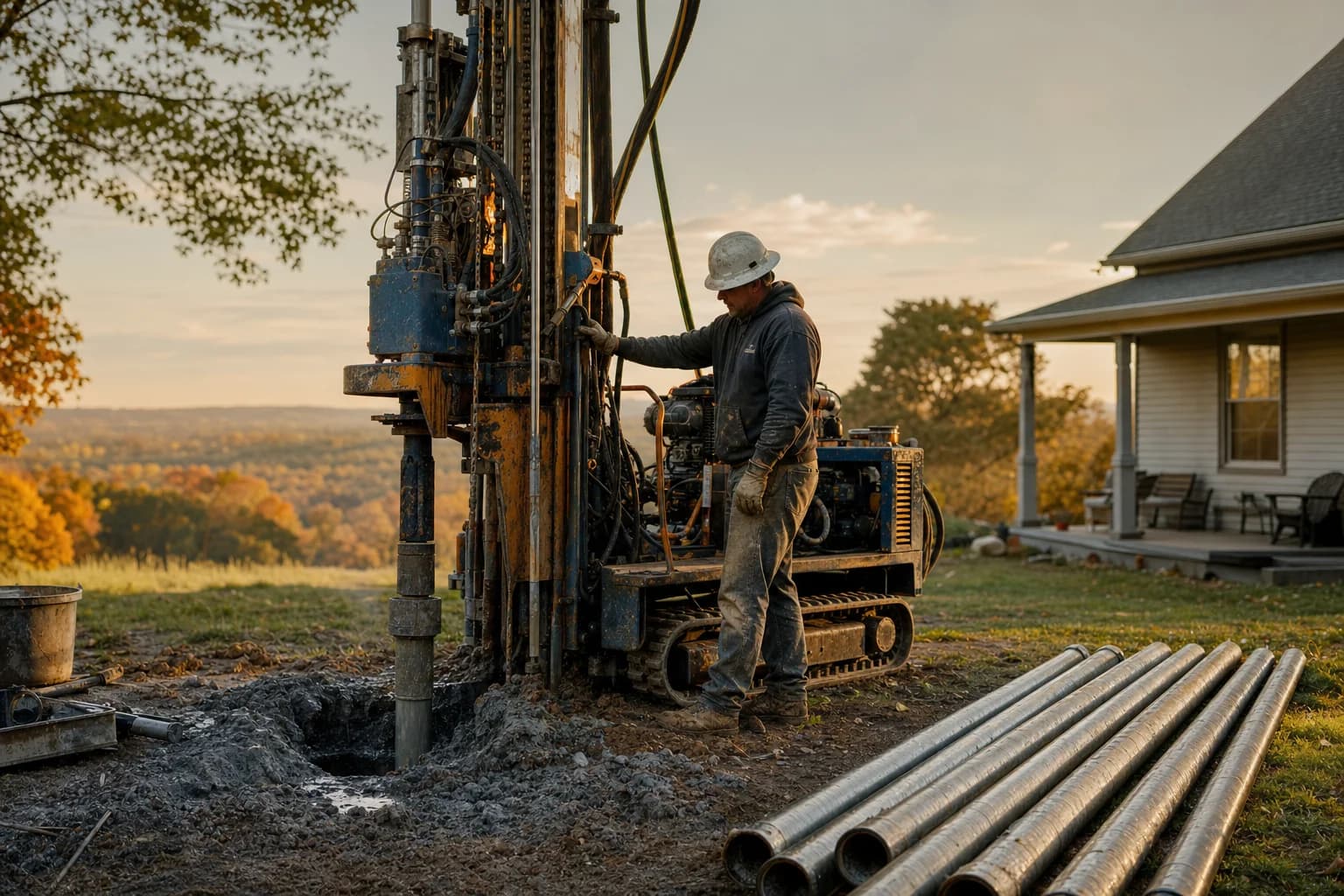
What Is a Drilled Well?
A drilled well is a deep, machine-bored water well lined with continuous casing and sealed with grout - the construction type behind nearly all new private wells in the United States.
The EPA classifies private wells into three types by how they are built: dug or bored wells, driven wells, and drilled wells. Drilled wells are constructed with powerful truck-mounted rigs - rotary, cable tool, or down-the-hole hammer - that can bore hundreds of feet through soil and solid rock. Typical residential drilled wells run 100 to 400 feet, the national average is roughly 150 feet, and wells in arid or hard-rock regions commonly exceed 500 feet.
Depth is the whole point. Shallow wells draw from the unconfined surface water table, which rises and falls with the weather and collects whatever soaks in from above. A drilled well punches through impermeable clay or rock into a confined aquifer: groundwater trapped under pressure between impermeable layers, isolated from surface runoff and recharged over long distances and timescales. Think of it as a pressurized water reserve under a heavy seal - nothing spilled on the surface above reaches it directly.
That depth, plus continuous steel or PVC casing and a sanitary grout seal, is why drilled wells carry the lowest contamination risk and the highest drought resilience of any well type - and why virtually every state now requires drilled construction for new residential wells. DrillerDB's database of 18 million+ U.S. well records shows what this looks like in practice: you can browse real drilled-well depths in your neighborhood on the interactive well map, or find out which aquifer your well actually draws from - it determines your depth, yield, and water chemistry.
$7,500
average total cost of a complete residential drilled well system (2024-2026 national data)
Source: HomeGuide
Drilled vs. Dug vs. Driven Wells
The three well types tap different layers of the earth - and the differences in safety, reliability, and lifespan are dramatic.
Dug wells are wide, shallow shafts excavated by shovel or backhoe and lined with stone, brick, or concrete tile. Driven wells are narrow pipes with a screened "sand point" tip, hammered into loose sand or gravel. Both stop in the shallow, unconfined water table. Drilled wells go far deeper, into confined bedrock or deep sand aquifers, and are the only type built with a continuous casing and grout seal from top to bottom.
How a Drilled Well Is Constructed, Step by Step
From siting to the first glass of water, a drilled well takes 6 to 12 weeks end to end - though the drilling itself usually takes just 1 to 5 days.
1. Siting and permitting (2-6 weeks)
Before a rig arrives, the driller picks the spot - not with a dowsing rod, but with state geological surveys, topographic maps, and databases of nearby well logs. The site must honor sanitary setbacks: commonly 50 to 100 feet from septic tanks and drain fields, 10 feet from property lines, and clear of overhead power lines. The contractor then files permits with the local or state health department.
2. Drilling the borehole (1-5 days)
The borehole - typically 8 to 10 inches in diameter - is bored by one of three methods, chosen for the geology:
- Rotary drilling (mud or air). The modern workhorse. A rotating bit grinds through soil and rock. Mud rotary circulates bentonite drilling fluid to cool the bit, lift cuttings, and hold soft walls open; air rotary uses high-pressure air and excels in hard bedrock.
- Cable tool (percussion). The oldest method: a heavy chisel bit is repeatedly raised and dropped to crush rock, which is bailed out. Slow, but still used where boulders or dense glacial till defeat rotary rigs.
- Down-the-hole (DTH) hammer. A pneumatic hammer mounted behind the bit strikes rapidly as it rotates - the go-to for pulverizing granite and basalt.
3. Setting the casing and screen
Once the bore reaches a water-bearing zone, the driller inserts the casing - usually 6-inch steel or Schedule 40/80 PVC - to hold the hole open and provide a sanitary conduit. In sand or gravel aquifers, a slotted well screen goes at the bottom to let water in while keeping sediment out, often surrounded by a graded gravel filter pack. In stable fractured bedrock, the lower borehole may remain open rock with no screen.
4. Grouting the annular space
The most important step for water safety. The gap between casing and earth (the annular space, about 1 to 2 inches) is pumped full of bentonite clay or neat cement grout. Without it, surface water and septic seepage could run straight down the outside of the casing into your drinking water. State codes typically require the seal to extend at least 20 to 50 feet below grade.
5. Well development and yield testing (1-2 days)
Drilling plugs the aquifer face with mud and rock dust, so the driller "develops" the well - surging and jetting water and compressed air through the screen to flush out fines and settle the filter pack. Then comes the pump test: sustained pumping that measures yield in gallons per minute (GPM) and drawdown, proving the well can support a household.
6. Pump installation and plumbing (1-3 days)
A submersible pump is lowered deep into the casing on a drop pipe - standard for wells over 25 feet (shallow wells can use above-ground jet pumps). A pitless adapter, fitted through the casing wall below the frost line, routes water underground to the house without any freeze-prone exposed plumbing. Crews trench the water line and pump wiring to the pressure tank indoors.
7. Wellhead completion and disinfection (3-10 days)
The casing is finished 12 to 24 inches above grade and fitted with a vermin-proof, vented sanitary well cap. The driller shock-chlorinates the system to kill bacteria introduced during construction, then samples the water for lab testing. Once the lab clears it and the final inspection passes, the well goes into service - and the driller files the completion report with the state.
Who does what
Typical Drilled Well Depths and Costs by Region
Drillers quote by the foot, so the two numbers that set your price are how deep the water is and how hard the rock is on the way down.
Drilling alone runs about $25 to $65 per foot; a complete system - drilling, casing, grout, pump, pressure tank, trenching, and electrical - averages $30 to $80+ per foot. Nationally that puts most finished residential wells between $3,000 and $15,000+, averaging around $7,500. Geography is destiny: the same house budget buys a finished 120-foot well in Indiana's soft glacial soils or barely starts a 500-foot hole in San Diego granite.
Regional figures compiled from licensed drilling contractors' published 2024-2026 pricing; see the sources list. Costs compound non-linearly past ~400 ft (heavier rigs, thicker casing, high-horsepower pumps). Always get 2-3 local quotes.
Depth pressure is real and growing. USGS monitoring in California's Central Valley shows intense drought-era pumping pulling water tables down so far that residents must deepen wells just to keep flow - in most of the Tulare Lake region, new wells are being constructed progressively deeper over time, some past 1,000 feet. Before you take quotes, look at what is actually under your property: the DrillerDB geology estimator predicts likely well depth from real drilling records near your address, and the well map shows the recorded depth of existing wells around you. For a quick read on just the groundwater, you can look up the likely water table depth near your address and the typical well depth alongside it.
Anatomy of a Finished Drilled Well
A completed well is an integrated system - one passive structure in the ground plus a chain of mechanical parts that move and pressurize the water.
From the bottom of the borehole to your kitchen tap:
- Borehole and casing - the structural spine. A 6-inch steel or PVC pipe inside an 8-to-10-inch bore, holding the earth back and giving water a sanitary path up.
- Well screen and filter pack - the slotted intake at the bottom that admits water while excluding sand that would shred pump impellers.
- Grout seal - bentonite or neat cement filling the annular space, legally required to block surface contamination from traveling down the casing.
- Submersible pump - the workhorse, suspended on a drop pipe well below the pumping water level (and 10-20 feet above the bottom, clear of settled sediment). Typically 1/2 to 5 HP depending on depth; costs $150-$1,500+.
- Pitless adapter - the frost-proof fitting ($40-$150) through the casing wall, 3 to 6 feet down, routing water underground to the house.
- Well cap - the vented, gasketed, bolted cover ($40-$75 for a sanitary model) that keeps insects, rodents, and runoff out of the casing.
- Pressure tank and switch - indoors, a bladder tank ($300-$800+) buffers pressure so the pump is not forced to start at every faucet draw; the switch cycles the pump between 30/50 or 40/60 PSI.
Each of these parts has its own failure modes, maintenance schedule, and replacement cost - our well system components guide covers every one in detail.
How Long a Drilled Well Lasts - and What Determines It
The hole in the ground outlives the machinery inside it: plan on 30-50+ years for the structure and 8-15 years per pump.
A properly constructed casing, grout seal, and borehole routinely last 30 to 50 years and often longer. What cuts that short: corrosive or acidic water slowly eating steel casing (PVC or stainless solves this), and regional water-table decline from drought or heavy agricultural pumping, which can leave an aging well literally high and dry.
The mechanical side turns over faster. Submersible pumps last about 8 to 15 years; their main killers are sand pumping through the impellers (often a degraded screen), mineral scaling, and short cycling - a failed pressure tank bladder forcing the pump to slam on and off with every flush, burning out the motor in a fraction of its rated life.
The cheapest life-extension program is boring: an annual bacteria and nitrate test, a yearly knock test, a glance at the wellhead each season, and a professional system audit every 3 to 5 years that checks pump amp draw, static water level, and specific capacity against the original well log.
Permits and Regulations
Drilling a well without a permit is illegal everywhere in the U.S. - and the rules about where and how you drill exist to protect the aquifer everyone shares.
Permitting runs through your state, county, or local environmental health department, and the licensed driller normally files it for you. Costs and process vary widely: Minnesota requires a Well Construction Notification with a fee (about $325) before any drilling starts, while some California counties run reviews that take weeks and cost over $1,000.
The rules cover more than paperwork: sanitary setbacks (typically 50-100 feet from septic systems, uphill from contamination sources, 10 feet from property lines), minimum grout depths, mandatory bacteria and nitrate testing before the well is approved for drinking, daily extraction limits for domestic wells in some states, and a completion report the driller must file when the job is done.
Requirements differ meaningfully state to state - licensing, setbacks, testing, and record systems all vary. Find the rules, agencies, and record-lookup links for your state in our state-by-state well owner guides.
How to Read a Well Log / Completion Report
Every drilled well has a birth certificate on file with the state - and it is the single most useful document a well owner can hold.
The well log (well completion report) is the document your driller filed when the well was finished. It contains four things you cannot learn any other way:
- Header and location - original owner, drilling date, and coordinates of the borehole.
- Lithologic log - a foot-by-foot diary of the geology (e.g., 0-20 ft topsoil and clay, 20-150 ft gray shale, 150-250 ft fractured sandstone), which explains your water chemistry and flow.
- Construction details - total depth, casing diameter and material, grout seal depth, and screen placement.
- Water level and yield data - the static water level (pump off), pumping level, drawdown, and tested yield in GPM.
That last section is diagnostic gold. If the 1995 log says the static level was 50 feet and today it measures 150, the aquifer is declining. If the static level is unchanged but yield has collapsed, the screen is likely scaled or clogged and the well needs rehabilitation, not replacement.
Look up your own well's record: our find-your-well-record guidewalks through every state's lookup system step by step. Curious how deep wells around you are before you drill or buy? Browse recorded depths on the well map or get a site-specific prediction from the geology estimator, both built on DrillerDB's 18 million+ well records.
Questions to Ask a Drilling Contractor
A dry hole or a botched seal costs as much as a good well. Interview drillers like you mean it - the good ones respect the questions.
When you are ready for bids, find licensed well drilling contractors near you - DrillerDB profiles show service areas, licensing, and reviews, so you can build a shortlist worth interviewing.
Frequently asked questions
Keep reading
Sources & further reading
- Learn About Private Water Wells — U.S. EPA (accessed June 2026)
- Aquifers and Groundwater — USGS Water Science School (accessed June 2026)
- How Much Does It Cost to Drill a Well? — HomeGuide (accessed June 2026)
- Wells (Groundwater Management) — California Department of Water Resources (accessed June 2026)
- Why Is Groundwater Quality Changing? — USGS California Water Science Center (accessed June 2026)
- How to Read a Well Report — Whatcom County, WA / WA Dept. of Ecology (accessed June 2026)
- Wells and Borings — Minnesota Department of Health (accessed June 2026)
- Sanitary Water Well Construction — Penn State Extension (accessed June 2026)
- The Private Well Class — Illinois State Water Survey / EPA (accessed June 2026)
- Wellowner.org Well Care Resources — National Ground Water Association (accessed June 2026)