A hardened point, a stack of pipe, and a long day with a driver - where the geology and the rules allow it, a driven well is still the cheapest working well on earth. Here is where they work, how to drive one, and the honest limits.
9 min readUpdated July 2026
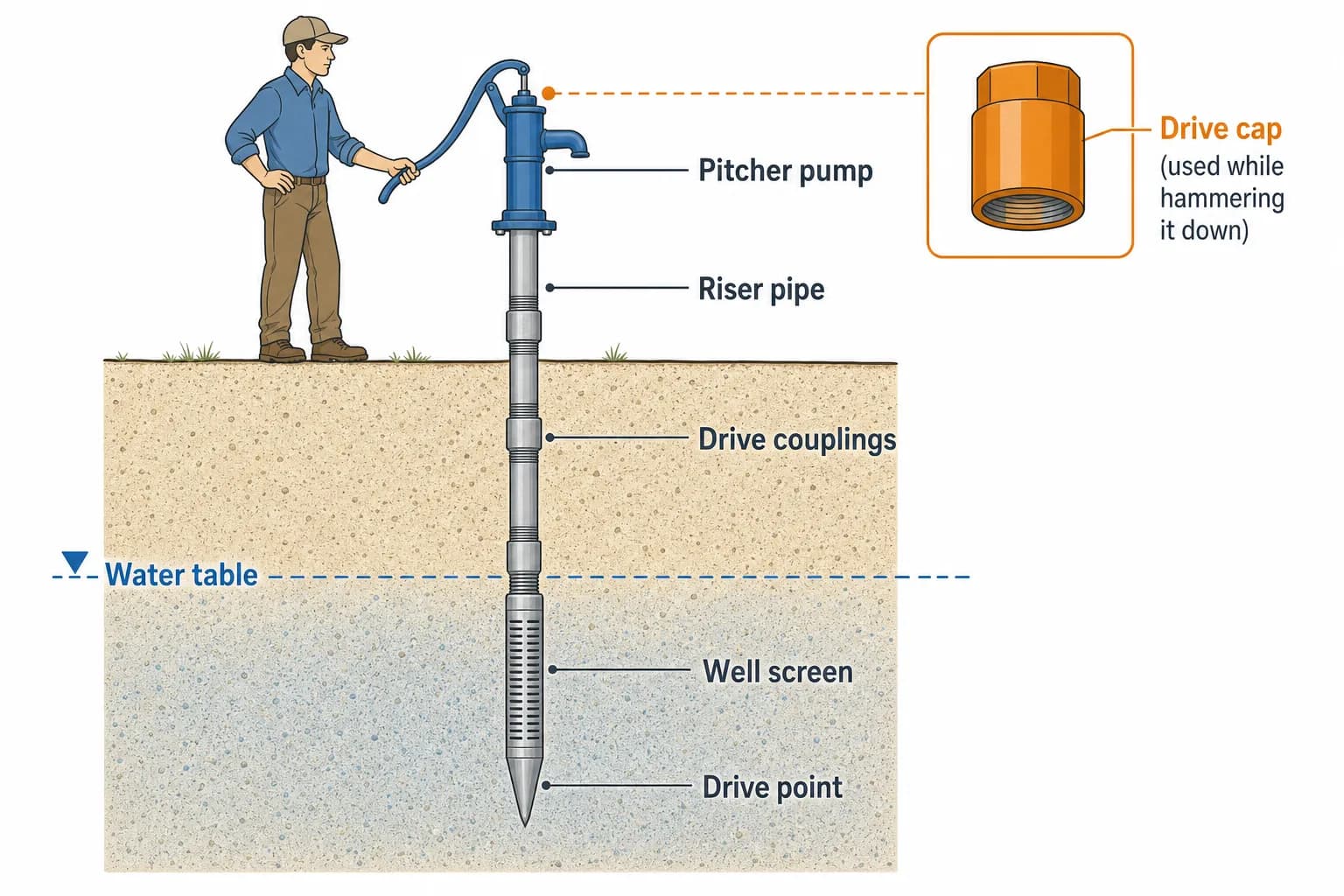
A sand point is hammered, not drilled: point, screen, riser, pitcher pump.
What a Sand Point Well Is
Of the three classic well types - dug, driven, drilled - the driven well is the one a determined owner can still build with hand tools.
The business end is the sand point itself: a forged steel tip attached to a 2-4 foot screened section, sized for 1.25 to 2 inch pipe. Threaded pipe sections stack above it, and the whole assembly is driven vertically into the ground - through soil, into saturated sand - until the screen sits below the water table. A pitcher pump or shallow-well jet pump at the surface pulls water by suction. The USGS puts typical driven wells at 30 to 50 feet; many working sand points are shallower.
Compare that with a modern drilled well - hundreds of feet of cased borehole with a submersible pump - and the sand point looks like a toy. But a toy that delivers real water for a few hundred dollars has never gone out of style at cabins, gardens, and stock tanks. For the full family tree, see types of water wells.
Where Sand Points Work (and Where They Never Will)
Three conditions, all mandatory: driveable ground, water within suction reach, and rules that allow it.
Sandy or gravelly soil, all the way down. The point must be physically driven, so dense clay, hardpan, cobbles, or shallow bedrock end the project - sometimes at the two-foot mark. Lakeshore, riverbank, outwash plains, and sandy coastal soils are classic sand point country.
Water table within about 25 feet. A surface suction pump cannot lift from deeper - atmospheric physics, not pump quality (the same limit explained in our hand pump guide). The water must also stay within reach in late summer and drought, not just in April.
A jurisdiction that allows it. Rules vary hard by state - see the legality section below.
Before buying anything, do the two free checks: look up nearby wells on the well mapto see how deep your neighbors' water is, and check the aquifer under your property. If neighboring wells are all 150-foot drilled holes, your sand point money is better spent on a driller's site visit.
How a Sand Point Is Driven
The method has not changed in a century: protect the pipe threads, hit it square, add sections, listen to the ground.
Driving a sand point, step by step
As needed
A one-to-two person job. Rent a post driver if you value your shoulders; some installers start the hole with a hand auger to save the first few feet of driving.
Check rules and call 811 before any driving
Utility lines run shallower than sand points. 811 marking is free and required.
Pick the spot with setbacks in mind
Uphill and at least the state-required distance from septic fields, animal yards, and fuel storage.
Start a pilot hole with a hand auger (optional but smart)
Saves driving effort and keeps the point vertical.
Drive with a cap protecting the threads
Post driver or sledge on a drive cap; keep the pipe plumb; snug couplings with each section.
Add pipe sections and check for water as you go
Drop a weighted string down the pipe - wet string means the screen is entering the aquifer. Drive the full screen below the water table.
Develop the well before judging it
Surge and pump until the water runs clear - a new screen needs to build its natural gravel pack.
Mount the pump, seal the top, and test the water
A proper sanitary termination and a coliform + nitrate test before anyone drinks it.
When the point refuses, believe it
A point that stops advancing has hit clay, cobbles, or rock, and more violence just wrecks the screen or shears a coupling. Pull it (a farm jack and chain work), move a few feet, or accept that the site wants a drilled well. Driving past refusal is how a $400 project becomes a $400 loss.
Yield and Depth: The Honest Limits
A sand point is a low-yield, shallow, vulnerable well. Every one of those words has consequences.
Sand point vs drilled well, honestly
Feature
Sand point (driven)
Drilled well
Typical depth
20-50 ft
100-400+ ft
Yield
A few GPM, suction-limited
Sized to household demand
Drought resilience
Poor - shallow table drops first
Good - deeper aquifers
Contamination exposure
High (shallow, minimal casing)
Lower (cased, grouted, deep)
Household primary supply
DIY possible
Typical cost
$300-$1,000 DIY
See the national cost guide
Shallow also means vulnerable: the same rain that recharges a sand point in days can carry fertilizer, septic effluent, and road salt with it. If a sand point supplies anything people drink, treat annual testing for bacteria and nitrate as non-negotiable, and read up on nitrates and coliform - the two classic shallow-well findings.
Permits and Legality: Check Before You Buy Pipe
A sand point is still a well in the eyes of your state - and states disagree sharply about who may build one and where.
The spread is wide. Wisconsin - classic sand point country - allows owner-driven points but regulates their construction, location, and setbacks under the state well code (Wisconsin DNR, cited below). Some states require a notification or permit before any well construction; some require even driven wells to be installed by licensed contractors; many prohibit new drinking-water sand points inside city limits or near contamination sources. Setback distances from septic systems, livestock yards, and fuel tanks apply everywhere and are the rule most DIYers accidentally break.
Before spending a dollar: check your state's page in our state-by-state well guides for permit requirements and setbacks, and call the county health department - they answer this exact question weekly. If your property already has an old unused point, state rules on proper well abandonment apply to it too; an open abandoned pipe is a direct channel into the aquifer.
Lifespan, Redevelopment, and 2026 Costs
The screen is the consumable. Everything else is plumbing.
Expect 10-25 years from a screen before scale and fines choke it, water-chemistry depending. A fading point can often be redeveloped - surging, backflushing, or an acid treatment appropriate to the scale - and when redevelopment stops paying, the honest fix is driving a fresh point a few feet away. Iron-rich water (common in the same sandy aquifers sand points love) accelerates screen plugging; our iron in well water guide covers what that chemistry does to equipment.
Sand point well costs (2026 ranges)
Item
Typical Low
Typical High
Notes
Sand point (tip + screen)
$50
$150
Stainless screens at the top of the range.
Pipe, couplings, drive cap, fittings (25-50 ft)
$150
$400
Galvanized or dedicated drive pipe.
Pitcher pump or shallow-well jet pump
$75
$500
Manual spout vs powered pressure delivery.
Complete DIY project, typical
$300
$1,000
Assuming your own labor and a cooperative site.
Contractor-installed driven well
$1,000
$3,000+
Where allowed; includes development and sanitary termination.
Materials pricing, 2024-2026. Budget for the possibility of refusal - a second point and a second attempt are part of honest sand point math, so keep leeway in the budget rather than planning the best case.
Frequently asked questions
A sand point (driven) well is the simplest well there is: a hardened steel point with a screened section, threaded onto lengths of 1.25-2 inch pipe, physically driven into the ground until the screen sits in a shallow water-bearing sand or gravel layer. A suction pump at the surface then draws the water. The USGS classifies driven wells as typically 30-50 feet deep.
Only where three things line up: soft, sandy or gravelly soil you can physically drive pipe through (no dense clay, cobbles, or bedrock near the surface); a water table within about 25 feet of the surface (the suction-pump limit); and a state or county that allows them. That combination is common near lakes, rivers, and in sandy glacial country - the upper Midwest, parts of the coastal plains - and rare in rocky or deep-water-table country.
Yes - it is the one well type that is genuinely DIY-able where conditions and rules allow. The classic method is a post driver or sledge on a drive cap, adding 5-6 foot pipe sections as you go. Plan on a hard day or two of labor, check your state's rules first (some require notification, permits, or licensed installers even for driven wells), and be prepared for the point to refuse - hitting clay or cobbles ends the attempt.
Modest amounts: enough for a garden, a cabin, livestock, or a single outdoor spigot. Yield depends on the screen sitting in clean, permeable sand and on the aquifer itself; a good sand point delivers a steady few gallons per minute through a suction pump, and a silty or poorly-developed one delivers frustration. They are not a match for a modern household's peak demand.
Treat it as unproven until tested. Driven wells are shallow by definition, and shallow groundwater is the most vulnerable to surface contamination - bacteria, nitrates from fertilizer or septic systems, and road salt. If it will be drinking water, test before first use and then at least annually for coliform bacteria and nitrate, and check your state's guidance for local concerns.
The screen is the wear item: 10-25 years is common before mineral scale and fine sediment choke it. A declining well can often be redeveloped - surged, backflushed, or treated to clean the screen - and when that stops working, the usual fix is pulling or abandoning the old point and driving a new one a few feet away. Abandonment must follow state rules; see our guide to properly abandoning a well.
If the water is for a house, almost always yes: a drilled well reaches deeper, cleaner, more reliable water and supports a submersible pump. A sand point earns its keep for low-stakes water - irrigation, a cabin, stock - where its few-hundred-dollar cost and DIY install beat a five-figure drilling job. Compare honestly against the real cost to drill in our national cost guide.
Geology says no? Get a real quote before giving up on well water.
If your soil or water table rules out a sand point, drilling may still pencil out. Get quotes from licensed local drillers, and check nearby well depths first so you know what you are in for.