
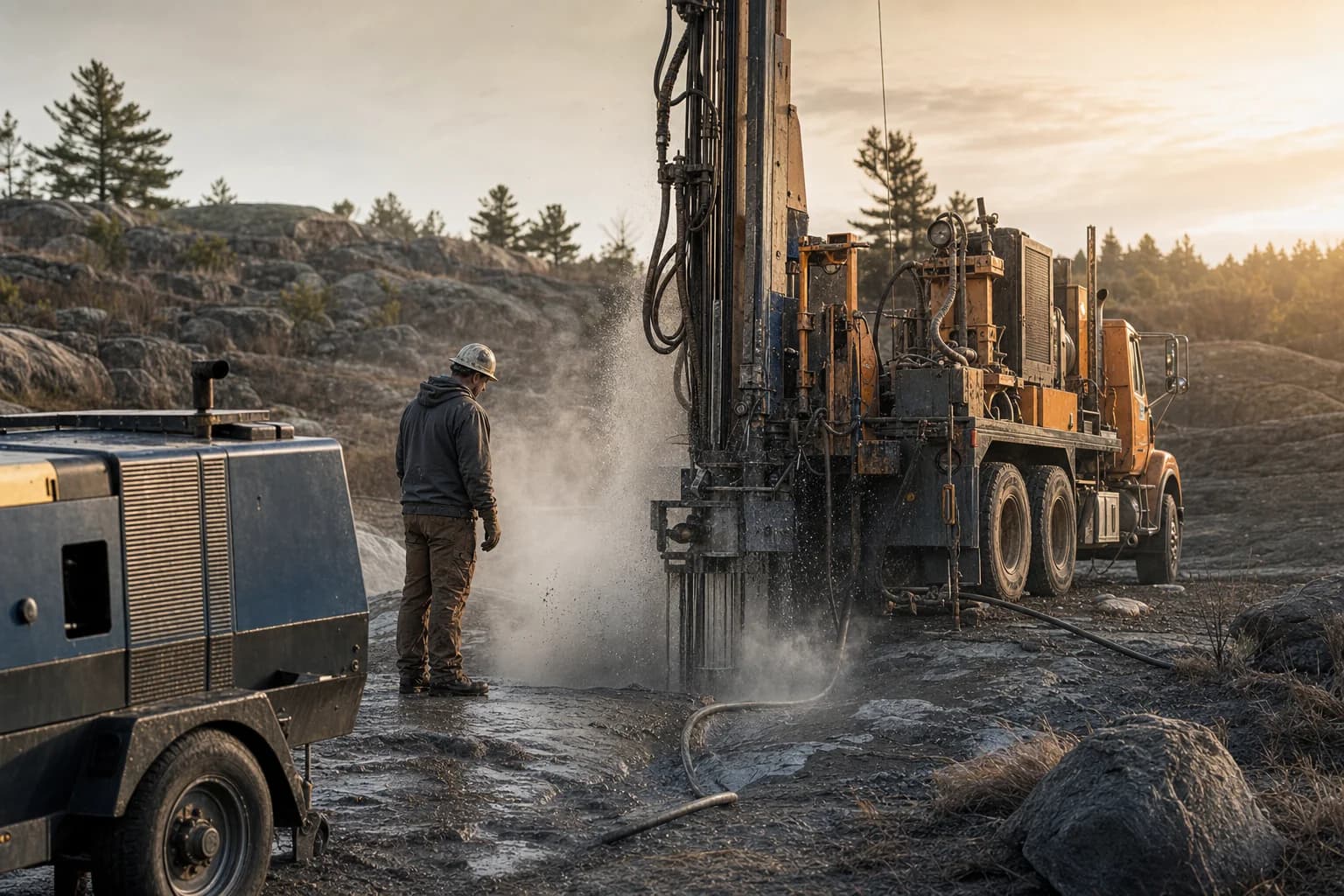
How Air Rotary Drilling Works
Air rotary replaces liquid drilling fluid with high-pressure compressed air. That one substitution does three jobs at once: it powers the hammer at the bottom of the hole, cools the bit, and blasts the pulverized rock back to the surface.
The heart of the system is an onboard rotary screw compressor - on modern residential rigs, typically rated at 900 to 1,250 CFM (cubic feet per minute) and 350 to 500 PSI. The air travels from the compressor through the rig's top-head drive, down the inside of the hollow drill pipe, and out through the bit at the bottom of the hole. It then turns around and races back up the annulus - the ring-shaped gap between the drill pipe and the borehole wall - carrying the rock cuttings with it.
That return trip is the part drillers obsess over. If cuttings stop moving up, they fall back onto the bit, the bit grinds old debris instead of fresh rock, and in the worst case the whole drill string gets stuck downhole. The U.S. Geological Survey's drilling manual puts the minimum uphole air velocity for cleaning a hole with dry air at 3,000 feet per minute - which is why drillers also inject water mist, foam, or polymers into the airstream when holes get deep or wet. Foam binds to rock chips and dramatically improves the air's lifting capacity, while also suppressing silica dust at the surface.
The cutting itself is done by one of two tools. In medium-to-hard rock, a tricone roller bit - three rotating cones studded with tungsten carbide teeth - crushes and shears the formation as the pipe turns. In genuinely hard rock (granite, basalt, quartzite), drillers switch to a down-the-hole (DTH) hammer: a pneumatic piston mounted directly behind a carbide button bit that strikes thousands of high-frequency blows while the string slowly rotates. Because the hammer sits at the bottom of the hole, none of the impact energy is lost through hundreds of feet of pipe - the source of air rotary's famous penetration rates. The hammer is interesting enough to get its own guide.
One failure mode worth knowing about: lost circulation. If the air escapes into large fractures or cavities instead of returning up the annulus, uphole velocity collapses and cuttings stop reaching the surface. Drillers respond by injecting stiff foam or lost-circulation materials to plug the voids, or by advancing steel casing past the troublesome zone. You will hear these terms on site; neither means your project is in trouble, just that the formation is fighting back.
The rigs themselves are self-contained mobile factories built around a hydraulic top-head drive that travels up and down the mast. The American fleet is dominated by a few heritage names your driller will mention like old friends: the Ingersoll Rand T3W and T4W lineage (now under Epiroc after Atlas Copco spun off its drilling division in 2018), Schramm's heavy-duty top-head rigs common in the Mountain West and Northeast, and GEFCO rigs frequent in the Midwest and South - the flagship GEFCO 30K carries a 565 HP engine and an onboard 1,000 CFM / 350 PSI compressor.
Where Air Rotary Excels - and Where It Fails
Drilling methods are married to geology. Air rotary is peerless in consolidated rock and fundamentally unsuited to loose sand - and using it in the wrong ground is a leading cause of abandoned boreholes.
In competent rock - granite, basalt, sandstone, limestone - the borehole walls support themselves, so the air's only job is to power the hammer and lift clean chips. In those conditions an air rotary rig can advance 50 to 200 feet per day. Just as valuable: because air does not plaster over aquifer fractures the way drilling mud does, the crew sees water the moment the bit hits it, blowing out of the blooey line in real time. That makes hard-rock regions - New England, the Sierra foothills, the Mountain West, the fractured bedrock of the Appalachians - classic air rotary country.
The mirror image is loose, unconsolidated ground: heaving sands, gravel and cobbles, soft clays. Oregon DOT's geotechnical manual notes that air drilling in soft soils blows out voids, disturbs the formation, and throws sediment-laden water around the site; without the hydrostatic support of liquid mud, a sandy hole simply caves in around the pipe. USGS well-construction logs record exactly this - air rotary holes abandoned because loose sedimentary layers kept collapsing into the bore. Deep alluvial country like California's Central Valley or sandy coastal plains is mud rotary territory instead.
Most real homesites are a sandwich: some thickness of soil and gravel over bedrock. The standard solution is a casing advancement system - best known by the trade name ODEX (and modern symmetric equivalents like Symmetrix). An eccentric reaming wing on the pilot bit cuts a hole slightly larger than the steel casing, and the casing is driven down foot-by-foot directly behind the bit, so the loose ground never gets a chance to collapse. At bedrock, the driller reverses rotation, the wing folds in, the bit comes back up through the casing, and drilling continues open-hole with standard air tooling.
Which method fits your lot is ultimately a geology question, and it is answerable before anyone quotes you. Check the real well logs from neighboring properties - depth, rock type, and yield - on the DrillerDB well map, and read up on your local formations in our geology hub. If every well on your road is 300 feet into granite, you already know what kind of rig is coming.
On Site: What the Homeowner Actually Sees
Hosting an air rotary rig is a short but intense construction event: a 40-foot machine, industrial noise, a rock pile, and - if all goes well - water blowing out of the ground by day three.
The raw drilling is remarkably fast, but the complete project is not. Plan on the rig and its support trucks (a pipe truck and a water truck) occupying your property for several days, with the full turnkey installation - through pump, trenching, and electrical - spanning 1 to 2 weeks:
102 dBA
noise level 10 feet from an operating air rotary rig - dropping to about 83 dBA at 50 feet and 71 dBA at 200 feet, comparable to heavy highway construction
The mess. Everything the bit pulverizes comes out of the ground through the blooey line - a large discharge pipe that spits rock dust, gravel, foam, and water into a containment area. A typical 200-foot well produces roughly 2.6 cubic yards of cuttings once the pulverized rock bulks up. The pile is non-toxic ground rock, and spreading it as fill or landscaping material after the rig leaves is genuinely homeowner work. The rig itself weighs tens of thousands of pounds and needs roughly 40 feet of length plus 40-45 feet of vertical mast clearance - expect rutted grass and compacted soil along its access path.
Water needs. Counterintuitively, the air method still uses water - the crew injects 5 to 25 gallons per minute during certain phases to suppress dust, cool the bit, and thicken the airstream - but total project usage typically lands between 100 and 500 gallons, versus the 1,000-3,000+ gallons a mud rotary pit demands. On a dry rural site, that difference matters.
The Blowing Yield Test
Air drilling comes with a built-in party trick: the driller can estimate your well's production before the rig ever leaves the hole.
Because the borehole is under enormous pneumatic pressure, any groundwater entering the hole gets blown to the surface along with the cuttings. To run a blowing yield test, the driller lifts the bit slightly off bottom and blows pure air down the hole for an extended period, measuring the water that exits the blooey line into a container or trench. It is fast, free, and a genuinely useful first estimate of gallons per minute.
It is also only an estimate. Air pressure can restrict natural inflow, or temporarily blow out a static pocket of water that will not recharge. For a certified figure - the kind real estate transactions and some lenders require - the Water Systems Council calls for a formal pumping test: a submersible pump run continuously for several hours (up to 24) while the drawdown is measured until the water level stabilizes. As a benchmark, 5 to 10 GPM is an excellent residential yield; below about 3 GPM, plan on a storage tank. How yield, pressure tank, and pump fit together is covered in our well components guide.
Speed, Depth, and What It Costs
Air rotary trades expensive iron for cheap hours: the rigs cost millions, but they finish in days. Depth capability runs past anything a house will ever need - modern high-pressure rigs reach 1,000 to 2,500+ feet.
The depth limit is set by physics: groundwater exerts about 1 PSI for every 2.31 feet of standing water column, so a hammer working 460 feet below the water table is pushing against 200 PSI before it does any work. That is why modern 350-500 PSI compressors matter - older 250 PSI rigs would simply "flood out" in high-yielding aquifers. For a residential well, capability is never the constraint; cost is.
On price, the single most important thing to understand is the difference between the drilling rate (the per-foot number in the ad) and the turnkey system cost (what you actually write checks for, including casing, grout, pump, pressure tank, wiring, and trenching). Per 2026 national data, drilling alone runs $25-$65 per foot, while complete systems average about $7,500 and range from $3,000 to $15,000+ - with hard-rock air work at the top of the per-foot scale.
National ranges from 2026 industry pricing guides; steel vs. PVC casing prices and fuel surcharges move local quotes. Always get 2-3 turnkey bids.
Air Rotary vs. Mud Rotary vs. Cable Tool
Different drillers will propose different methods based on their fleet and the local ground. Here is how the three main residential options actually compare.
Mud rotary's wall-supporting fluid temporarily seals aquifer fractures ("wall cake"), so mud-drilled wells need more post-drilling development; air-drilled and cable-tool wells expose water zones cleanly as they go.
The practical translation: in hard-rock country (the Sierra foothills, New England, the Mountain West), air rotary is the default and usually the cheapest path to water. In deep sandy basins, mud rotary is not a preference but a necessity. And cable tool - functionally antique - survives in niches where finding thin, low-yield water veins takes a surgical patience that fast rotary methods would blow right past. For the full landscape, including sonic, jetting, and bucket auger rigs, start at the well drilling methods hub, and see types of water wells for how drilled wells compare to dug and driven ones.
Questions to Ask Your Driller About Air Rotary
A good contractor will answer all of these without flinching. Print this list and bring it to the site visit.
Licensing is non-negotiable: every state regulates well construction, and the combination of 500 PSI air, rotating steel, and aquifer protection rules makes this strictly professional work. Verify credentials and compare local contractors at find a well driller.
Frequently asked questions
Keep reading
Sources & further reading
- Application of Drilling, Coring, and Sampling Techniques (TWRI Book 2, Ch. F1) — U.S. Geological Survey (accessed June 2026)
- Well Development Using Compressed Air — Water Well Journal (NGWA) (accessed June 2026)
- Choosing the Right Drilling and Well Development Method — Water Well Journal (NGWA) (accessed June 2026)
- Geotechnical Design Manual (2024) — Oregon Department of Transportation (accessed June 2026)
- Data Series 1058, Appendix B: Well Construction Logs — U.S. Geological Survey (accessed June 2026)
- Determining the Yield of Your Well — Water Systems Council (accessed June 2026)
- Well Drilling Manual — National Ground Water Association (accessed June 2026)
- Air Rotary vs. Mud Rotary Drilling — SC Well Service (accessed June 2026)
- Rotary Drilling Technologies — Cascade Environmental (accessed June 2026)
- Gas Well Drilling Noise Impact and Mitigation Study — Pipeline Safety Trust (accessed June 2026)
- Well Drilling Costs (2026 Pricing Guide) — WellDrillingCosts.com (accessed June 2026)
- Well Drilling Costs in 2025 — Epp Well Solutions (accessed June 2026)
- How Much Does Well Drilling Cost? — Angi (accessed June 2026)
- Frequently Asked Questions — Friedel Drilling (accessed June 2026)
- Epiroc Group (formerly Atlas Copco drilling division) — Epiroc (accessed June 2026)
- Schramm Inc. - Top-Head Drive Drill Rigs — Schramm (accessed June 2026)
- GEFCO 30K Drill Rig Specifications — GEFCO (accessed June 2026)