
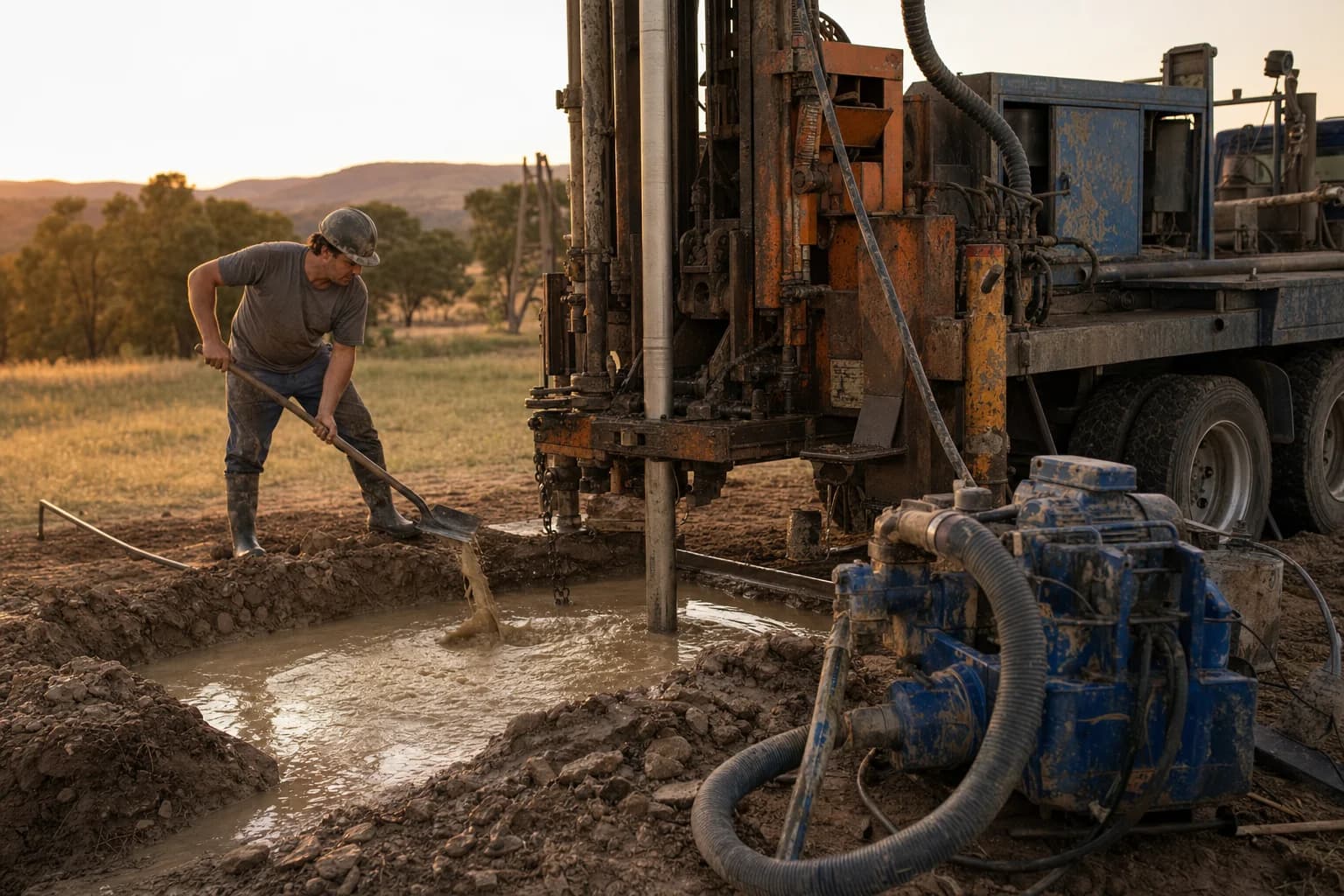
What Is Mud Rotary Drilling?
Mud rotary - formally direct mud rotary - drills with a rotating bit on hollow pipe while a continuous stream of engineered fluid does three jobs at once: cooling the bit, carrying cuttings to the surface, and holding the raw borehole open.
The best way to understand mud rotary is to stop thinking of drilling as digging a deep hole and start thinking of it as a fluid-based, recirculating excavation system. The "mud" is not a byproduct - it is a structural component of the well while it is being built. The heavy column of fluid presses outward against loose sand and gravel with enough hydrostatic pressure to keep the hole from collapsing, something no amount of clever tooling can do on its own.
The technique was born in the Texas oil patch. On January 10, 1901, at Spindletop Hill near Beaumont, drillers deliberately pumped thick mud to stabilize hundreds of feet of caving sand - the first documented use of mud to hold a borehole open by hydrostatic pressure. At 1,139 feet the well erupted as the legendary Lucas Gusher, and modern rotary drilling was born. By the 1920s engineered bentonite had replaced shovel-mixed native clay, and that is essentially the system residential water well drillers still run today.
If your driller proposes mud rotary, it is almost never a preference - it is what your geology demands. Before bids arrive, you can check the real depth, geology, and yield of wells already drilled around your property on the DrillerDB well map, which makes the "why this method?" conversation with your contractor much more concrete.
How It Works: The Mud Circulation Loop
Everything in mud rotary revolves around one closed loop. If any stage of it fails, drilling stops.
Clean drilling fluid starts in the suction pit, an excavated reservoir (or steel tank) beside the rig. A mud pump draws it out and forces it up the standpipe and through the kelly - the heavy tube that transmits rotation to the drill string. Residential-class rigs push 150 to 360 gallons per minute at 350 to 800 PSI; deep or directional work uses triplex pumps running 450-540 GPM at up to 1,200 PSI. The fluid travels down the hollow drill pipe, jets out through nozzles in the rotating bit, then reverses direction and climbs the annulus - the space between the drill pipe and the raw earthen wall - carrying the crushed cuttings with it. At the surface, the dirty mud runs down a trench into the settling pit, where the heavy cuttings drop out, and the cleaned fluid overflows back into the suction pit to make the trip again.
That loop explains why mud rotary succeeds where other methods fail: the driller is simultaneously cooling the bit, hauling debris out, and pressurizing the borehole walls so they cannot cave. It also explains the method's one famous blind spot - because the hole is full of pressurized surface fluid, the driller cannot simply see water when the bit hits an aquifer. Finding the water-bearing zones takes interpretation: changes in the cuttings, drilling speed, and often geophysical logging after the hole is done.
The Science of the Mud Itself
The word 'mud' undersells it. Modern drilling fluid is a monitored chemical slurry of fresh water, Wyoming bentonite, and polymers - and its properties get checked all day long.
The star ingredient is bentonite, a sodium montmorillonite clay mined primarily in Wyoming. As the pressurized mud pushes water into the porous formation, the microscopic plate-like bentonite particles get left behind, plastered against the borehole wall. The result is the filter cake (or wall cake): a thin, tough, semi-impermeable membrane - ideally about 2/32 of an inch thick - that seals the hole, stops fluid loss, and stabilizes the walls.
Here is the engineering paradox at the heart of every mud rotary well: the driller must deliberately plug the aquifer with clay in order to drill the hole, then aggressively destroy that same clay plug later so the well can produce water. Quality matters enormously. Commercial bentonite builds a thin, tough cake that development can remove; cheap native clay builds a thick, fluffy cake that may never fully come off - and a well that never reaches its real yield.
The crew tracks four fluid properties throughout the job:
- Viscosity - thickness, which lifts the cuttings. Measured with a Marsh funnel: time how long a quart takes to drain. Pure water at 70 degrees F runs 26 seconds; good drilling mud runs 32-38 seconds, pushed to 40-50 in heavy gravel.
- Weight - fresh water is 8.33 pounds per gallon; ideal mud is 8.5-9.5 ppg. Let drilled solids build the weight too high and the fluid can fracture the formation and vanish into it.
- Sand content - kept under 2 percent, because sandy mud is liquid sandpaper that eats the pump, pipe, and bit.
- pH - bentonite hydrates best slightly alkaline, so drillers add soda ash to bring makeup water to a pH of 8.5-9.5.
Where Mud Rotary Excels (and Where It Struggles)
No drilling method is universally best - the ground decides. Mud rotary is the undisputed champion of unconsolidated formations.
Unconsolidated means loose material that never cemented into solid rock: sand, gravel, silt, and clay. In pure sand, a hole drilled with air collapses almost instantly; the hydrostatic pressure of heavy mud is the only practical way to keep a sandy borehole open. That makes mud rotary the default method across the coastal plains and in alluvial valleys - regions built from deep sedimentary deposits, ancient riverbeds, and coastal silts. It also handles interbedded clays gracefully, because the driller can adjust the fluid chemistry to keep native clay from swelling and seizing the drill string. In these settings, mud rotary is fast: up to 300 feet per day in soft ground, with a perfectly cylindrical hole ready for PVC or steel casing.
Its weaknesses are the mirror image:
- Hard rock is slow. Mud rotary can chew through granite or basalt with tricone roller-cone bits, but air rotary penetrates hard rock 2 to 3 times faster.
- Lost circulation.Hit a cavern, void, or heavily fractured zone and the mud escapes into the formation instead of returning to the surface - taking the borehole's pressure support with it. Drillers respond fast with thick "pills" of lost-circulation material to plug the void.
- Aquifer masking. The sealed, fluid-filled hole hides the moment the bit strikes water, so identifying the producing zone takes skill and sometimes logging.
In transitional ground - sediments sitting on bedrock - contractors often run a hybrid job: mud rotary through the loose overburden to set surface casing, then air rotary for the deep rock. Curious what is actually under your lot? The DrillerDB geology hub maps formations from millions of real well logs, and nearby logs on the well map show which method local drillers used at what depth.
What You Will See on Your Site
Mud rotary is a wet, muddy, genuinely disruptive construction event. Knowing what is normal keeps the week from being alarming.
Day one usually starts with a backhoe, not a drill rig. The crew excavates the suction and settling pits next to the drill site - and they are bigger than most homeowners expect, because the rule of thumb calls for combined pit volume of roughly three times the volume of the finished borehole. Then comes the water: mud rotary cannot start without 2,000 to 5,000 gallons of clean makeup water. If you do not have a municipal spigot or hydrant access, expect bulk water truck deliveries before the bit ever turns.
2,000-5,000 gal
of clean makeup water is needed before a mud rotary rig can even begin drilling - often trucked in on rural sites
Source: Lone Star Drills
Two parts of that week deserve a closer look. First, casing and grouting: empty PVC floats in heavy mud, so the crew part-fills the casing with clean water as it descends. State codes then require the annulus to be sealed so surface contamination cannot ride down the outside of the pipe. The standard practice - reflected in EPA guidance and state well manuals - is the tremie pipe method: grout pumped to the very bottom of the annulus pushes the lighter mud up and out, leaving a solid sanitary seal from the bottom up. (More on each part in our well components guide.)
Second, mess and cleanup. Your yard will be an active industrial site: heavy trucks compacting the lawn, and the area around the rig coated in bentonite and cuttings. When the well is done, the spent mud is regulated waste. The EPA classes it as a special waste - non-toxic bentonite or not, it smothers vegetation and shifts the pH of waterways - and dumping it in a stream or storm drain violates the federal Clean Water Act, with state fines reaching $10,000 per day in Texas. Legitimate disposal paths are polymer solidification (drying the pits to a solid that passes the EPA paint filter test before landfilling), vacuum hauling to a licensed facility (common where local rules are strict, as in parts of California and Texas), or land application of clean water-based mud on rural acreage where allowed.
Speed, Depth, and 2026 Costs
Depth is the single biggest cost driver. Mud rotary's materials and cleanup add real line items, but in soft ground its speed keeps total costs competitive.
Aggregated 2025-2026 estimates from the cited national cost surveys; rocky terrain, deep aquifers, and remote mobilization push toward the high end. Get 2-3 local quotes.
On speed: expect roughly 100-300 feet per day in unconsolidated soils and 50-100 feet per day in rock. Typical residential boreholes run 100 to 400 feet deep (most land at 150-200 feet) and are drilled oversized - a 6-to-8-inch hole for 4-inch casing - to leave room for the gravel pack and the annular grout seal. Costs overall have climbed in recent years on steel and PVC supply constraints, diesel prices, and a shrinking pool of licensed drillers, which is one more reason itemized bids matter.
Well Development: Where Your Yield Is Won or Lost
A freshly drilled mud rotary borehole is useless. The filter cake that saved the hole is now a clay wall between the aquifer and your well screen - and it has to be destroyed.
Well development is the aggressive mechanical and chemical process of breaking up the filter cake, pulling the drilling mud back out of the formation, and restoring the aquifer's natural permeability around the screen. For a standard mud rotary well it takes about 8 to 16 hours of continuous work, and it is absolutely non-negotiable. The crew's toolkit:
- Surging - a tight-fitting plunger (surge block) is worked up and down the casing, driving pressure waves out through the screen to crack the cake, then pulling the shattered clay and fine sand back into the well.
- High-velocity jetting - a tool fires horizontal streams of water (50 to 1,000+ PSI at the nozzle) through the screen openings, pressure-washing the cake off the borehole wall.
- Airlifting and pumping - compressed air lifts the muddy water out, over and over, until the well runs crystal clear.
- Chemical deflocculants - for stubborn cake, polyphosphates (like sodium tripolyphosphate) neutralize the positive edges of the clay platelets so the particles repel each other, turning the solid wall cake back into a thin fluid that pumps right out.
8-16 hours
of continuous surging, jetting, and airlifting is typical to properly develop a mud rotary well - rushing it permanently reduces yield
Source: SC Well Service
This is the phase to protect when you negotiate. A contractor who rushes development to save hourly labor leaves filter cake in the formation - and the homeowner inherits a well with permanently reduced flow, chronic cloudy water, and sand pumping that grinds down an expensive submersible pump years early. Development hours belong in writing in the bid.
Mud Rotary vs. Air Rotary (and the Rest)
The big residential matchup is mud versus air - and it is decided by your geology, not by the contractor's taste.
Ranges compiled from the cited method comparisons and 2025-2026 cost surveys (SC Well Service, Water Well Journal, Angi). In mixed ground, many contractors mud-drill the overburden, set casing, then finish in rock with air.
Air rotary is genuinely superior - faster and cheaper - when the ground is solid rock. But in a valley of ancient river sediments, air is not a cheaper option; it is a physically impossible one. The older cable tool method also handles unconsolidated ground (slowly, driving casing as it goes), and down-the-hole hammers rule the hardest rock. Sonic rigs, which vibrate through sand and cobble with no mud at all, are the emerging alternative where disposal rules bite hardest. For the full map of who wins where, see the well drilling methods guide and our overview of types of water wells.
Questions to Ask Your Driller About Mud Rotary
A good mud rotary contractor will answer all of these without flinching. Print the list and bring it to the bid walk-through.
Method-savvy questions like these signal to a contractor that you will notice corners being cut - which is exactly why bids get sharper. When you are ready to collect them, start with licensed well drillers near you.
Frequently asked questions
Keep reading
Sources & further reading
- Guide to Mud Rotary Drilling — Lone Star Drills (accessed June 2026)
- Direct Mud Rotary Drilling (Field Sampling and Analysis Technologies Matrix) — Federal Remediation Technologies Roundtable (FRTR) (accessed June 2026)
- Choosing the Right Drilling and Well Development Method — Water Well Journal (NGWA) (accessed June 2026)
- The Good, Bad, and Ugly of Wall Cake — Water Well Journal (NGWA) (accessed June 2026)
- The Well Development Process — Water Well Journal (NGWA) (accessed June 2026)
- Drilling Fluids (Water Well Standards Program) — Nebraska Department of Water, Energy, and Environment (accessed June 2026)
- Marsh Funnel — Wikipedia (accessed June 2026)
- Air Rotary vs. Mud Rotary Drilling — SC Well Service (accessed June 2026)
- The Well Development Process Explained — SC Well Service (accessed June 2026)
- Design and Installation of Monitoring Wells (SESD Operating Procedure) — U.S. EPA (accessed June 2026)
- Summary of the Clean Water Act — U.S. EPA (accessed June 2026)
- Proper Disposal of Drilling Waste — The Driller (accessed June 2026)
- Well Drilling Wastewater Management (PUB2189) — Missouri Department of Natural Resources (accessed June 2026)
- How Much Does Well Drilling Cost? — Angi (accessed June 2026)
- Well Drilling Costs (2025-2026 National Data) — WellDrillingCosts.com (accessed June 2026)
- Well Drilling Cost Calculator — A&J Well Drilling (Rhode Island) (accessed June 2026)
- Spindletop Oilfield — Texas State Historical Association (accessed June 2026)
- Water Well Construction Manual (grouting and annular sealing) — Michigan EGLE (accessed June 2026)