
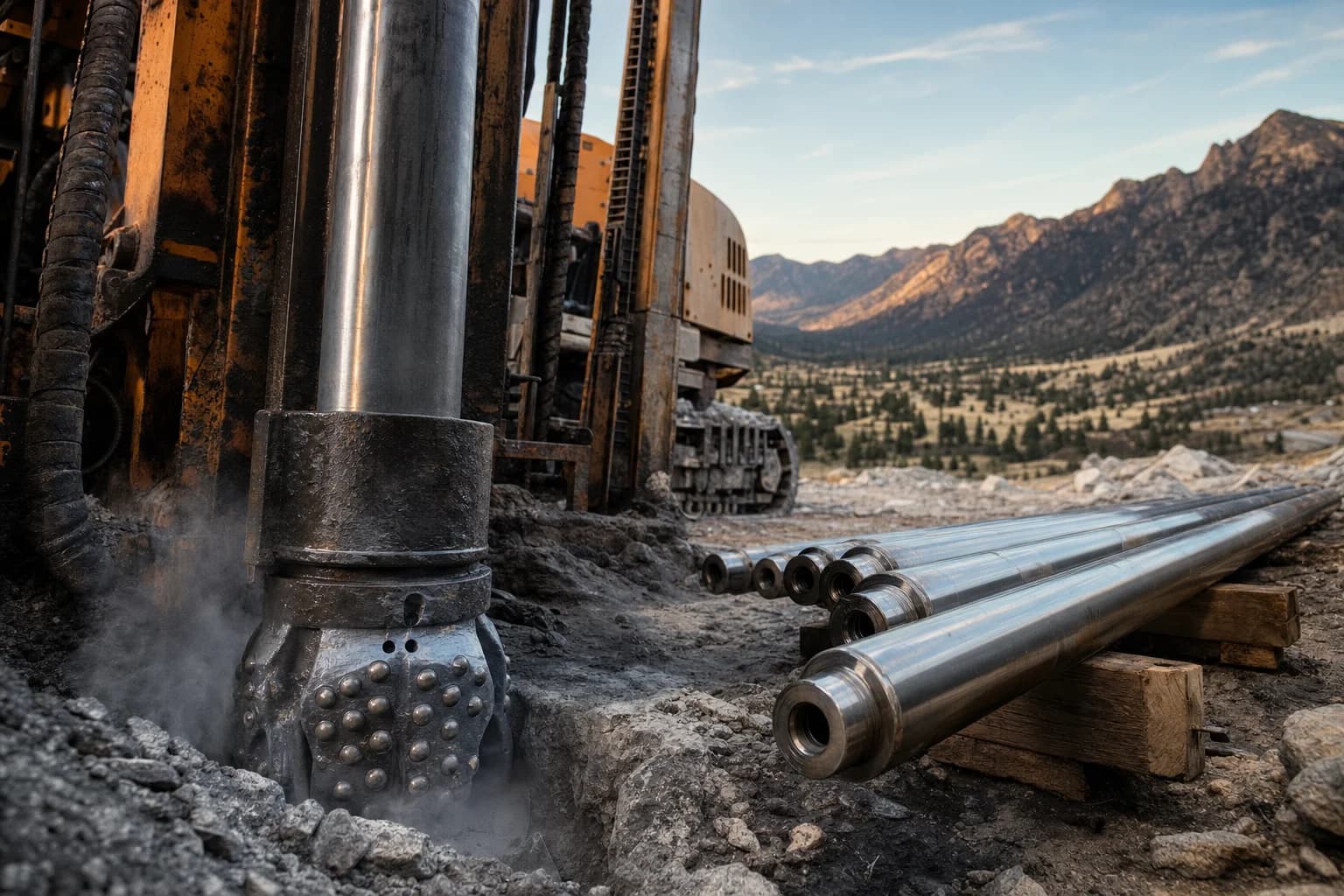
How a DTH Hammer Works
Most drilling methods scrape or grind the earth away. Down-the-hole drilling shatters it - with a piston-driven hammer that travels down the borehole and strikes the bit directly against the rock face.
The name is literal. In down-the-hole drilling the percussive hammer is not mounted on the rig - it is screwed onto the bottom of the drill string, riding just behind the bit. A large compressor at the surface forces high-pressure air down the hollow steel drill pipe; when it reaches the hammer, the air drives an internal steel piston that strikes the back of the drill bit roughly 600 to 1,000 times per minute.
Because the piston hits the bit directly, essentially none of the impact energy is lost on the way down - whether the hole is 50 feet deep or 1,000. That single fact is the defining advantage of DTH, and why it became the standard for water wells in hard rock. (DTH is technically a form of air rotary drilling - same rigs, same air circulation - with a hammer swapped in for the rolling cone bit.)
Three other pieces complete the system:
- Rotation from the surface.The hammer only smashes; the slow spin comes from the rig's top drive, turning the drill string at about 60 to 100 RPM so the bit indexes onto fresh rock with every blow. Too slow and the buttons pound the same spot; too fast and the bit skips and burns up its carbide.
- Air exhaust up the annulus. The same air that drives the piston exhausts through ports in the bit face, flushing the shattered rock (cuttings) up the annulus - the gap between drill pipe and borehole wall - at uphole velocities around 30 mph. Crews often inject a little water or foam to knock down dust.
- Carbide button bits. No blades or teeth - the face is studded with rounded tungsten carbide domes (hardness above 90 HRA) that crush and spall rock by blunt impact. Faces come flat for general drilling, convex for speed in abrasive rock, and concave for holding a straight hole.
Where DTH Excels: Hard-Rock Geology and US Regions
DTH is not a general-purpose method. It is purpose-built for consolidated rock - and in the granite and basalt country of the US, it has no real competition.
The harder the rock, the more DTH pulls away from everything else. Granite and gneiss - the crystalline bedrock under much of the eastern seaboard - have compressive strengths around 130 MPa (roughly 19,000 PSI), and a DTH hammer still moves through them at 20 to 40 feet per hour. Basalt, at 140-150 MPa, slows that to 18-30 ft/hr; limestone (around 60 MPa) is almost easy at 30-50 ft/hr. The one place DTH struggles is loose, unconsolidated ground - sand, gravel, and clay collapse around an air-drilled hole, which is why that work goes to mud rotary instead.
20-40 ft/hr
DTH penetration rate in solid granite - versus roughly 8-15 ft/hr for a conventional tricone rotary bit in the same rock
Source: WellDrillingCost.com
That geology maps cleanly onto the regions where DTH rigs dominate residential drilling:
- New England and the Appalachian Piedmont. From Maine down through the western Carolinas and north Georgia, a few feet of topsoil sits on hundreds of feet of granite. DTH is the default method, wells typically run 100 to 500 feet, and water strikes commonly come around 300 feet.
- The Texas Hill Country. Dense Edwards limestone over granite plutons, with wells reaching the Trinity and Edwards aquifers at 200 to 800 feet.
- The Mountain West and Pacific Northwest. Colorado, Idaho, Arizona, and Oregon combine complex volcanic geology - including the stacked flows of the Columbia River Basalt Group - with deep, arid-climate water tables. Wells routinely run 200 to 400+ feet, and basalt country often pushes rigs past 600.
Depth is rarely the limit. Standard residential wells land between 150 and 300 feet, but because the hammer loses no energy with depth, DTH rigs can exceed 1,000 feet when the compressor can keep up. To see what the rock under your property looks like before anyone quotes a price per foot, start with the DrillerDB geology huband check neighboring wells' depths and rock types on the well map.
Compressor Requirements: The Lungs of the Operation
A DTH hammer is only as strong as the air behind it. The compressor powers the piston AND lifts every pound of cuttings out of the hole - and at depth it has to fight the well's own water column to do it.
Compressors are sized by volume (cubic feet per minute, CFM) and pressure (PSI). A small 3-inch hammer for shallow work can run on a tow-behind unit putting out 185-375 CFM. The 5- and 6-inch hammers used for residential wells are a different animal: modern high-performance hammers want on the order of 950-1,000 CFM at 350 PSI, which means a deck-mounted industrial compressor roughly 18 feet long, weighing 22,000 to 57,000 pounds with its carrier.
Why so much pressure? Hydrostatic head. Once the borehole fills with groundwater, the compressor must overcome the full weight of that water column before a single PSI goes into striking rock - like blowing through a straw at the bottom of a swimming pool instead of a drinking glass.
~290 PSI
of compressor output consumed just fighting the water column in a 650-foot water-filled borehole - before any air reaches the hammer piston
Source: Wassara
This is also where the most interesting variant comes in: water-powered DTH hammers(pioneered by Sweden's Wassara) drive the piston with high-pressure water instead of air. Water is incompressible, so the hammer keeps full striking power at any depth, with no dust and far less noise - which is why water hammers were chosen for delicate work like the Malmo Live geothermal field and grout holes at the Chicago McCook Reservoir. The catch is supply: roughly 80 gallons per minute of clean water, usually trucked to the site. If your site is urban, dusty, or environmentally sensitive, ask whether a contractor offers water-hammer drilling.
What You'll See (and Hear) On Your Property
For a few days, a DTH rig turns your yard into a small mining operation: a 30-ton drill rig, an industrial compressor, a pipe truck - and a lot of noise.
The active drilling is short - usually 1 to 3 days - but it sits inside a much longer project timeline:
Phases and durations from aggregated 2024-2026 driller scheduling data; permitting time varies widely by county.
Noise is the big one.Between the diesel compressor, cooling fans, pipe handling, and high-pressure air exhaust, measured drilling operations exceed 90 dBA within 6-10 feet of the rig (generator sets up to 102 dBA). At 50 feet - a neighbor's window on a small lot - expect 83-88 dBA, louder than a lawnmower. It takes about 500 feet of distance to fall to 60-65 dBA, normal-conversation level.
Expect mess as well as noise: the air exhaust ejects pulverized rock dust and muddy water around the borehole, contained - mostly - by settling pits or mud management equipment. The rigs themselves compact lawns and crack thin driveways, so agree on access routes in advance. Vibration, on the other hand, is milder than people fear: DTH's rapid light blows transmit far less shake to nearby foundations than the old cable tool method's slow, heavy strikes.
One more thing you may see: through the soft overburden at the top of the hole, the crew will often run an ODEX or Symmetrix casing-advancement system - a clever bit that cuts a hole slightly larger than the steel casing and pulls the casing down behind itself. Once the casing is seated in bedrock, the bit retracts back up through the pipe and the DTH hammer takes over. That grouted casing is what protects your future drinking water from surface contamination - the part of the well the EPA's private well guidance cares most about. (For the finished well underground, see our well components guide.)
Speed, Depth, and What It Costs
Hard rock is the most expensive thing to drill through, and DTH is how it gets drilled. A complete residential well system averages $7,500-$15,750 nationally - but geology drives the per-foot price.
Aggregated 2024-2026 national driller surveys and regional averages; full project range runs $3,000 (shallow sediment) to $45,000+ (extreme terrain). Get 2-3 local per-foot quotes.
Why rock costs more is no mystery after the sections above: the compressor burns serious diesel, and abrasive rock eats tungsten carbide bits that cost thousands of dollars each. But hard rock comes with a real financial consolation prize:
The biggest cost variable is one nobody controls: how deep your rock makes the driller go. Two houses a mile apart can see well bills differ by $10,000 because one sits over a fracture zone at 180 feet and the other chased water to 550. Before signing a per-foot contract, look up what wells around you actually hit - depth, rock layers, and yield - on the DrillerDB well map, drawn from over 17 million US well records.
DTH vs Top Hammer vs Tricone Air Rotary
Three methods compete for rock drilling. Picking the wrong one for the geology can raise drilling costs 30-50% - here is how they differ and why DTH wins for deep residential wells in rock.
Depth, energy-loss, and penetration figures from the cited DTH engineering references and 2024-2026 driller cost surveys.
The physics is simple. A top hammer generates its shockwave at the surface, and that wave bleeds energy through every threaded pipe joint on the way down - fine for 50-foot quarry blast holes, hopeless for a 400-foot water well. A tricone bit (the classic air rotary tool) crushes rock under pure weight and rotation - effective in soft-to-medium formations, a crawl in granite. The DTH hammer sidesteps both problems by putting the jackhammer against the rock itself.
In practice, drillers combine methods: a typical New England well is mud rotary or ODEX casing through 50 feet of glacial till, then DTH hammer to total depth. Our well drilling methods hub compares every approach - including cable tool, the slow percussion ancestor DTH replaced - and our types of water wells guide covers dug and driven wells too. For the finished product, see what a drilled well is.
Questions to Ask Your Driller About DTH
You do not need to know hammers to hire well - you need the right questions. Print this list and bring it to your contractor conversations.
A properly built DTH well is a generational asset - 25 to 40 years of service with routine upkeep and the annual water testing the CDC recommends. When you are ready for quotes, find licensed well drillers near you.
Frequently asked questions
Keep reading
Sources & further reading
- Down-the-Hole Construction Drilling Guide — Wassara (accessed June 2026)
- Understanding Down-the-Hole Hammers: A Guide for Engineers and Drillers — TerraRoc Drilling (accessed June 2026)
- DTH Drilling vs. Top Hammer Drilling — HardRock Drills (accessed June 2026)
- Rock Drill Bit Types Explained — Kelleg Drilling Tools (accessed June 2026)
- Water Well Drilling and Air Compressors: What's It All About? — Sullair (accessed June 2026)
- Down the Hole (DTH) Drilling Tools — Rockmore International (accessed June 2026)
- Surface and Exploration Drilling Reference Book — Epiroc (accessed June 2026)
- Center Rock Inc. - DTH Hammers and Bits — Center Rock (accessed June 2026)
- ODEX Drilling (Overburden Casing Advancement) — Sinodrills (accessed June 2026)
- Water-Powered Drilling in Water-Rich Formation Near Malmo Harbour — Wassara (accessed June 2026)
- Noise and Vibration Technical Appendix (drill rig noise measurements) — California Public Utilities Commission (accessed June 2026)
- Noise Exposure in Drilling Operations — CDC / NIOSH (accessed June 2026)
- How Much Does It Cost to Drill a Well? — HomeAdvisor (accessed June 2026)
- Bedrock Well Drilling Cost — WellDrillingCost.com (accessed June 2026)
- How Deep Does a Residential Water Well Need to Be? — Skillings & Sons (accessed June 2026)
- Texas Groundwater Conditions (Trinity and Edwards Aquifers) — Texas Water Development Board (accessed June 2026)
- Private Drinking Water Wells — U.S. EPA (accessed June 2026)
- Guidelines for Testing Well Water — CDC (accessed June 2026)