
How Cable Tool Drilling Works
Every other rig on this site cuts by spinning. The cable tool rig cuts by falling: a 1,200 to 2,000 pound string of forged steel is lifted a few feet and dropped, over and over, crushing the rock beneath it.
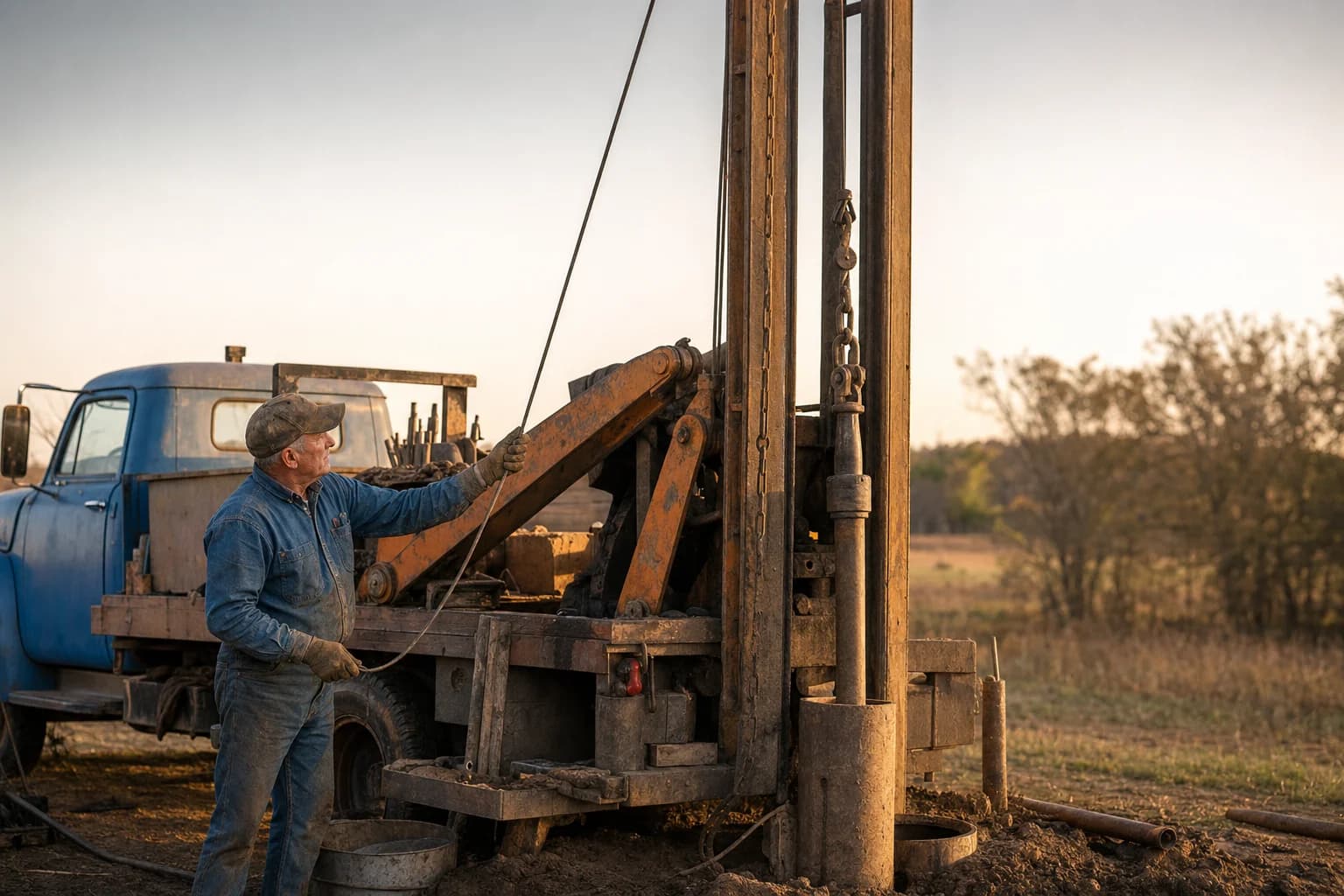
Percussion drilling is the oldest well-making method in existence - Chinese crews were pounding brine wells to depths of 3,000 feet with bamboo-suspended tools more than 4,000 years ago. The American version, the truck-mounted "spudder," mechanized that idea: a deck engine drives a pivoting walking beam that yanks a steel cable up and lets it free-fall, 15 to 60 strokes per minute. Everything that matters happens at the end of that cable.
The tool string hanging downhole has four working parts, top to bottom: a rope socket that connects cable to steel, a pair of drilling jars (sliding links that act as a slide-hammer to free a stuck bit), a long solid drill stem that adds weight and keeps the hole plumb, and the heavy chisel bit that does the crushing. One elegant detail: the cable is left-hand-lay wire rope, so it twists slightly as it stretches and untwists on the drop - rotating the bit a fraction of an inch with every stroke and cutting a perfectly round hole with no rotary drive at all.
Because the bit only crushes - it does not lift anything out - the work runs in a steady cycle. The driller pours in a few buckets of water (5 to 20 gallons) if the hole is dry, pounds until 5 to 10 feet of crushed rock and water have churned into slurry, then hoists the whole tool string out on the main drum (the bull reel). Down a second cable - the sand line - goes the bailer, a hollow steel tube with a one-way dart valve in its base. It fills in the slurry, snaps shut when lifted, and dumps its load at the surface. Then the string goes back in and the pounding resumes.
In loose sand and gravel that would cave in an open hole, the rig solves the problem mechanically rather than chemically: it threads a steel drive caponto the permanent well casing and uses the walking beam to hammer the pipe down foot by foot as the bit advances inside it. No drilling mud, no temporary borehole wall - the finished well's own casing holds the ground back from day one. For what that casing connects to once the well is done, see our well components guide.
Why Drillers Still Use It in 2026
Rotary rigs took the volume market decades ago. Cable tool survived anyway, because four of its traits have never been fully replicated.
1. Perfect, honest formation samples.A rotary rig floods the hole with bentonite mud or pressurized air; a cable tool hole contains nothing but the ground itself and a little clean water. Every bailer load is pure, recognizable rock from a known depth - which is why the resulting lithologic logs are some of the best in any state's records, and why environmental agencies still specify cable tool for monitoring wells where samples must be uncontaminated. Rotary mud can also plug the fine water-bearing fractures it touches, permanently costing yield; cable tool never introduces anything that needs to be cleaned back out.
2. Boulders and glacial till. Till is chaos: clay, gravel, and rounded boulders in no particular order. A fast-spinning rotary bit that catches the edge of a hard boulder in soft clay can glance off and deflect the hole. A chisel bit dropping straight down with a ton of steel behind it simply shatters the boulder and keeps going, dead plumb. In heavy-till country this is not nostalgia - it is the right tool.
3. Casing goes in as the hole goes down. Driving permanent steel casing simultaneously with drilling walls off unstable sediment continuously, seals out shallow contaminated zones as they are passed, and means there is never an open, unsupported borehole waiting to collapse overnight.
4. Almost no water required. Mud rotary needs thousands of gallons and a mud pit; cable tool needs buckets. In arid regions, remote sites, and the developing world, that single fact decides the method. The compact LD Rhino cable tool rig, for example, completes a typical 160-foot well on about 28 gallons of gasoline and a tenth of the water a rotary job consumes - which is why humanitarian water programs still ship cable tool rigs to off-grid regions of Africa.
Where It Excels: Geology and Regions
Cable tool work today clusters where the ground rewards it and the culture sustains it.
Geologically, the method shines in glacial till and bouldery overburden (the upper Midwest, New England, and the northern tier generally), in unstable sands and gravels where simultaneous casing matters, and in shallow water-table country - regions where domestic wells finish at less than 100 feet in unconsolidated material or soft rock, shallow enough that a slow rig is still an affordable rig. You can read up on what your local formations look like in our geology hub.
Culturally, the strongest American stronghold is the Amish and Mennonite drilling communityin Pennsylvania, Ohio, and Indiana, where mechanically simple, electronics-free spudders powered by basic deck engines fit both the economics and the way of working - and where the knack of "reading the cable" is passed down through generations. The other modern niches are environmental and monitoring-well work, where federal remediation guidance values the method's fluid-free sampling, and off-grid and developing-world projects, where a rig that fits in a 20-foot shipping container and can be repaired with a welder beats a million-dollar machine that cannot get parts.
Before you assume your property needs (or suits) a particular method, look at the evidence next door: DrillerDB's well map lets you check real nearby well logs - depth, geology layers, and yield - so you can see what rigs actually encountered on your road before a contractor quotes the job. Many of the cleanest old logs you will find were made by cable tool rigs.
The Craft: Reading the Cable
A modern rotary console reports torque, down-pressure, and mud flow on a screen. A cable tool driller gets the same information through one hand resting on a moving steel rope.
Veteran operators - nicknamed "jar heads" after the clattering drilling jars - genuinely read geology by feel. Hard granite sends a sharp, crisp shock up the cable. Soft clay returns a dull, spongy thud and slack line, the cue to shorten the stroke before the bit buries itself and sticks. And when the bit breaks into water-bearing gravel, the fluid at the bottom changes the rhythm to a distinct swishing that an experienced hand recognizes instantly. The driller is operator, mechanic, and field geologist at once - keeping a vintage engine running at the steady rhythm the tools demand while logging the formation stroke by stroke.
The machinery itself is part of the story. The method peaked with the Bucyrus-Erie spudders of the mid-20th century - the light 20W with its 32 to 36-foot mast and Hercules four-cylinder gas engine, the heavier 22W on a 36 to 40-foot telescoping mast, and the massive 36L, built to handle casing loads up to 120,000 pounds. Welded up from steel channel iron, these rigs were close to indestructible; machines built in the 1950s and 60s are still drilling wells today, and used examples remain sought after rather than scrapped.
That longevity cuts both ways. The skills take years of apprenticeship to build, and as the older generation retires, fewer young drillers choose three weeks of weather and cable-feel over a climate-controlled rotary cab. The method is not dying because it stopped working - it is thinning out because mastery is expensive. If you find a good spudder operator, you have found someone carrying a 4,000-year-old trade.
What You Will See On Site
Hiring a cable tool contractor changes the homeowner experience in one big way: the rig does not visit your property - it moves in.
A 200 to 400-foot well that a rotary rig finishes in days will take a spudder two to three weeks. Plan around these realities:
- Timeline: at 10 to 30 feet per day, expect the rig, the crew, and their casing truck on your property for the duration - including equipment parked on site over weekends. Agree on access routes, storage, and cleanup expectations before day one.
- Noise: the rhythmic banging of a heavy tool string on rock runs roughly 53 to 115 decibels, eight hours a day, for the life of the job. It is the soundtrack of a pile driver. Warn your neighbors - sincerely.
- Clearance: spudders squeeze into tighter yards than big rotary trucks, but the mast still stands 36 to 54 feet tall. Check overhead power lines, tree limbs, and eaves, and make sure a loaded casing truck can reach the hole.
- Water and mess: here cable tool is the gentle option. No mud pit, no 2,000-gallon tanks - just bailer loads of rock slurry dumped into a small trench or tub. Total water use is buckets, not tankers.
10-30 ft
of progress per day for a cable tool rig, vs 100-200+ ft per day for modern rotary rigs
Source: SC Well Service
One more expectation worth setting: this is not a DIY method. Shallow driven sand-point wells aside, drilling with heavy machinery into bedrock requires a licensed contractor almost everywhere - Indiana's Marion County requires a permit and a licensed well driller outright, Oregon requires a licensed well constructor physically on site whenever a cable tool machine is advancing casing, and Iowa's owner exemption applies only if the landowner personally does the work. Wake County, NC even requires contractors to post a $10,000 performance bond. Verify licensing before anyone's mast goes up - our contractor directory is the fastest place to start.
The Speed and Cost Reality
Slow rig, cheap iron; fast rig, expensive iron. The two effects largely cancel - which surprises most homeowners.
A used cable tool rig costs $20,000 to $60,000. A modern rotary rig runs from about $110,000 used to well past $1,000,000 new. So when you pay for a rotary well, you are mostly paying off a million-dollar machine for two days; when you pay for a cable tool well, you are mostly paying a skilled crew for two or three weeks. In the markets where both still compete, the completed price often lands in the same range - roughly $20 to $85 per drilled foot, with Rhode Island averaging $20-$30/ft and California hard-rock cable tool work quoted at $60-$85/ft.
Compiled from the regional cost surveys in the sources list; always get 2-3 local quotes for your geology.
Cable Tool vs. Other Drilling Methods
The honest comparison: rotary wins on speed everywhere, and cable tool wins on everything that is not speed - in the specific ground that suits it.
Speed, duration, water, and rig-cost figures compiled from the drilling-method comparisons and used-rig listings in the sources below; every geology favors a different column, so treat the method as a consequence of your ground, not a menu choice.
Want the deeper dives? See how the air-powered hammer-and-rotate rigs work in our air rotary guide, how fluid-circulation rigs handle deep sand in the mud rotary guide, or zoom out to the full well drilling methods comparison - including which method most likely built the drilled well already on your property.
Questions to Ask a Cable Tool Driller
A few direct questions separate a craftsman with the right rig for your ground from a slow job you did not need.
For the broader checklist that applies to any rig - insurance, references, contracts, and red flags - see the rest of our well owner resources, and compare answers from at least two licensed contractors near you before committing.
Frequently asked questions
Keep reading
Sources & further reading
- Cable Tool Drilling (Site Characterization Technology 3.2.2) — Federal Remediation Technologies Roundtable (FRTR) (accessed June 2026)
- Learn About Private Water Wells — U.S. EPA (accessed June 2026)
- Application of Drilling, Coring, and Sampling Techniques to Test Holes and Wells (TWRI 2-F1) — USGS (accessed June 2026)
- Cable Tool Drilling Explained — SC Well Service (accessed June 2026)
- Well Drilling Methods Compared — SC Well Service (accessed June 2026)
- Choosing the Right Drilling and Well Development Method — Water Well Journal (NGWA) (accessed June 2026)
- One Man's Opinion: Two Weak Points of the Bucyrus-Erie 20W — The Driller (accessed June 2026)
- Selecting the Last Wire Line for a Spudder: The Casing Line — The Driller (accessed June 2026)
- Cable Tool Rigs (used rig inventory and specifications) — Sun Machinery (accessed June 2026)
- Cable Tool Drilling — CNY Well Drilling (accessed June 2026)
- Old Water Well Drilling Rigs in Demand — Farm Show Magazine (accessed June 2026)
- Cable Tool vs. Rotary Cost Comparison (LD Rhino rig) — Rhino Rig (accessed June 2026)
- How Much Does It Cost to Drill a Well? — Blair & Norris (accessed June 2026)
- California Well Drilling Costs — WellDrillingCosts.com (accessed June 2026)
- Private Well Program — Marion County Public Health Department (IN) (accessed June 2026)
- Well Contractor Certification — Iowa Department of Natural Resources (accessed June 2026)
- Well Contractors (bonding and permitting requirements) — Wake County, NC (accessed June 2026)