
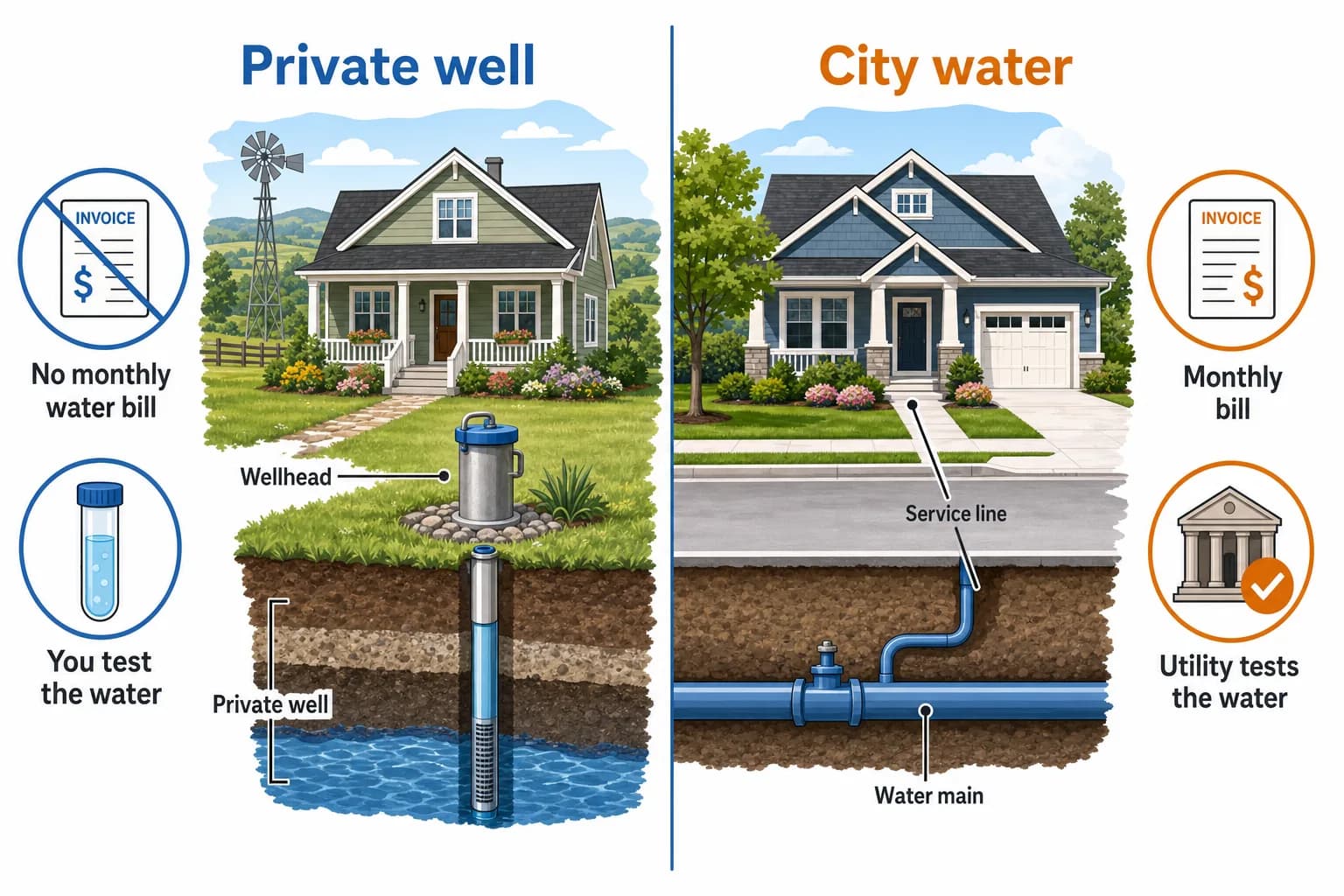
The Quick Comparison
The pattern in one sentence: city water trades money for convenience; well water trades responsibility for independence and lower running costs. Neither side of that trade is wrong - but one of them probably fits your situation better.
Cost: Monthly Bills vs. Periodic Lumps
Well water is cheaper month to month. The honest accounting includes the lumps.
City water arrives with a bill that never stops: the EPA WaterSense program puts the average family's water spending at more than $1,000 per year, and rates in most markets have risen steadily. A well owner pays none of that. Pumping a household's water takes a modest amount of electricity - typically a few dollars a month.
What the well owner budgets for instead:
National ranges. Averaged over a decade, a trouble-free well typically runs well below utility service - but the costs arrive as lumps, not a smooth bill.
If you are pricing a brand-new well rather than owning an existing one, that is a different number entirely - see the cost to drill a water well (and remember depth quotes are estimates: budget a 15-25% contingency, since wells that must go deeper than estimated bill the extra footage at the quoted per-foot rate - normal practice, not sharp dealing).
Quality and Safety: Regulated Utility vs. You as the Regulator
City water is tested constantly and published annually. Your well is tested exactly as often as you test it.
Public systems operate under the federal Safe Drinking Water Act: legally enforceable limits, continuous monitoring, and an annual consumer confidence report in your mailbox. That system is not perfect - main breaks, aging distribution pipes, and chlorination byproducts are real - but it is accountable.
A private well answers to nobody. The EPA explicitly does not regulate individual wells; the entire monitoring program is whatever you order from the lab. Done right, that is an annual bacteria and nitrate test plus screening for the contaminants your region is known for - arsenic in much of New England and the Southwest, radon in granite country, nitrate in farm country. Our contaminant guide maps what belongs on your panel, and your state well guide covers local specifics.
Reliability: Outages, Droughts, and Yield
- Power outages: the well pump is electric, so an outage stops your water after the pressure tank empties. The fixes are standard - a generator sized to start the pump, extra storage, or stored drinking water. City systems usually ride through local outages.
- Drought: shallow wells in small aquifers can fade in extended dry spells; deep wells in strong aquifers barely notice. Meanwhile, city customers face watering restrictions a well owner never sees. Local geology decides which side of this trade you are on - check well depths near you.
- Yield: a well delivers what the aquifer gives. Most domestic wells comfortably out-supply a household, but a marginal well makes itself known in August. A yield test is part of any good well inspection.
- Failure modes: when city water fails, you wait for the utility. When a well fails, you call a contractor and pay the bill - but you are one phone call from action, not one of ten thousand households on a boil notice.
Buying (or Selling) a Home With a Well
A well is not a red flag. An undocumented well is.
If you are under contract on a well-served home, three checks belong in due diligence:
- The well record: depth, casing, age, and yield at completion. Look it up free - millions of state well logs are searchable.
- A lab water test: bacteria, nitrate, and regional extras. FHA, VA, and USDA loans generally require a passing lab test on private-well homes; even when your lender does not, order one anyway.
- A well inspection: flow test, equipment condition, and wellhead sanitation - see what a well inspection covers.
Sellers can flip all three into selling points: pull the log, test the water, fix the small stuff, and hand the buyer a folder. A documented well with a fresh clean test reads as an asset, not a question mark.
Can You Switch From One to the Other?
City to well: if your land can support a well, you can drill one even where a main runs past the house - common for irrigation, and some households go fully independent. It is a capital project: drilling costs plus pump and tank, weighed against the water bills it retires. An irrigation-only well is often the best of both: city water in the house, free water on the lawn.
Well to city: where a main is available, connecting typically involves a tap/connection fee plus the service line - and utilities and health departments have rules about what happens to the old well (isolate it or decommission it properly; never leave it as an open, forgotten hole).
Either direction, the first call is your utility; the second is a licensed well contractor.
Frequently asked questions
Keep reading
- How Does a Well Work? - the system you would be taking on, explained.
- Well Water Testing - what to test, when, and what it costs.
- Cost to Drill a Water Well - if you are pricing the switch to well water.
- Well Maintenance Guide - the ownership routine, honestly sized.
Sources & further reading
- Learn About Private Water Wells — U.S. EPA (accessed July 2026)
- Statistics and Facts (average family water spending) — U.S. EPA WaterSense (accessed July 2026)
- Protect Your Home's Water — U.S. EPA (accessed July 2026)
- Domestic (Private) Supply Wells — U.S. Geological Survey (accessed July 2026)