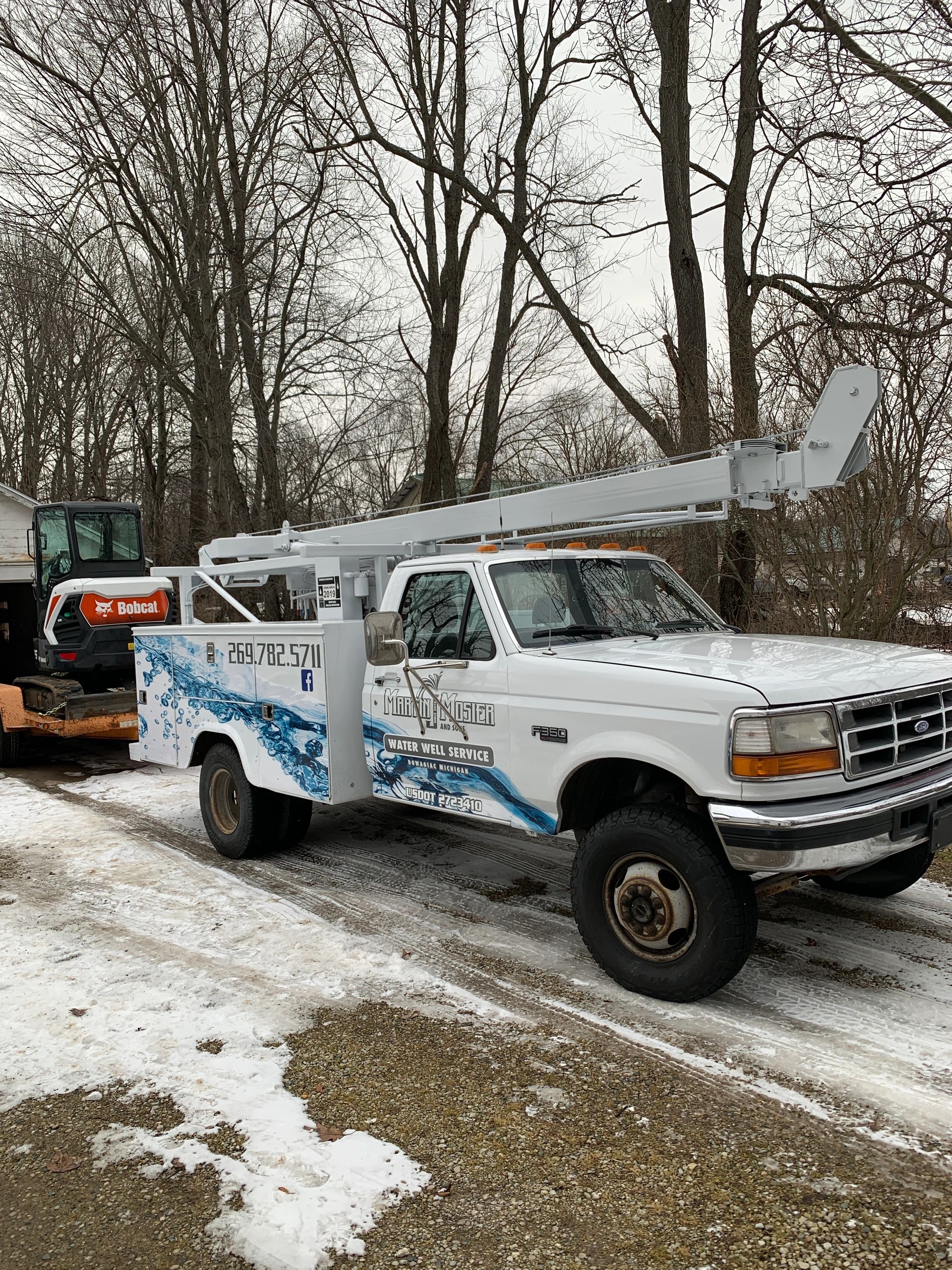
Active Driller3.3 (25)
Benton Harbor, MI 49022
Well DrillingWell Maintenance
Typical Coloma area well geology: alternating sand/clay with significant sand/gravel aquifers below ~80-120 ft, static water level ~30-80 ft, most residential wells 110-140 ft deep.
Showing contractors within 60 miles of Coloma. 60 results found.
Check depths and logs of existing wells in the area before you drill.
Open well map →Costs, permits, maintenance tips for private wells in Michigan.
Open guide →Not in Coloma? Search well drilling near me in the national directory, or find well service and repair near me and well pump service near me for work on an existing well.
A geological estimate for the Coloma area.
The most representative geology beneath Coloma consists of an upper sand or sand & gravel layer (often with fine sand), followed by thick clay and/or clay with silt, transitioning into successively alternating layers of sand (fine to medium, occasionally coarse) and clay. Below roughly 80-120 ft, a thick, transmissive sand and/or sand & gravel unit is common, providing the main aquifer tapped for residential and high-capacity wells. Typical static water levels occur between 30-85 ft below grade, with residential well completions most frequently between 110-140 ft, and high capacity (public supply) wells extending as deep as 180-195 ft. Outlier or single-well inclusions (such as very thin or anomalously thick layers) are omitted in this generalized model.
| Depth (Feet) | Formation Type | Description | Characteristics |
|---|---|---|---|
| 0 – 8 ft | Sand (fine to medium), locally with gravel | Topsoil and unconsolidated fine to medium sand, occasional gravel | Color: Brown/Light Brown Hardness: Unconsolidated |
| 8 – 40 ft | Clay (with variable silt and sand) | Mostly brown to gray clay, some silt and minor sand lenses | Color: Brown to Gray Hardness: Soft to Firm |
| 40 – 50 ft | Sand & Silt or Gravel | Sand & silt or isolated sand/gravel stringers, variable occurrence | Color: Brown to Gray Hardness: Unconsolidated |
| 50 – 90 ft | Clay (some with silt/sand interbeds) | Thick clay (gray or brown), with possible thin moist sand/clay stringers | Color: Brown to Gray Hardness: Firm to Hard |
| 90 – 115 ft | Sand & Gravel, Sand (medium-fine) | Thick sand and/or sand & gravel, primary aquifer unit, water bearing | Color: Brown/Gray/Tan Hardness: Unconsolidated |
| 115 – 145 ft | Clay (locally silty or sandy, some hard clay) | Another thick clay interval, potential for hard or moist character | Color: Gray/Dark Gray Hardness: Firm to Hard |
| 145 – 175 ft | Sand (medium to coarse), locally with silt or clay | Lower sand and/or sand with silt or clay, marks base of typical water supply formation in deeper wells | Color: Brown/Gray Hardness: Unconsolidated |
| 175 – 195 ft | Sand & Clay (coarse/fine alternations) | Alternating coarse sand with clay, basal interval seen in deeper high-capacity wells; merge with above for typical residential wells | Color: Gray/Brown Hardness: Unconsolidated |