
The Tradition of Water Witching
Before there were well logs and aquifer maps, there was a neighbor with a forked stick. Water witching is one of rural America's oldest traditions - and it deserves a fair hearing, not a sneer.
Water dowsing - also called water witching, divining, or doodlebugging - is the practice of locating underground water with a hand-held tool: a forked stick, a pair of bent wires, or a pendulum. It shows up in documented European history in the 15th and 16th centuries among German miners hunting metal ores, drew condemnation from both the Catholic Church and Martin Luther, and crossed the Atlantic with early settlers. It has been part of American well drilling ever since, especially in rural communities where a new well is a major gamble and any assurance feels worth having.
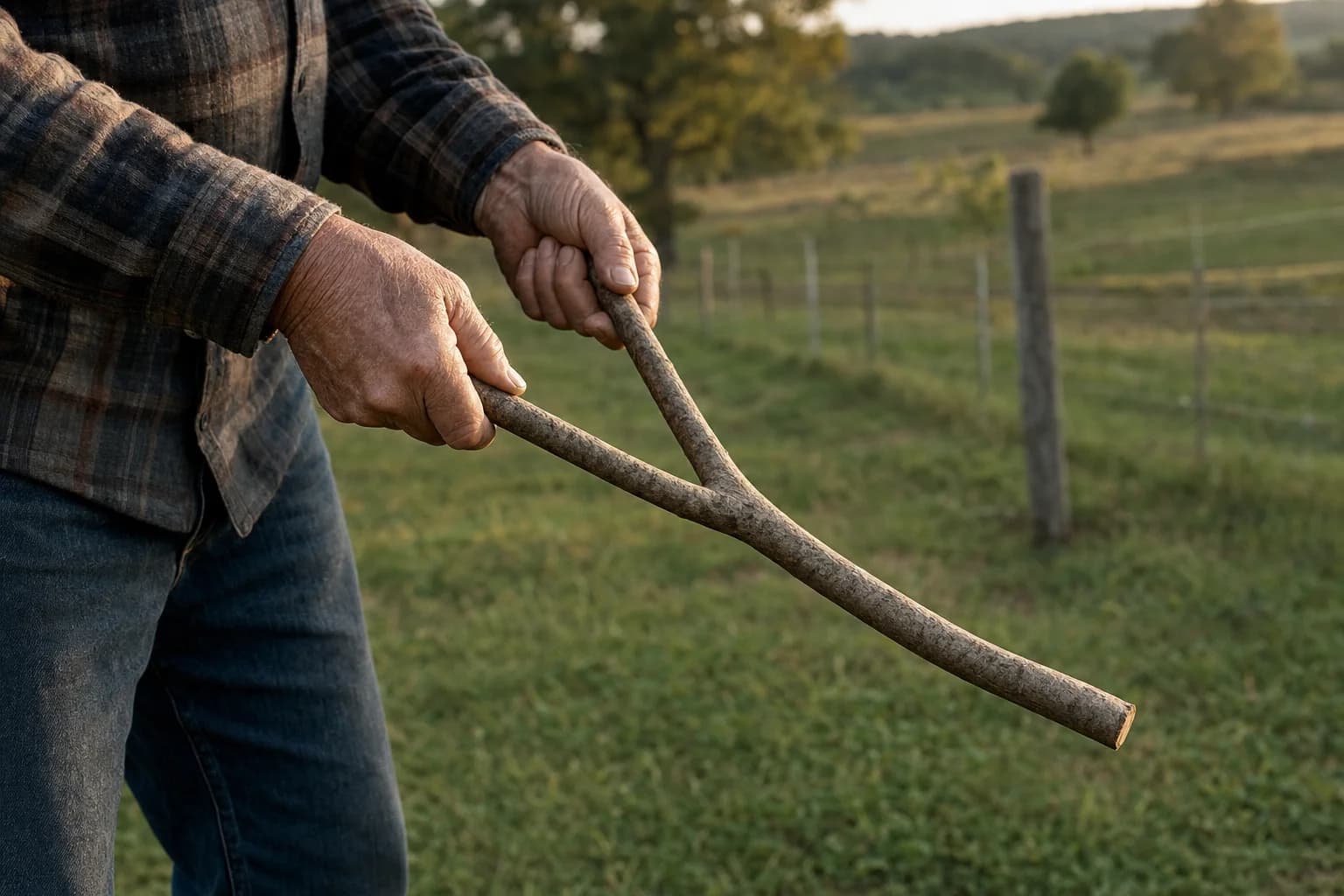
The classic tool is a Y-shaped twig cut from a "water-loving" tree - willow, peach, or dogwood. The American witch-hazel tree even owes its name to the practice: settlers thought it resembled the European hazel shrubs used for dowsing rods (from the Old English wiche, meaning bendable). The dowser grips one fork in each hand, palms up, stick angled skyward, and walks the property. Over water, the stick is said to rotate downward - sometimes, by the dowsers' own accounts, hard enough to blister their palms. Modern practitioners often swap the twig for two L-shaped wires (frequently cut from coat hangers) that cross over a target, or a pendulum whose swing answers yes-or-no questions about depth and yield.
Underneath the technique sits a specific picture of the underground: water flowing in narrow, fast-moving veins - underground rivers crisscrossing beneath the land, occasionally welling up from deep "domes." In that picture, siting a well is like hitting a buried pipe. Miss the vein by a few feet and you drill a dry hole, which is exactly why a specialist who can find the vein seems indispensable. Keep that mental model in mind; it is the key to everything that follows, because it is sincere, intuitive, and - as we will see - geologically wrong.
What Controlled Studies Show
Because finding water is economically serious, dowsing is one of the most thoroughly tested folk practices on Earth. The tests have a consistent result.
Start with the United States Geological Survey, which has weighed in for more than a century. Flooded with inquiries about divining rods in the early 1900s, the USGS commissioned hydrologist Arthur J. Ellis to review the entire history and evidence; his 1917 report, The Divining Rod: A History of Water Witching (Water-Supply Paper 416), found no reliable evidence that dowsing works. O.E. Meinzer, who led the agency's groundwater division from 1912 to 1946, put the conclusion in plain language: the Survey advises the public "not to expend any money for the services of any water witch." That remains the USGS position today, and the National Ground Water Association - the professional body of the drilling industry itself - takes the same stance: controlled experimental evidence shows the technique is without scientific merit.
The strongest single test is also the most sympathetic one ever run. In the late 1980s the German government funded the Munich experiments (the "Scheunen" or barn experiments) with a grant of roughly 400,000 DM - researchers who hoped to validate dowsing, screening about 500 self-described dowsers and advancing the best 43 to the main trials. The setup was elegant: on the ground floor of a barn, water was pumped through a pipe whose position was randomized; upstairs, the dowser walked the floor and marked where the pipe ran below. Over two years the selected dowsers performed 843 double-blind tests.
37 of 43
hand-picked 'best' dowsers in the Munich experiments showed zero detectable ability across 843 double-blind tests - and the rest fell within chance under standard statistical analysis
Source: Skeptical Inquirer
The original team announced that a few participants had shown real skill. Then independent scientists checked the math. Physiologist J.T. Enright's reanalysis - published in Naturwissenschaften and summarized in Skeptical Inquirer - showed the claim depended on unconventional, after-the-fact statistical choices that spotlighted isolated lucky guesses while setting aside the enormous failure rate. Under standard analysis, even the best performers were indistinguishable from random guessing. Enright concluded the experiments amounted to "the most convincing disproof imaginable" of dowsers' claims.
The pattern repeats wherever conditions are controlled. In a 1991 test at Kassel, Germany, the skeptic organization GWUP buried plastic pipes 50 centimeters under a level field and randomly switched water flow through them. Thirty dowsers agreed in advance that the test was fair and predicted near-perfect success; their results matched random guessing. Trials run by James Randi's foundation over the years produced the same outcome. There is no controlled study in the scientific literature in which dowsers reliably outperformed chance.
One honest caveat: these tests measure dowsing against hidden, randomized targets. Out in a real pasture, dowsers do often stand over water - and the next section explains why that is true even though the rod has nothing to do with it.
Why Water Witching Seems to Work
Dowsers are not con artists. They are almost always sincere people experiencing two genuine phenomena: generous geology and an involuntary reflex of their own hands.
First, the geology. The vein model of groundwater is intuitive but incorrect. Groundwater does not normally flow in narrow underground rivers; it fills the tiny pores, cracks, and fractures of rock and sediment in a broad, continuous saturated zone beneath the water table. In any region with adequate rainfall and favorable geology, that zone spans entire properties - entire counties. The USGS is blunt about what this means for dowsing's reputation: in many areas, underground water is so prevalent that it would be hard to drill a well and not find water.
Physicist Christopher Baird offers a memorable analogy: fill a box entirely with green socks, blindfold a volunteer, and ask him to use magic powers to pull out a green sock. He succeeds every time. The dowser points, the driller drills, water appears, and the rod gets the credit - but the driller would likely have hit water 20 feet in any direction. Every completed well becomes another testimonial, because in water-everywhere geology the test cannot fail.
Second, the rod. When a dowser says the stick moved on its own, believe them - it did, in the sense that they never consciously moved it. The cause is the ideomotor effect, a well-documented neuropsychological reflex in which expectation produces unconscious, involuntary muscle movements. Dowsing tools amplify it brilliantly: a flexed Y-rod or a pair of loosely balanced L-rods sits in unstable equilibrium, where opposing forces cancel almost perfectly and the slightest twitch makes the tool snap or swing. As the dowser walks, their brain integrates real environmental cues - greener vegetation, the low spot in a valley, the simple expectation that water "should" be here - and fires micro-movements too small to feel. The tool converts them into a dramatic dip that feels exactly like an external force grabbing the rod. The same reflex moves Ouija board planchettes and swings pendulums; it fools smart, honest people precisely because it operates below awareness.
Third, the memory. Confirmation bias finishes the job. When the dowsed well produces, the story becomes local legend and gets retold for decades. When it comes up dry or weak, there is always a reason - the driller stopped short, the hills threw the reading off, the vein moved - and the miss fades from memory. Hits are counted; misses are explained. Over a career, that arithmetic builds an honest reputation on top of a method that controlled tests show contributes nothing.
Dowsing vs. Modern Well Siting
Side by side, the two approaches differ in mechanism, evidence, and - most importantly for your wallet - financial risk.
Sources: USGS Water Science School, NGWA position paper on water witching, and the Munich/Kassel trial record cited below.
How Hydrogeologists and Drillers Actually Site Wells
Modern well siting is an earth science with a toolbox - and the first tool is paperwork, not machinery.
1. Neighboring well logs. Every licensed driller files a well log - a legal record of the exact depth drilled, the geologic layers encountered, the static water level, and the yield in gallons per minute. The wells around your property are test holes someone else already paid for. If five neighbors hit usable water at 100-140 feet in the same sandstone, that is a far stronger prediction than any rod can offer. This is the research step homeowners can do themselves - millions of these records are searchable on the DrillerDB well map.
2. Geologic and aquifer maps. Hydrogeologists pair well logs with topographic and surficial geology maps to understand which formations carry water, where they outcrop, and how the local terrain recharges them.
3. Fracture-trace analysis. In bedrock country, where water lives in cracks rather than sand, geologists study aerial photographs for subtle linear features - shallow troughs, aligned vegetation - that betray fracture zones below. Penn State Extension documents that wells placed on fracture traces and their intersections yield significantly more water than wells placed at random. A USGS case study at Stewartstown, Pennsylvania used fracture-trace mapping, borehole logging, and aquifer testing to show that a handful of discrete fractures supplied most of a water-supply well's flow - precision placement no folk method can replicate.
4. Geophysical surveys. For high-stakes or difficult sites, geophysicists image the subsurface directly. Electrical resistivity surveys exploit the fact that wet ground conducts electricity better than dry rock, mapping water-bearing zones before drilling. Seismic refraction sends sound waves into the earth and times their return to geophones, profiling depth to bedrock and the water table - useful to depths of thousands of feet.
5. Test holes. When real uncertainty remains, contractors drill a small-diameter test hole and run a pumping test to confirm volume and drawdown before committing to a full-size well. It is the scientific method at its most literal: a cheap, falsifiable experiment before the expensive one.
For a typical residential lot, steps 4 and 5 are rarely needed - the neighboring logs settle it. What matters is that every step above is checkable and improves with data, which is also how to vet a contractor: a good driller will talk fluently about local depths and formations, and our guide to drilling methods explains the rig-side decisions that follow. Increasingly, the industry is going further - applying machine-learning models to millions of digitized well logs to predict groundwater availability and optimal drill sites, which makes the public record under your county more valuable every year.
The Cost of Guessing Wrong
The case against folklore siting is not philosophical - it is a line item. Dry holes get billed.
Well drilling is priced per foot, and the meter runs whether or not the hole produces. If a chosen spot sits over deep, tight, or barren rock, the driller can bore hundreds of feet, declare a dry hole, and lawfully invoice for every foot at the drilling-only rate. The homeowner then starts over - new spot, new hole, new bill. In forgiving geology the dowser's spot works because every spot works; the danger zone is exactly the difficult geology where siting matters most and folklore has the least to offer.
National ranges; per-foot rates vary sharply with rock hardness and region. Get 2-3 local quotes and ask each driller how dry holes are billed.
Research Your Site Before You Drill
The modern replacement for the dowser is not a gadget - it is the public record. Your neighbors' wells have already mapped the aquifer under your land.
Every drilled well around you produced a filed, public well log: depth, geology layer by layer, static water level, yield. Read a handful of them and you know - before spending a dollar - roughly how deep your well will be, what rock the bit will pass through, and what flow rate to expect. This is precisely the analysis a hydrogeologist starts with, and it is the part a homeowner can do alone in an evening. For a one-line starting point, you can check the likely water table depth near you, which summarizes the static water level and typical well depth from those same records.
23M
U.S. well records aggregated on DrillerDB - searchable by address on the well map, with depth, geology, and yield from official state filings
Source: DrillerDB well map
That is the whole modern answer to the dowsing question. The tradition asked a person with a stick to sense what was underground; the public record simply shows you. If the logs around you say water at 120 feet, you do not need anyone - dowser or geophysicist - to find it. And if the logs show scattered dry holes and 600-foot bores, you have learned something far more valuable: this is a property where real hydrogeology, not hope, should pick the spot.
Frequently asked questions
Keep reading
Sources & further reading
- Water Dowsing — USGS Water Science School (accessed June 2026)
- The Divining Rod: A History of Water Witching (Water-Supply Paper 416) — USGS (A.J. Ellis, 1917) (accessed June 2026)
- Position Paper: Water Witching — National Ground Water Association (accessed June 2026)
- Testing Dowsing: The Failure of the Munich Experiments — Skeptical Inquirer (J.T. Enright, 1999) (accessed June 2026)
- Water Dowsing: The Scheunen Experiments — Naturwissenschaften (J.T. Enright, 1995) (accessed June 2026)
- How Does Water Dowsing Work? — West Texas A&M University (C.S. Baird) (accessed June 2026)
- Dowsing: Dowse It Work? — McGill University Office for Science and Society (accessed June 2026)
- Dowsing (history, tools, and the 1991 Kassel test) — Wikipedia (accessed June 2026)
- Ideomotor Phenomenon — Wikipedia (accessed June 2026)
- Water Well Location by Fracture Trace Mapping — Penn State Extension (accessed June 2026)
- Case Study: Delineating a Contributing Area to a Water-Supply Well in a Fractured Crystalline-Bedrock Aquifer, Stewartstown, Pennsylvania — USGS (accessed June 2026)
- National Water Information System (NWIS) — USGS (accessed June 2026)
- Private Drinking Water Wells — U.S. EPA (accessed June 2026)
- Private Drinking Water Well Programs in Your State — U.S. EPA (accessed June 2026)
- How Much Does It Cost to Drill a Well? — HomeAdvisor (accessed June 2026)